

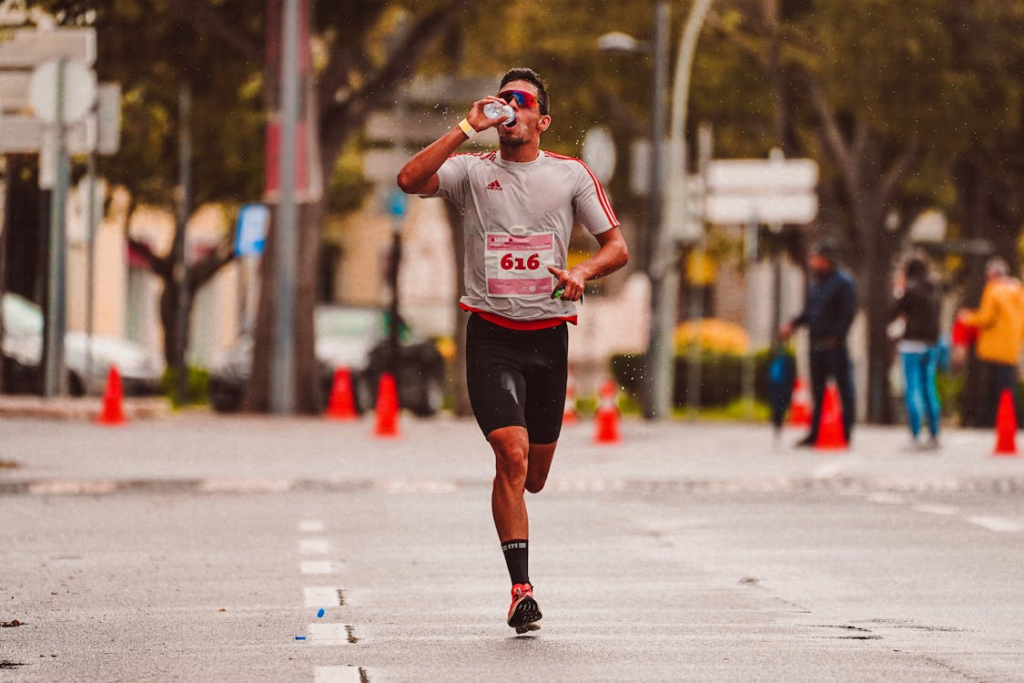
You’re Not Dehydrated—You’re Unprepared
It’s April.
The weather is shifting.
Your training load is increasing.
Your coffee is now iced instead of hot.
But your hydration?
Still the same.
Unplanned.
Reactive.
Based on “I’ll drink if I feel thirsty.”
That approach might work for daily life.
It does not work for performance.
Because by the time you feel thirsty—
you’re already behind.
The Science: What You Actually Lose When You Sweat
Sweat is not just water.
It’s a combination of:
- Water
- Sodium
- Chloride
- Electrolytes
The most critical loss?
Sodium.
Sodium controls:
- Fluid distribution
- Muscle contraction
- Nerve signaling
When you sweat, you lose both fluid and sodium.
Sweat rates vary significantly:
- 0.5 to over 2.0 liters per hour
(Sawka et al., 2007)
Sodium concentration also varies per athlete.
Which leads to one key conclusion:
Hydration is individual.
The Problem With “Just Drink Water”
Most runners replace fluid with only water.
That creates a physiological mismatch.
When sodium is not replaced:
- Blood sodium levels drop
- Fluid absorption becomes inefficient
- Performance declines
In extreme cases:
- Exercise-associated hyponatremia can occur
(Hew-Butler et al., 2015)
This is why:
Drinking more water does not equal better hydration.
Why This Matters (Especially for Endurance Athletes)
Hydration directly impacts:
- Cardiovascular efficiency
- Core temperature regulation
- Perceived exertion
Even a 2% loss in body mass from dehydration can impair performance (Cheuvront & Kenefick, 2014).
Now layer on:
- Heat
- Duration
- Intensity
And performance degradation accelerates.
Female Athletes — A Critical Layer
Female athletes must consider:
- Hormonal fluctuations
- Fluid balance sensitivity
- Risk of low energy availability
Hydration is not isolated.
It interacts with:
- Nutrition
- Recovery
- Hormonal health
Ignoring hydration compounds existing stress on the system.
Practical Application: How to Hydrate With Precision
1. Start Before You Run
Hydration begins before the session.
Not during.
Strategy:
- Drink fluids consistently pre-run
- Include sodium (electrolytes)
You should not “catch up” during training.
2. Know Your Sweat Rate
This is your baseline metric.
Test it:
- Weigh yourself before training
- Weigh yourself after
- Adjust for fluid consumed
The difference = fluid loss
Now you have data to guide intake.
3. Replace Fluids Intentionally
General guideline:
- 400–800 ml/hour
But adjust based on:
- Sweat rate
- Temperature
- Duration
And always include electrolytes.
4. Set a Hydration System
Do not rely on thirst.
Use structure:
- Drink every 20–30 minutes
- Small, consistent intake
Set alerts on your watch.
Automate the behavior.
5. Use Environmental Strategy
Hydration is logistics.
- Loop your routes
- Place bottles strategically
- Use hydration vests when needed
Planning removes friction.
6. Combine Hydration + Fueling
Optimal hydration includes:
- Sodium
- Carbohydrates (CHO)
This improves:
- Fluid absorption
- Energy availability
- Performance sustainability
Coaching Insight
I’ve seen athletes run:
10 miles
No fluids
Midday heat
And then say:
“I hit the wall.”
That’s not surprising.
That’s predictable.
Hydration is not something you fix mid-run.
It’s something you prepare before the run even starts.
Key Takeaways
- Hydration is more than water—it requires sodium and electrolytes
- Sweat rate is individual and must be measured
- Drinking only water can impair performance
- Hydration must be planned, not reactive
- Structure improves consistency and performance
- Hydration + carbs enhances endurance output
Closing
Discipline is not just training harder.
It’s preparing your body to sustain the work you demand from it.
And when hydration becomes intentional,
your performance stops depending on conditions—
It starts depending on execution.
References
Sawka, M. N., Burke, L. M., Eichner, E. R., Maughan, R. J., Montain, S. J., & Stachenfeld, N. S. (2007). Exercise and fluid replacement. Medicine & Science in Sports & Exercise, 39(2), 377–390.
Hew-Butler, T., Rosner, M. H., Fowkes-Godek, S., Dugas, J. P., Hoffman, M. D., Lewis, D. P., et al. (2015). Statement of the Third International Exercise-Associated Hyponatremia Consensus Development Conference. Clinical Journal of Sport Medicine, 25(4), 303–320.
Cheuvront, S. N., & Kenefick, R. W. (2014). Dehydration: physiology, assessment, and performance effects. Comprehensive Physiology, 4(1), 257–285.