
With thanks to Ketut Subiyanto for the photo
Most of the details we obsess over in strength training don't actually move the needle. Here's which levers matter for runners and how I use them in real-world programming with my athletes.
The problem isn't doing strength work — it's how we prescribe it
Every season I get athletes asking the same question: "What strength routine should I follow?" And every season I find myself correcting the same mistake — not in execution, but in an obsession with variables that, according to the evidence, don't change the outcome much at all.
We've spent years arguing about time under tension, whether you need to train to failure, which periodization model is "the right one," whether equipment (free weights vs. machines) even matters. The ACSM position stand published this year cuts through a lot of that noise [PMID:41843416]: resistance training consistently improves strength, hypertrophy, power, muscular endurance, and physical function — but very few prescription variables actually explain those improvements. Most of the details we tend to obsess over show no consistent effect on the final result.
For me, as a coach working with runners, this is genuinely good news. It means I can simplify the prescription and put my energy — and the athlete's — into the levers that actually move the needle.
What DOESN'T matter as much (and we can stop fighting over it)
According to the ACSM review of reviews [PMID:41843416], these variables show no consistent effect on strength, hypertrophy, or performance when volume and intensity are held equivalent:

- Equipment type (machines vs. free weights vs. bands)
- Complex periodization vs. simple linear models
- Time under tension as an isolated variable
- Training to failure as a systematic approach
- Blood flow restriction as a substitute for heavy loading
This doesn't mean these tools are useless — it means they aren't necessary for progress. If an athlete prefers machines because it gives them more confidence in execution, or because they're coming back from an injury, I'm not sacrificing results by prioritizing that comfort. The variable that actually matters is progression: systematically increasing load, volume, or execution speed over time.
What DOES matter: every adaptation has its own lever
Here's the part I use every day in programming. The central finding of the ACSM review is that each specific adaptation responds to a distinct manipulation, not to some generic "just lift weights" cocktail:
- Maximal strength → responds to heavy loads (≥80% 1RM)
- Hypertrophy → responds to volume (accumulated sets × reps)
- Power → responds to moderate loads moved with explosive intent
For a runner, this changes the whole conversation. I don't need my athletes to turn into powerlifters, and I don't need them chasing bodybuilder-level hypertrophy. I need them to develop power and neuromuscular function, because those are the adaptations most transferable to running economy and finishing-kick speed. And those come from moderate loads moved fast — not high volumes or endless sessions.
How I translate this into real programming
I split the strength prescription by season phase and the dominant physiological goal for that block.
Base phase: maximal strength as the foundation
In the base block, we prioritize maximal strength because it's the foundation everything else — especially power — gets built on. Without a strength base, power gains stall quickly.
- Loads ≥80% 1RM
- Full range of motion
- 2-3 sets per exercise
- Performed at the start of the session, while the nervous system is fresh
- Minimum 2 sessions per week, with at least 48 hours of recovery between sessions
I'm not chasing failure. I'm chasing quality reps under heavy load, with one or two reps in reserve. This also protects technique, which matters a lot for runners who don't have years of weight-room history behind them.
Specific phase: power as transfer
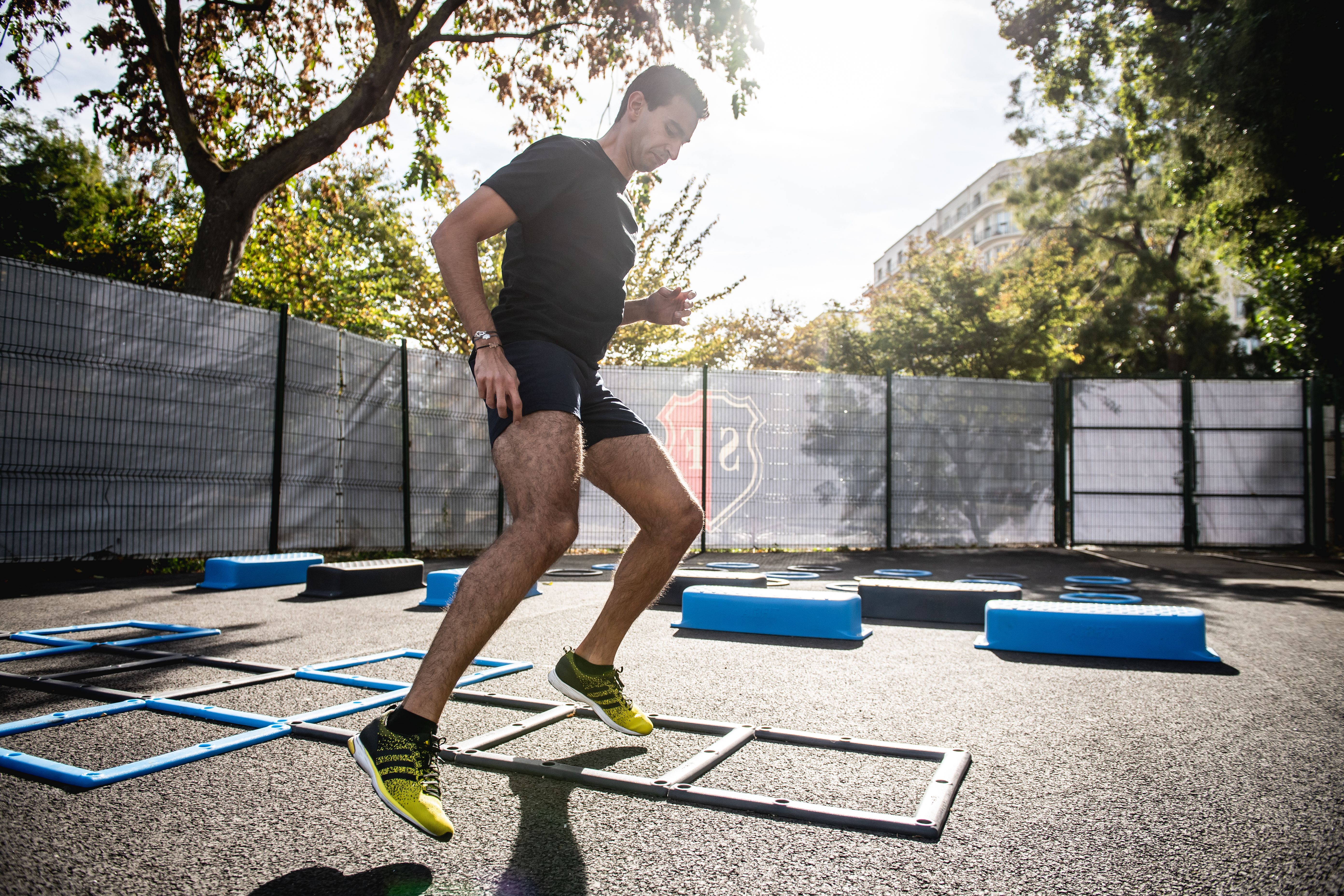
As we get closer to racing season, the emphasis shifts to power — the adaptation with the most direct transfer to a finishing kick or a mid-race surge.
- Moderate loads (roughly 40-60% 1RM)
- Explosive, intentional execution on the concentric phase
- Short sets (3-5 reps), low volume, lots of quality repetitions
- Exercises that resemble the running pattern: jumps, jump squats, sled drags, progressive plyometrics
The detail I watch most closely here isn't the load — it's execution speed. If the rep starts slowing down, we're no longer training power, we're training strength-endurance. I cut the set there, not when the athlete "can't do any more."
Year-round: muscular endurance as maintenance
For distance runners, I keep a muscular endurance component going (low loads, high reps, 15-20+) mainly in the upper body and core — not because it's the top physiological priority, but because it supports posture in the final kilometers of a long race.
Why progression matters more than variable perfection
The message I repeat most to my athletes is this: the variable that guarantees results isn't the "perfect" exercise — it's sustained progression. The body adapts to a stimulus that gradually increases in demand, not to whatever variable happens to be trendy this month.
There's a direct parallel here to what we see in cardiovascular training. Just as an endurance athlete's heart shows structural adaptations consistent with cumulative stimulus over years [PMID:40667749], the neuromuscular system responds to progressive, repeated exposure to load — not to variety for variety's sake. Switching exercises every week because you need to "shock the muscle" is, in most cases, noise that just makes it harder to track real progress.
The piece many run coaches ignore: biomarkers and monitoring
Something I've started paying closer attention to in recent cycles is stress and recovery markers when combining strength work with high running volume. Exercise biomarkers — from inflammatory markers to indicators of metabolic stress — give us an objective window into whether an athlete is actually absorbing the combined load or quietly accumulating unmanaged fatigue [PMID:41922043]. They don't replace clinical judgment or an honest conversation with the athlete, but they help me decide whether this week is the week to pull back on strength volume or hold steady.
This is especially relevant for masters athletes, where recovery between heavy strength sessions tends to be slower and where hormonal factors — including testosterone levels, which relate to body composition and vascular health — can influence how a training stimulus actually translates into real adaptation [PMID:26590935]. That's not a reason to avoid heavy strength work as a masters athlete; it's a reason to watch recovery more closely.
A quick aside on cross-training volume: strength doesn't replace aerobic stimulus
I sometimes get asked whether increasing strength work while reducing running volume can help drop body fat without losing aerobic fitness. The evidence comparing high-intensity modalities — cycling vs. running — for fat loss shows similar results between modalities when intensity is equivalent [PMID:38233990], but that's not interchangeable with strength training. Strength and cardiovascular HIIT train different systems. I use this to explain to my athletes why I don't replace their aerobic work with weight-room time, or vice versa — each stimulus has its own purpose, and there are no shortcuts between them.
Practical takeaways: what I tell my athletes
- Choose the adaptation before you choose the exercise. Ask yourself whether this session is about strength, power, or muscular endurance — and adjust load and speed accordingly.
- Don't get hung up on equipment. Barbell, dumbbell, or machine — what matters is that the load progresses.
- Power is trained fast, not heavy. If the rep gets slow, you've already switched goals without noticing.
- Sustained progression beats constant variety. Changing your routine every week is noise, not stimulus.
- Watch recovery closely, especially as a masters athlete combining heavy strength work with high running volume.
Conclusion
Prescribing strength training for runners doesn't require complexity. It requires clarity about which adaptation each block of the season is targeting, and the discipline to progress that variable consistently over time. Recent evidence confirms something many of us have suspected for a while: fewer decisions, executed well, beat a program stuffed with variables that sound sophisticated but don't change the outcome.
References
- Currier BS, D'Souza AC, et al. American College of Sports Medicine Position Stand. Resistance Training Prescription for Muscle Function, Hypertrophy, and Physical Performance in Healthy Adults: An Overview of Reviews. Med Sci Sports Exerc. 2026. [PMID:41843416]
- Frandsen J, Aaroe M, et al. Cardiac Effects of Prolonged Endurance Exercise in Young and Older Athletes. Scand J Med Sci Sports. 2025. [PMID:40667749]
- Siebers M, Bizjak DA, et al. Exercise biomarkers. Adv Clin Chem. 2026. [PMID:41922043]
- Couvert A, Goumy L, et al. Effects of a Cycling versus Running HIIT Program on Fat Mass Loss and Gut Microbiota Composition in Men with Overweight/Obesity. Med Sci Sports Exerc. 2024. [PMID:38233990]
- Traish AM, Zitzmann M. The complex and multifactorial relationship between testosterone deficiency (TD), obesity and vascular disease. Rev Endocr Metab Disord. 2015. [PMID:26590935]
Endurance Mindset Newsletter
Weekly science-based coaching notes from Henri. Free.
Train with Henri
Ready to put this into practice?
1-on-1 coaching built around the science in this article. Personalized to you.
Apply for Coaching

