August Brings a Wave of New Super Shoes for Road Runners
August 19, 2026
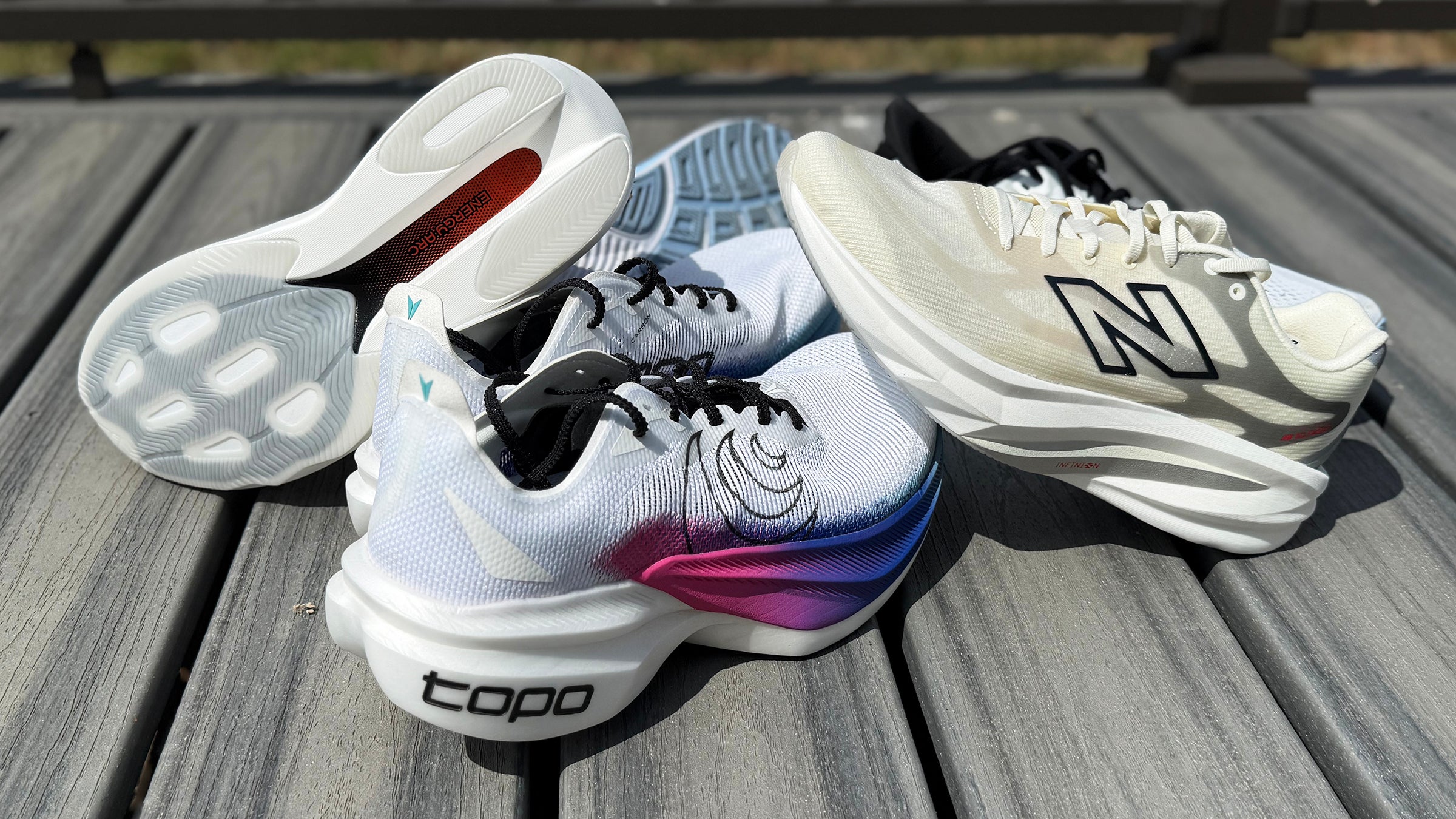
Foto vía Outside Run
If you're the type who checks new shoe drops the way you check the football transfer market, August 2026 has you happy. Brooks launched its Hyperion Elite 6 on August 1st—after years of the running community calling out its rigidity and lack of "snap"—and in the same month, the New Balance SuperComp Rebel and Topo Athletic's first super shoe ever debut. Three brands, three different bets, one same goal: to earn a place on your feet on race day. And this isn't just marketing noise: the "super shoes" category (carbon fiber plate + high-energy-return foam) remains, to this day, the most significant individual technological advancement that distance running has seen in the last two decades.
The Context
"Super shoes" were born with Nike's Vaporfly in 2016-2017 and changed marathon personal records forever, both elite and amateur. The formula: a rigid plate (typically carbon fiber) embedded in super lightweight and elastic foam, designed to return energy with each stride and reduce the metabolic cost of running. What used to be a niche of three or four models is today a complete category where almost every brand wants to compete.
Brooks arrives late to that party compared to Nike or Adidas, and its Hyperion Elite had been criticized for feeling "stiff" and unresponsive. The Elite 6 promises to fix that: rethought plate geometry and renewed foam to deliver more "pop" without losing stability. New Balance, for its part, does something smart: it creates an intermediate step (the SuperComp Rebel) between its top-of-the-line model (SuperComp Elite, expensive and designed for race day) and its plated trainer (FuelCell Rebel), giving the average runner a mid-range option for price and durability. And Topo Athletic, a niche brand known for its wide fit and "natural" philosophy, finally enters the world of carbon plates, a sign that even the most traditional brands can no longer ignore this technology.
What the Science Says
The real question isn't which shoe looks better in photos, but whether it actually makes you run faster and with less wear. Here the evidence is solid: running economy studies show that super shoes reduce the energetic cost of running by 2% to 4% compared to traditional shoes, which in a marathon translates to several minutes. But the benefit isn't equal for everyone: it depends on your weight, your running mechanics, and your level of accumulated fatigue.
That's where a key data point enters: the "durability" of running economy—that is, how well you maintain your efficiency when you already have 30 km under your belt—is just as important as initial efficiency. A recent study in well-trained runners found that strength training improves precisely that durability of running economy and high-intensity performance when you're already fatigued (Zanini et al., Medicine & Science in Sports & Exercise, 2025). Translation: the shoe can give you a technological boost, but if your legs can't hold strong through kilometer 35, that "boost" dilutes. Technology helps, but it doesn't replace strength work in the gym.
⚖️ PMP Verdict
If you're a competitive club runner, demanding with your times, and have already run in super shoes before, it's worth trying these three new options: Brooks fixes a real problem in its historic line, and New Balance gives you a more accessible and durable "super shoe" option for hard training without sacrificing your competition pair. Topo Athletic is the riskier bet: first generation of a new model, so expect to wait for reviews before buying it for your target marathon.
If you're a recreational runner, averaging fewer than 3-4 training sessions weekly, or just getting back into running after an injury, you don't need—and shouldn't yet—a super shoe. They're more expensive, less durable (300-400 km lifespan) and their real benefit shows more at sustained fast paces, not easy jogging.
For Your Training
- Don't wear your new super shoe on race day without testing it first in at least 2-3 quality sessions (intervals, tempo, fast long run).
- Combine your investment in technology with strength work twice a week: squats, lunges, jumps. It's what sustains your running economy when fatigue shows up.
- If your budget is tight, prioritize an intermediate model (like the new SuperComp Rebel) for quality workouts, and save the top-of-the-line model only for race day.
References
- "Strength Training Improves Running Economy Durability and Fatigued High-Intensity Performance in Well-Trained Male Runners: A Randomized Control Trial." — Zanini M, Folland JP, Wu H, Medicine & Science in Sports & Exercise, 2025. https://pubmed.ncbi.nlm.nih.gov/40016936/
Original source
Outside Run ↗Never miss an edition.
Get the running news brief and analysis straight to your inbox. No spam, unsubscribe anytime.