Kenny Bednarek and Melissa Jefferson-Wooden Secure the Sprint Doubles in the Ultimate Championship Finale
September 15, 2026
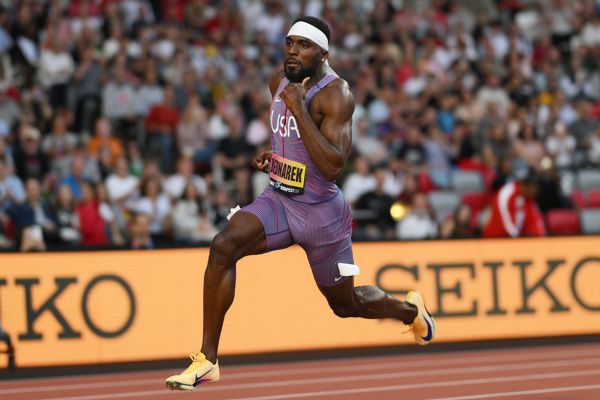
Foto vía World Athletics
Kenny Bednarek left no doubt. One day after taking the 100 meters at the inaugural World Athletics Ultimate Championship, the American closed out the weekend in Budapest with a dominant 19.52 in the 200 meters, the year's world-leading mark. On the women's side, Melissa Jefferson-Wooden replicated the feat with 21.47, completing her own sprint double. Two athletes, two doubles, one clear message: in this new competition format, pure speed ruled.
For any runner—from someone chasing a PR in the 5K to someone dreaming of dropping their 400-meter time—these results are far more than a footnote in the results. They're a window into how performance is built at the highest point of sport, and what principles from that science also apply to your daily training.
The Context
The World Athletics Ultimate Championship is a new format within the world athletics calendar: a condensed competition with fewer qualifying rounds and more focus on direct clashes between the planet's best in each event. Unlike a traditional World Championships, which stretches over more than a week and multiplies qualifying rounds, this format seeks explosive performance in fewer days, with less margin for recovery between races.
That's precisely what makes Bednarek and Jefferson-Wooden's double so meritorious: they didn't just win one race, they won two, on consecutive days, in a format that demands lightning-fast recovery between rounds and finals. Bednarek, an Olympic medalist and regular World Championships competitor in the 200m, was already consolidating himself as a reference point in men's sprinting; Jefferson-Wooden, meanwhile, has had a season of steady ascent that places her among the most well-rounded sprinters on the circuit. Seeing both dominate the 100m and 200m in the same weekend is a demonstration that the current elite doesn't just have maximum velocity, but the capacity to repeat it under accumulated fatigue.
What the Science Says
Repeating a maximum effort one day after another isn't physiologically trivial. Neuromuscular fatigue, microscopic muscle damage, and the metabolic stress of a 100-meter final don't disappear overnight. What allows athletes like these to repeat elite performance on consecutive days is a combination of privileged genetics and absolutely meticulous recovery logistics.
This is where personalized nutrition plays a decisive role. Recent evidence on individualized nutrition in elite athletes (Sutehall & Pitsiladis, 2025) shows that adjusting macronutrient intake, meal timing, and hydration to the athlete's specific metabolic profile can make the difference between complete recovery and partial recovery between rounds. It's no accident that top-level sprint teams work with sports nutritionists who calculate every gram of protein and carbohydrate post-competition.
Hydration and electrolyte balance are also silent protagonists. The classic work by Shirreffs and Sawka (2011) on fluid and electrolyte needs in competition remains mandatory reference: even mild dehydration can affect neuromuscular function, something critical when we're talking about races decided by hundredths of a second. In an environment like Budapest, with heat and the demand of multiple rounds, maintaining fluid balance between races isn't a minor detail—it's part of the performance strategy.
What It Means for You
You don't run 200 meters in 19 seconds, but the principles that support these results do apply to you, scaled to your level:
Recovery between intense efforts is planned, not improvised. If your week includes a speed session one day and a demanding race the next, your nutrition and hydration in the hours after the first effort determine how you arrive at the second.
Hydration matters more than you think, even in short distances. Don't wait to feel thirsty during a repeat session; start well-hydrated and replenish afterward.
Individualization wins games. What works for your training partner might not work for you. Pay attention to how your body responds to different nutrition strategies and adjust accordingly, instead of copying generic protocols.
Bednarek and Jefferson-Wooden's double wasn't just talent on the track: it was the visible result of invisible decisions made in the hours between race and race. That's the lesson you take to your next speed session.
References
- "Fluid and electrolyte needs for training, competition, and recovery." — Shirreffs SM, Sawka MN, J Sports Sci 2011. https://pubmed.ncbi.nlm.nih.gov/22150427/
- "Personalized Nutrition for the Enhancement of Elite Athletic Performance." — Sutehall S, Pitsiladis Y, Scand J Med Sci Sports 2025. https://pubmed.ncbi.nlm.nih.gov/40164953/
Original source
World Athletics ↗Never miss an edition.
Get the running news brief and analysis straight to your inbox. No spam, unsubscribe anytime.