Oblique Seville Crowned 100m Champion at Diamond League Final in Brussels
September 26, 2026
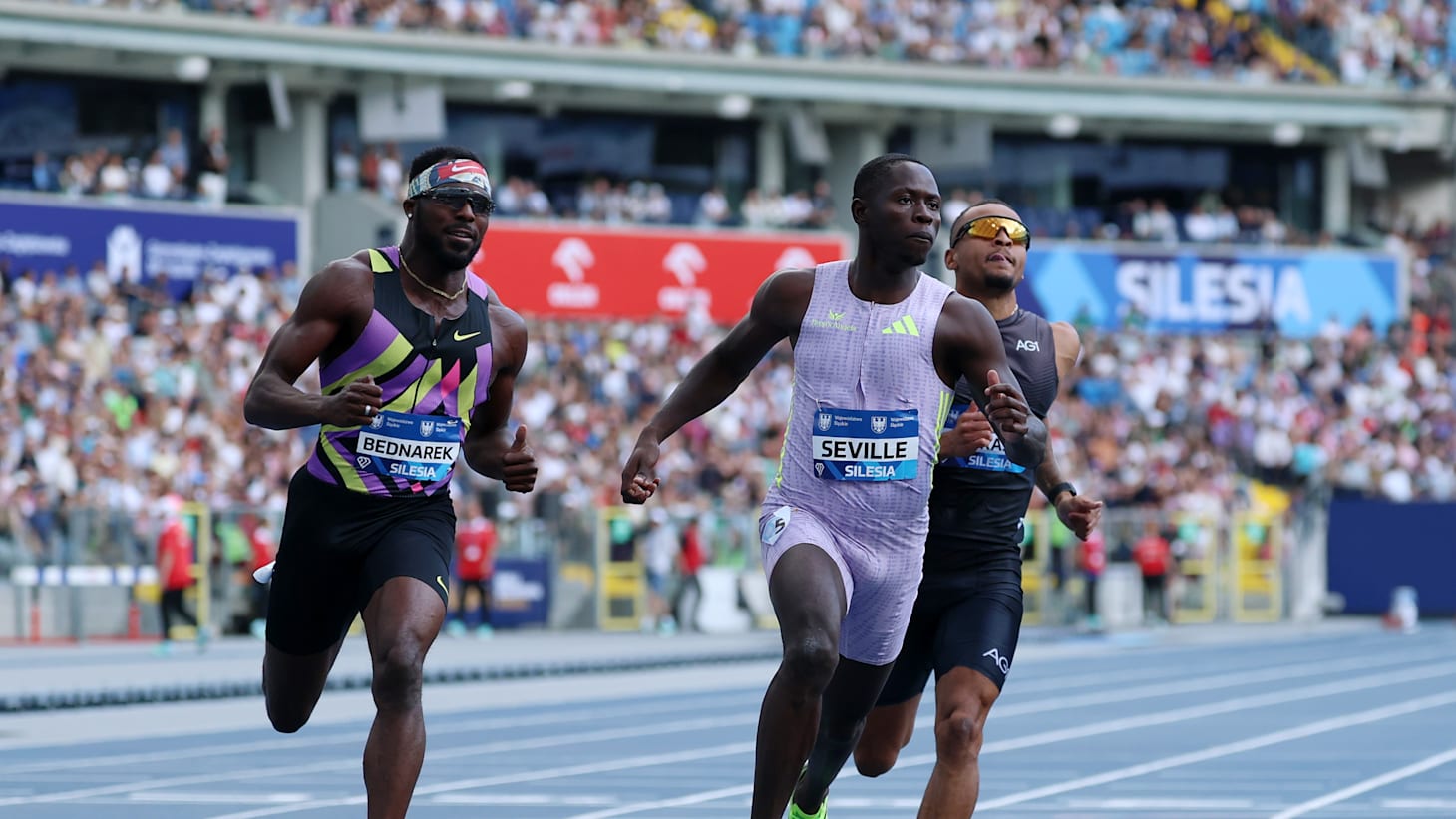
Picture by 2026 Getty Images
Under the lights of King Baudouin Stadium, Oblique Seville did what few achieve when the pressure mounts: run faster, not slower. The Jamaican, already a world champion, closed out the 2026 Diamond League season with a convincing 9.90 in the 100 meters, leaving behind Cameroonian Emmanuel Eseme and a Kayinsola Ajayi who arrived in Brussels with a psychological advantage: the Nigerian had beaten him twice during the year. But finals are another animal entirely, and Seville knew it.
This was no ordinary race. It was the culmination of an entire season of duels, adjustments, and rematches, resolved in less than ten seconds in front of the circuit's most demanding crowd.
The Context
The Diamond League is the most prestigious league in world athletics, a series of elite meetings contested throughout the season in cities like Doha, Rome, London, or Monaco. Each meet awards points, but everything is decided at the Final: a single event at year's end, where only the best in the annual rankings for each event compete. Winning there is not just adding another trophy — it is the definitive proof of who arrives in the best form when it truly matters.
For the men's 100 meters, this carries special weight. It is the premier event, the shortest and the most brutal: there is no margin for error, no time to correct mid-race. A bad start, a tenth of hesitation, and the final is lost before 30 meters. That Seville was able to reverse the recent head-to-head record against Ajayi—who had beaten him twice during the season—on the stage of greatest pressure says a great deal about his ability to manage the moment, not just pure speed.
What the Science Says
Elite sprinting is, above all, an exercise in neuromuscular system and fatigue management under extreme pressure. But what distinguishes a champion from a talented finalist is not just genetic ceiling — it is everything surrounding the fine-tuning of season preparation.
Research in personalized nutrition for elite performance (Sutehall & Pitsiladis, 2025) shows that individualized details—from electrolyte management to carbohydrate loading according to each athlete's metabolic profile—mark differences that in sprinting translate to thousandths of a second, exactly the margin that separated Seville from Eseme. In a championship final, after a long season with multiple qualifying rounds, the ability to arrive "fresh" and at the optimal point of hydration and energy replenishment (Shirreffs & Sawka, 2011) is not a minor detail: it is the difference between repeating your best time of the year or falling short.
It is also worth mentioning the psychological component of "perceived fatigue management" under conditions of maximum demand (Azevedo et al., 2021): although that work focuses on endurance, the principle applies equally to sprinting — the ability to regulate effort and response to competitive stress, knowing you have already lost twice against the same rival, is a trainable skill, not just a gift.
What It Means for You
You do not run 100 meters flat out against the best in the world, but Seville's lesson applies directly to your training and your races, regardless of distance:
Losing does not define the season. Ajayi beat Seville twice before the final. Seville did not get trapped in those results — he adjusted and arrived better prepared for the moment that mattered. If you had a bad race or a poor recent training session, do not over-react: focus on arriving at your peak for your real objective.
Fine-tuning preparation matters as much as volume. The details of nutrition, hydration, and recovery become more decisive the higher the level of competition. If you are already training consistently, your next performance leap probably lies in those fine margins, not in running more kilometers.
Train your response to pressure. The ability to execute your best version when the moment demands it is a skill, and it is practiced: in preparation races, in tempo-goal simulations, in visualization. Do not wait for "the big day" to arrive to discover how you react to competitive stress.
References
- "Personalized Nutrition for the Enhancement of Elite Athletic Performance." — Sutehall S, Pitsiladis Y, Scand J Med Sci Sports 2025. https://pubmed.ncbi.nlm.nih.gov/40164953/
- "Fluid and electrolyte needs for training, competition, and recovery." — Shirreffs SM, Sawka MN, J Sports Sci 2011. https://pubmed.ncbi.nlm.nih.gov/22150427/
- "Fatigue development and perceived response during self-paced endurance exercise: state-of-the-art review." — Azevedo RA, Silva-Cavalcante MD, Lima-Silva AE, Eur J Appl Physiol 2021. https://pubmed.ncbi.nlm.nih.gov/33389141/
Original source
Olympics.com ↗Never miss an edition.
Get the running news brief and analysis straight to your inbox. No spam, unsubscribe anytime.