Julien Alfred and Melissa Jefferson-Wooden Rematch in Zurich
August 27, 2026
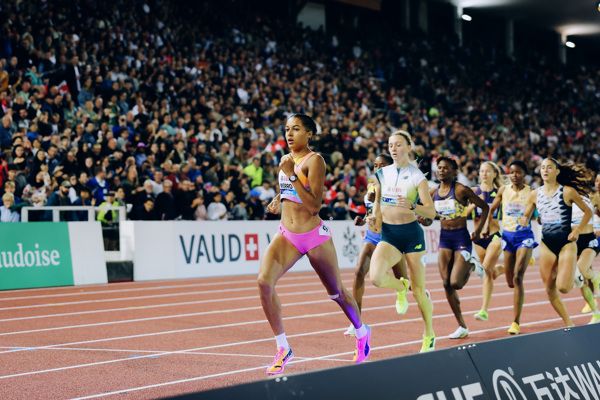
Foto vía World Athletics
Just weeks ago, in Silesia, Melissa Jefferson-Wooden snatched victory from Julien Alfred by just five hundredths: 10.78 to 10.83. In the world of the 100 meters, that difference is a chasm and at the same time an invitation. Now both return to share the track at Weltklasse Zurich, the penultimate stop of the Diamond League 2026, and the card gets even thicker with the presence of Sha'Carri Richardson. If you love sprint athletics, this is one of those nights you shouldn't miss: there's recent history, there's a pending rematch, and there are direct implications for who arrives best positioned for the big final in Brussels.
The Context
The Diamond League is the elite circuit of world athletics: a series of meets contested throughout the season in cities like Doha, Oslo, London, Lausanne, Zurich, and Brussels, where the world's best athletes compete for points, prestige, and prize money. Each event awards points based on results, and the top finishers of the regular season qualify for the final, which this year takes place in Brussels. Zurich, by tradition, is one of the most prestigious stops on the calendar: a fast track, a packed stadium atmosphere, and a history of notable marks.
For sprinters, this is not just another race. It's the last chance to accumulate points and, above all, to play the psychological game before the final showdown. Jefferson-Wooden arrives with the momentum of having beaten Alfred in Silesia, something that in the 100 meters—a race decided in less than 11 seconds where confidence weighs as much as technique—can set the tone for what comes next. Alfred, the Olympic champion and one of the most complete sprinters of the last generation, will look to respond on her preferred stage: a final of the highest level where there's no room for doubt at the start. And Richardson's breakthrough, with her ability to accelerate in the second half of the race, adds a variable that can reshuffle the entire podium.
What the Science Says
The 100-meter sprint is, in essence, an exercise in pure neuromuscular power, but the performance of an elite sprinter cannot be explained by genetics or starting technique alone. Modern sports science has been showing how much weight the factors surrounding competition carry. Personalized nutrition, for example, is an area that has gained traction at the highest level: adjusting macronutrient intake, meal timing, and hydration to the individual athlete's profile can make minimal but decisive differences in events where everything is decided in hundredths (Sutehall & Pitsiladis, 2025). And speaking of hundredths: maintaining optimal hydration status is no small detail, since even minor losses of fluids and electrolytes can affect neuromuscular function and the ability to generate explosive force (Shirreffs & Sawka, 2011).
It's also worth looking at the physiological differential between men and women in sprint and endurance performance, a field that has gained scientific relevance in recent years to better understand how to train, periodize, and compete according to each athlete's hormonal and muscular profile (Besson, Macchi & Rossi, 2022). This type of research helps explain why the margin between the world's best can be so tight: we're not talking about raw talent differences, but fine optimization of every possible variable, from sleep to recovery between sets.
What It Means for You
You're not running the 100 meters against Sha'Carri Richardson, but the logic that separates the world's best is the same that can improve your daily training, at any distance. First: small margins matter. If you're one of those who trains "more or less well" on hydration, sleep, or pre-competition nutrition, you've got room to gain time without changing your training plan. Second: strength and power aren't just for sprinters. Well-structured strength work improves running economy and sustains performance when fatigue sets in, something that applies equally to a 100-meter sprint and the final kilometers of a marathon (Zanini, Folland & Wu, 2025). And third: watch these races with fresh eyes. Pay attention to the start, to the reaction, to how each athlete manages the tension of the moment—they are mental management lessons you can apply to your own start, whether a track workout or the starting gun of your next road race.
References
- Sutehall S, Pitsiladis Y. "Personalized Nutrition for the Enhancement of Elite Athletic Performance." Scand J Med Sci Sports, 2025. https://pubmed.ncbi.nlm.nih.gov/40164953/
- Shirreffs SM, Sawka MN. "Fluid and electrolyte needs for training, competition, and recovery." J Sports Sci, 2011. https://pubmed.ncbi.nlm.nih.gov/22150427/
- Besson T, Macchi R, Rossi J. "Sex Differences in Endurance Running." Sports Med, 2022. https://pubmed.ncbi.nlm.nih.gov/35122632/
- Zanini M, Folland JP, Wu H. "Strength Training Improves Running Economy Durability and Fatigued High-Intensity Performance in Well-Trained Male Runners: A Randomized Control Trial." Med Sci Sports Exerc, 2025. https://pubmed.ncbi.nlm.nih.gov/40016
Original source
World Athletics ↗Never miss an edition.
Get the running news brief and analysis straight to your inbox. No spam, unsubscribe anytime.