Amazfit Launches the Cheetah 2 Ultra, Its Trail Running-Focused Smartwatch
October 10, 2026
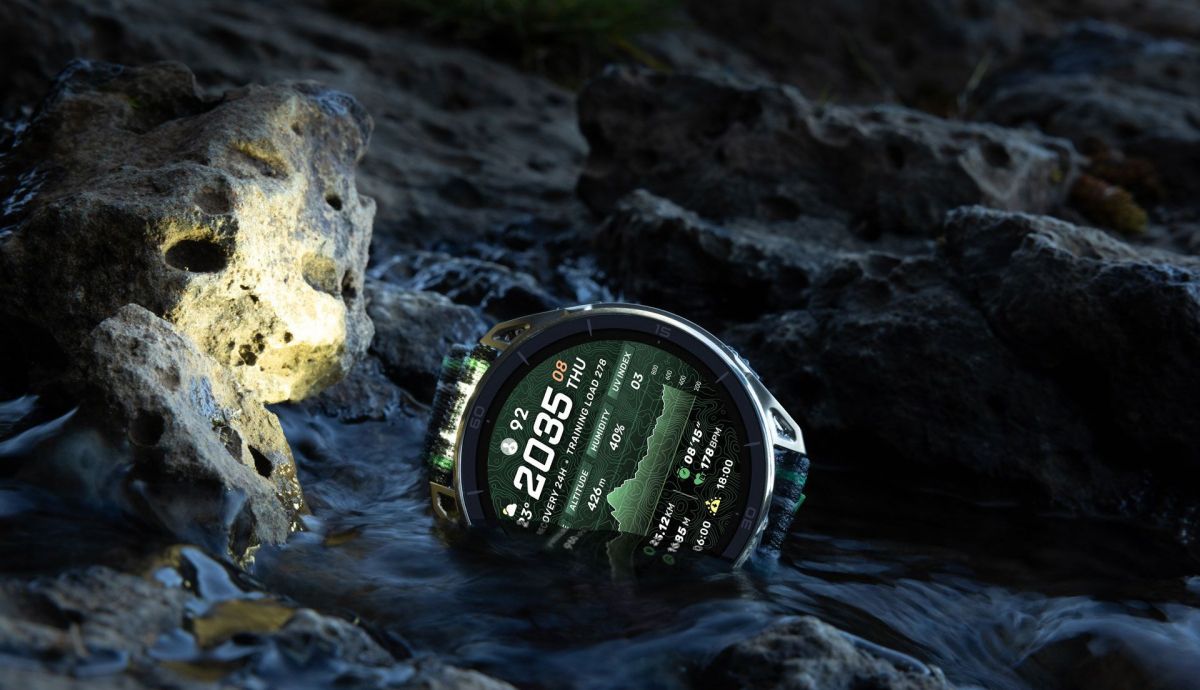
Foto vía Sportlife
There are smartwatches designed for the urban runner who does 5K before work, and there are smartwatches designed for the person who's going to spend 20 hours alone on a mountain, at night, in fog and with no cell service. The new Amazfit Cheetah 2 Ultra clearly belongs to the second category. With more than 180 sports modes, offline maps, and up to 33 hours of battery life in GPS mode, the Chinese brand is diving headfirst into a segment that until recently was dominated by Garmin and Coros with almost no competition. If you run ultras, or dream of doing so, this interests you.
The Context
Long-distance trail running has a particular characteristic that sets it apart from running a marathon on asphalt: the effort can last 15, 20, or more than 30 continuous hours, often in areas without cell signal or any nearby human presence. There, the smartwatch stops being a motivational accessory and becomes a tool for safety and tactical decision-making.
That's why battery life is the stat that stands out most about the Cheetah 2 Ultra: 33 hours with active GPS exceeds several reference models on the market and targets 100-mile runners directly. Offline maps are equally relevant — they allow you to navigate a trail without relying on mobile data, something critical when you get lost at hour 14 of a race and fog won't let you see the next marker.
The specific trail mode, with configurable metrics for effort and mountain performance (cumulative elevation gain, pace adjusted for gradient, estimated power), addresses a real need: running in the mountains isn't measured the same way as running on flat ground. A 5:00 min/km pace on a 15% climb is nothing like a 5:00 on flat terrain, and for years generic smartwatches ignored that difference.
What the Science Says
The fundamental question isn't "does this smartwatch measure well?" but rather "does this information change how I run, and does that make me better or safer?" Here the evidence is more nuanced than marketing suggests.
On one hand, there's solid support for the value of monitoring vital signs during prolonged exercise. Azevedo et al.'s (2021) review on fatigue in self-paced effort shows that perceived exertion becomes less reliable as exercise duration increases — the body "lies" about how much more it can give. Having objective data (pace, heart rate, variability) helps counter that distorted perception, especially in the second half of an ultra.
Pacing management also has backing: Cuk et al.'s (2024) study on pace variability in marathons confirms that runners who maintain more uniform pacing — neither burning out early nor holding back too much — tend to perform better. In trail running, where elevation gain complicates self-regulation even further, having a smartwatch that adjusts pace for gradient can be the difference between reaching the finish or dropping out at kilometer 80.
Now, the honest caveat: Guppy et al.'s (2023) review on technology in elite sport is clear on one point — technology amplifies decision-making, but it doesn't substitute for judgment or experience. A smartwatch with 180 modes won't make you a better trail runner if you don't know how to interpret what it shows you.
⚖️ PMP Verdict
It works for ultramarathon and serious trail runners who need real battery life and reliable offline navigation — here the Cheetah 2 Ultra competes on equal footing with market leaders, probably at a better price.
It doesn't work for the runner who does 10K in the park or is training for their first road marathon: you're paying for battery life and features you'll never need. For that profile, a simpler, cheaper smartwatch performs exactly the same.
For Your Training
If you're preparing for your first ultra, don't let the smartwatch do the work that's yours to do: practice your pacing strategy during long training runs, not race day. Use the elevation gain and effort metrics adjusted for gradient during your mountain runs to calibrate what pace is sustainable on climbs versus descents, and review that data after each long session to spot fatigue patterns before they surprise you in competition.
References
- Azevedo RA, Silva-Cavalcante MD, Lima-Silva AE. "Fatigue development and perceived response during self-paced endurance exercise: state-of-the-art review." Eur J Appl Physiol, 2021. https://pubmed.ncbi.nlm.nih.gov/33389141/
- Cuk I, Markovic S, Weiss K. "Running Variability in Marathon-Evaluation of the Pacing Variables." Medicina (Kaunas), 2024. https://pubmed.ncbi.nlm.nih.gov/38399506/
- Guppy F, Muniz-Pardos B, Angeloudis K. "Technology Innovation and Guardrails in Elite Sport: The Future is Now." Sports Med, 2023. https://pubmed.ncbi.nlm.nih.gov/37787844/
Original source
Sportlife ↗Never miss an edition.
Get the running news brief and analysis straight to your inbox. No spam, unsubscribe anytime.