Matthew Brennan wins Stage 11 of the Vuelta a España in a sprint, and Enric Mas remains leader
September 4, 2026
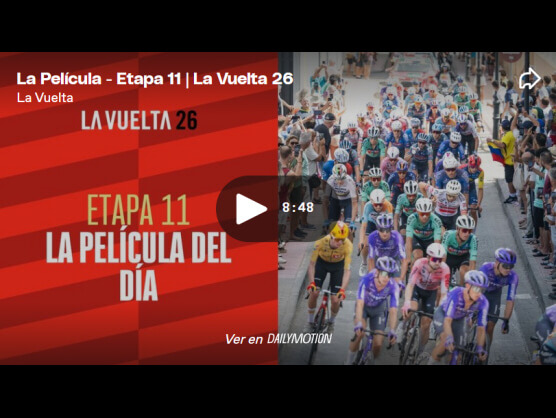
Foto vía EsCiclismo
Stage 11 of the Vuelta a España ended the way many expected—either with a breakaway or an attack from the favorites—but it came down to a sprint. Matthew Brennan, the young British rider from Visma-Lease a Bike, triumphed in Lorca after 151.3 km from Cartagena, edging out Bryan Coquard and Jordi Meeus in the final kilometer. It was a "calm" day in the general classification—Enric Mas still holds the red jersey with 1:18 over Primož Roglič and 1:39 over Félix Gall—but don't be fooled: these transition stages are where final victories are forged, and where a Grand Tour cyclist's body wages a silent battle against accumulated fatigue.
The Context
The Vuelta a España is the last of the three major stage races on the cycling calendar (alongside the Giro d'Italia and the Tour de France), and it's usually the most unpredictable: it's raced in late summer, with brutal mountain stages and a peloton arriving physically and mentally exhausted from a long season.
Stage 11 was one of those "transition" days that are actually far from simple. These are flat or rolling stages where teams like Visma-Lease a Bike organize their entire lead-out train to vie for victory in a sprint finish, while the general classification leaders—Mas, Roglič, Gall, Carapaz—simply try to survive without wasting extra energy or suffering crashes.
Why does this matter for the final outcome? Because in a three-week race, you don't win the red jersey just on mountain stages. You win it by managing fatigue day after day. That Mas maintains 1:18 over Roglič at this point, with decisive stages still ahead, speaks to a level of race management nearly as important as his raw physical capacity.
What the Science Says
What separates a cyclist who arrives fresh in the third week from one who falls apart isn't just genetics: it's nutrition and recovery between stages. A recent review article on personalized nutrition in elite athletes (Sutehall & Pitsiladis, 2025) emphasizes that in extreme and consecutive endurance events, the strategy of carbohydrate and electrolyte replenishment day after day determines who can maintain their level and who collapses in the final week.
This connects directly to what we've long known about fluid and electrolyte needs in competition (Shirreffs & Sawka, 2011): in stages like Cartagena to Lorca, with heat and constant exposure over kilometers, progressive dehydration—even minimal—can impair the cognitive performance needed to position well in a mass sprint or simply to stay on the leader's wheel during an unexpected change of pace.
It's also worth considering accumulated fatigue from a physiological perspective. A review on fatigue development in self-paced exercise (Azevedo et al., 2021) explains that perceived effort changes with accumulated central fatigue, not just local muscle wear. This is key in a Grand Tour: the general classification cyclists aren't "resting" on flat stages; they're actively managing how much mental and physiological reserve they have left for the mountains ahead.
What It Means for You
You may not be racing a Vuelta a España, but if you're training for a long race—a half marathon, a marathon, an ultra—there are direct lessons here:
"Easy" stages aren't optional. Just as the peloton manages effort on a flat stage to arrive fresh at the mountains, your low-volume weeks or easy recovery rides exist so you can perform in key workouts. Don't skip them or turn them into races.
Hydration and carbs are part of training, not an extra. If you're training high volume for several consecutive days (for example, during a heavy block week), your fluid and electrolyte plan should be as intentional as your interval plan. The evidence is clear: the margin between performing and collapsing comes down to these details.
Learn to read your accumulated fatigue, not just today's tiredness. One bad day means nothing; several days of heaviness does. Keep records (perceived effort, sleep, mood) to detect if you're accumulating real fatigue before it costs you on race day.
Mas is leading the Vuelta with race intelligence, not just legs. You can apply the same logic to your next goal: manage the day-to-day so you arrive whole when it matters.
References
- Sutehall S, Pitsiladis Y. "Personalized Nutrition for the Enhancement of Elite Athletic Performance." Scand J Med Sci Sports, 2025. https://pubmed.ncbi.nlm.nih.gov/40164953/
- Shirreffs SM, Sawka MN. "Fluid and electrolyte needs for training, competition, and recovery." J Sports Sci, 2011. https://pubmed.ncbi.nlm.nih.gov/22150427/
- Azevedo RA, Silva-Cavalcante MD, Lima-Silva AE. "Fatigue development and perceived response during self-paced endurance exercise: state-of-the-art review." Eur J Appl Physiol, 2021. https://pubmed.ncbi.nlm.nih.gov/33389141/
Original source
EsCiclismo ↗Never miss an edition.
Get the running news brief and analysis straight to your inbox. No spam, unsubscribe anytime.