Keely Hodgkinson Debuts Innovative Nike Speed Suit in 800m Victory at Athlos London
September 21, 2026
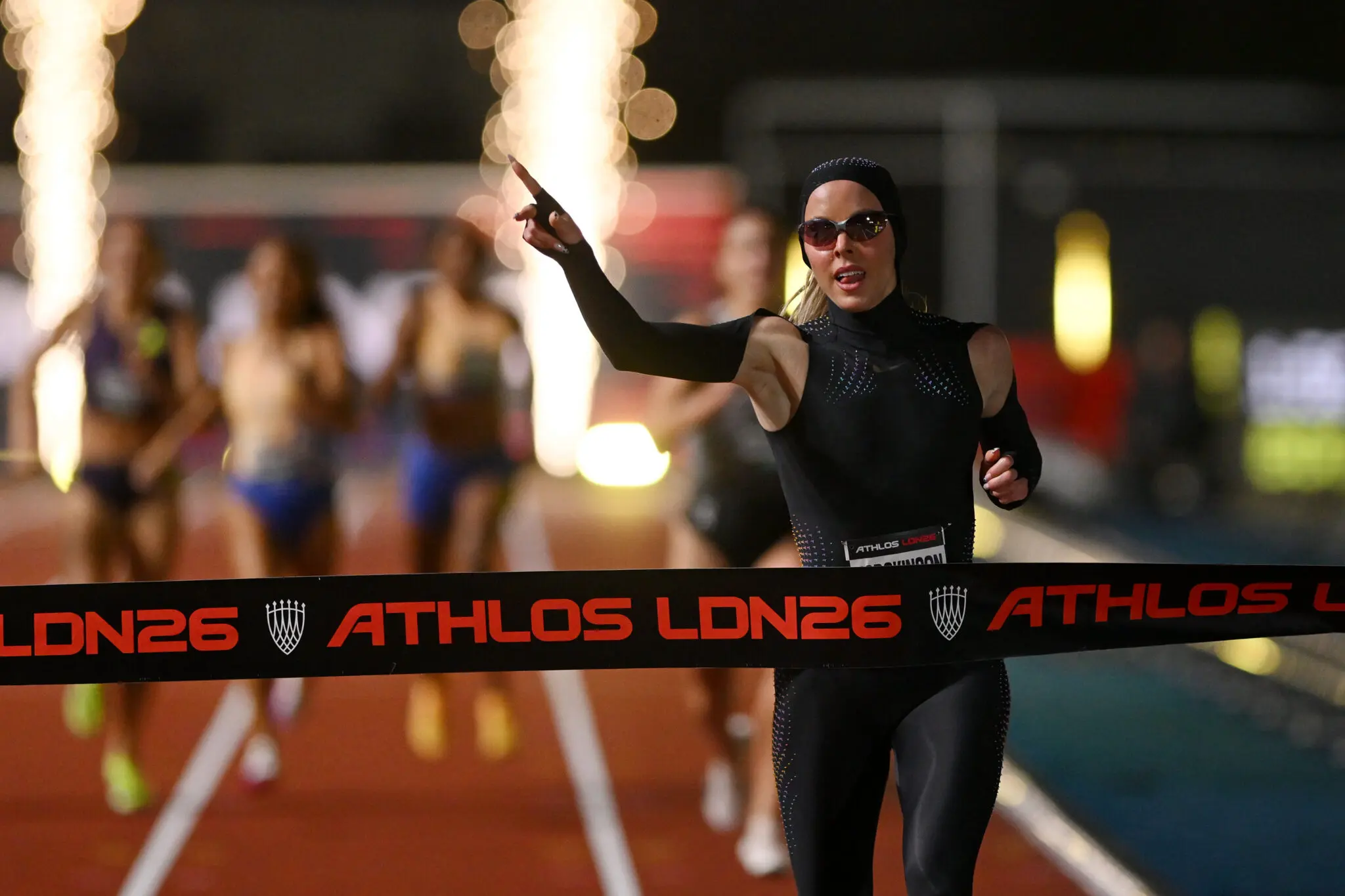
Pic Keely Hodgkinson (Getty)
Keely Hodgkinson didn't need a new suit to remain the best 800m runner on the planet. But at Athlos London, while closing her 2026 season with a commanding 1:56.40—a meet record and a margin of more than two seconds over Switzerland's Valentina Rosamilia—the Olympic champion was wearing something worth understanding: a speed suit developed exclusively for her over six months, with 3D-printed vortex generators. It's not empty marketing. It's aerodynamics applied to the human body in motion, and it matters to you because it signals where elite equipment is heading in the coming years.
The Context
Athlos London is part of Athlos, a women's-only athletics circuit launched to give visibility and million-dollar prize purses to the world's best athletes outside the traditional Diamond League calendar. In this format, every detail counts: these are short, high-intensity races where milliseconds determine podiums and prize money.
The suit Hodgkinson debuted is full-body, with an integrated hood and open back—a design that seeks to minimize the surface area of fabric exposed to air without sacrificing heat dissipation in critical zones. What makes it distinctive isn't the cut, but the surface: small vortex generators, 3D-printed and strategically positioned, which according to Nike alter the airflow around the body to reduce drag.
The idea isn't new in high-performance sport. Formula 1 and track cycling have been using controlled vortices for decades to "stick" airflow to a surface and delay boundary layer separation, which is what generates drag. Translating that principle to an athletics suit—a curved, flexible surface in constant movement on a human body that isn't a rigid object—is an engineering challenge quite different and far more complex than adding channels to a cycling helmet.
What Science Says
Here it's worth being honest: published, peer-reviewed scientific evidence about vortex generators in athletics apparel is still sparse—this is cutting-edge technology developed in-house by brands, with data rarely shared openly. What we do know, from the literature on technological innovation in elite sport, is that the gap between technological development and independent scientific validation is a recurring and acknowledged problem in the field (Guppy et al., Sports Medicine, 2023). That study raises precisely the need for "guardrails"—regulatory and evaluation frameworks—so that technological innovation doesn't distort competitive equity before solid evidence exists about its actual magnitude of benefit.
This doesn't mean the suit doesn't work. It means that, unlike a shoe with a carbon plate—whose benefit in running economy is well documented with independent biomechanical studies—a personalized speed suit with aerodynamic microstructures still exists in a zone where the brand is the one measuring, narrating the benefit, and deciding what data it shares.
What is indisputable is the physical principle: at higher speeds, aerodynamic drag grows exponentially (proportional to the square of velocity). In an 800m race run at elite pace—Hodgkinson spends much of the race above 25 km/h—even small reductions in drag can translate into accumulated hundredths or tenths of a second. The question isn't whether the effect exists, but how much it weighs against other factors: fitness, race tactics, and the natural day-to-day variability of human performance.
⚖️ PMP Verdict
This suit serves—and serves tremendously—an elite-level athlete in a short, fast race where every hundredth counts and personalized R&D budget makes economic sense. It doesn't serve anyone else, at least not yet: it's not for sale, there's no published independent evidence of its actual magnitude of benefit, and in distance or ultramarathon races aerodynamic drag weighs proportionally far less than running economy, nutrition, or pace management. It's a fascinating story of innovation, but it's not yet a story of proven, replicable science.
What It Means for You
If you're running 5K, 10K, or a marathon, this suit doesn't change anything in your training this week. But it is a good reminder of where the real return on investment really is for a recreational or competitive amateur runner: strength work that improves running economy and delays fatigue in hard efforts has solid, accessible evidence (Zanini et al., Med Sci Sports Exerc, 2025), far above any garment. Invest first in what we already know works before chasing the next marketing innovation.
References
- Guppy F, Muniz-Pardos B, Angeloudis K. "Technology Innovation and Guardrails in Elite Sport: The Future is Now." Sports Medicine, 2023. https://pubmed.ncbi.nlm.nih.gov/37787844/
- Zanini M, Folland JP, Wu H. "Strength Training Improves Running Economy Durability and Fatigued High-Intensity Performance in Well-Trained Male Runners: A Randomized Control Trial." Med Sci Sports Exerc, 2025
Original source
Athletics Weekly ↗Never miss an edition.
Get the running news brief and analysis straight to your inbox. No spam, unsubscribe anytime.