Kenya's Dominance on the Streets of Copenhagen: Total Control of the Mile and Half Marathon
September 20, 2026
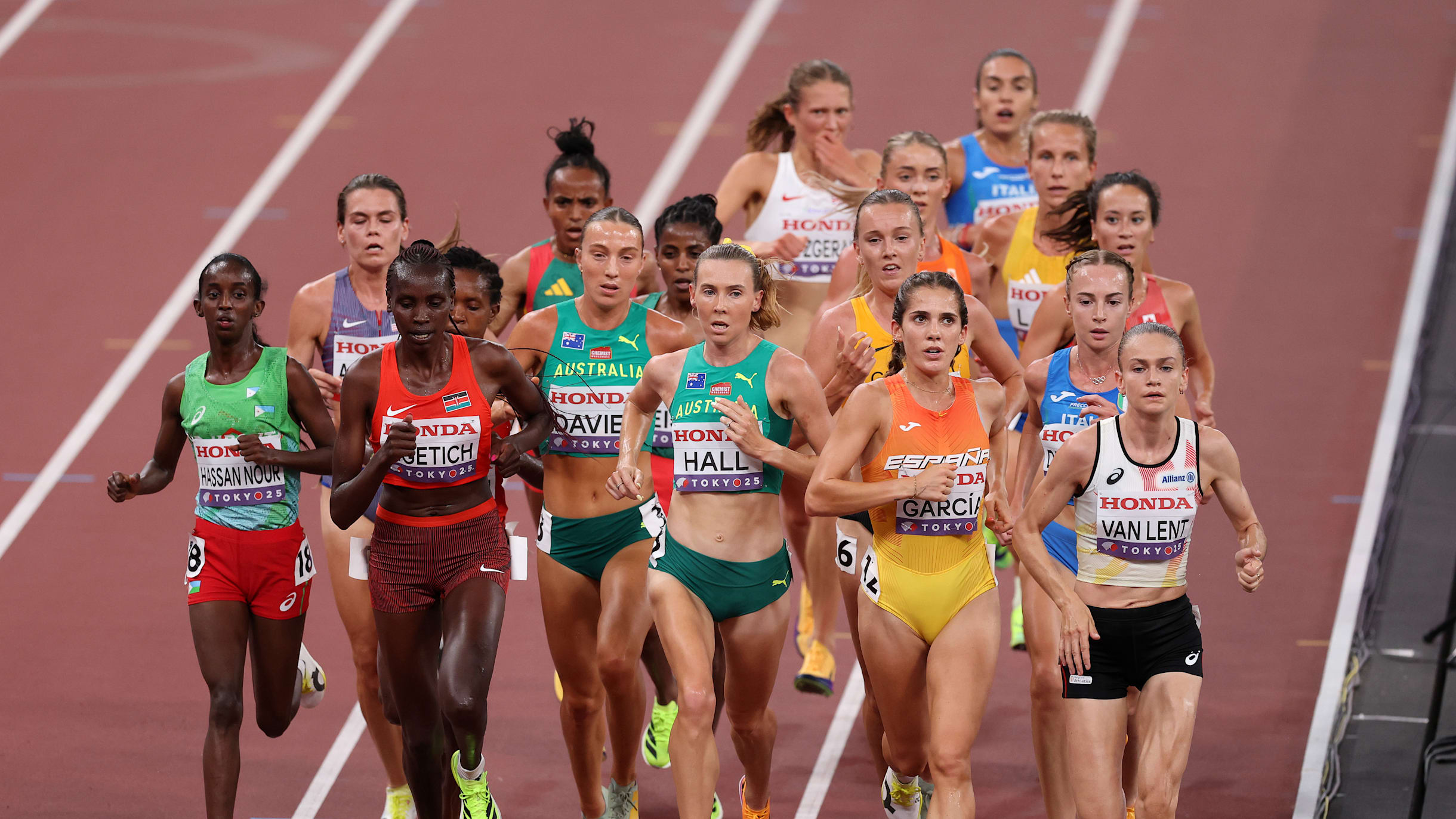
Foto por: 2025 Getty Images
The weekend in Copenhagen will be remembered for the drama of the men's 5K, yes, but the real lesson came from Kenyan and Ethiopian runners who moved through the Danish streets as if they owned them. Agnes Ngetich led an assault that made clear, once again, a pattern that no longer surprises anyone in world athletics: when it comes to pure endurance on asphalt, East Africa continues to set the pace for the rest of the planet. With 496 athletes from 85 federations competing in the mile and half marathon, the 2026 World Road Championships was also a stage for figures like Jimmy Gressier, the Frenchman who already claimed gold in the track 10,000m, and American Yared Nuguse, who sought to prove that mile speed can also coexist with distance running.
The Context
The World Athletics Road Championships is a relatively young event in its current format: it brings together on the same weekend races that normally exist separately—5K, 10K, mile, and half marathon—under one organizational roof, with team classification in addition to individual. This makes it a fascinating thermometer: it measures not only who is fastest on a given day, but which countries have the depth of talent to dominate multiple distances simultaneously.
That's where Kenya and Ethiopia claim the laurels. That Agnes Ngetich and her teammates dominated the women's half marathon is not an isolated anecdote; it's confirmation of a sustained hegemony lasting decades in long-distance endurance racing. The mile, by contrast, is a different animal: it demands a combination of pure speed and aerobic capacity that traditionally favored runners from a more "track-oriented" tradition, like Nuguse, an Olympic medalist and world championships finalist in the 1500m. Seeing Kenyans compete on equal—or superior—footing in this hybrid distance as well is a signal that their athletic development no longer limits itself to classic distance racing.
Gressier, for his part, represents the other side of the coin: a European who broke the mold by winning world gold in the track 10,000m, and who came to Copenhagen to test whether that form translates to the road. These crossovers of specialists in a single event are precisely what make the World Road Championships valuable: everyone doesn't compete in their own niche; everyone competes against everyone else.
What the Science Says
Why do Kenya and Ethiopia keep sweeping? The answer isn't a single magic factor, but the sum of well-documented variables. Genetics and training altitude play their part, but recent sports science increasingly focuses on fine-tuning: personalized nutrition, metabolic monitoring, and carbohydrate strategies tailored to the individual athlete. A recent article on personalized nutrition in elite athletes (Sutehall & Pitsiladis, 2025) raises precisely this point: generic protocols are no longer enough; the margin separating a world champion from a finalist lies in the individualized detail, from carbohydrate timing to each runner's glycemic response during prolonged effort.
This connects to another finding relevant for races like the half marathon: carbohydrate management during effort is decisive in long-distance endurance (Cao et al., 2025). Kenya and Ethiopia's teams, with increasingly professionalized support structures, have incorporated these strategies with a precision that was once exclusive territory of European or North American programs.
There's also a pacing component. Research on pace management in half marathon and marathon races shows that elite African female runners typically sustain more consistent splits in the second half of the race (Nikolaidis et al., 2019), an ability that combines trained physiology with extremely refined tactical race reading.
What It Means for You
You don't need to be born in the Rift Valley to apply these lessons to your own training. First: consistency in pace matters more than you think. If you tend to "blow up" in the second half of your long runs, practice negative splits in training, not just on race day. Second: stop improvising your race nutrition. Test your carbohydrate strategy on long training runs, not the day of your half marathon. Third: if you compete in hybrid distances like the mile or 5K, don't neglect speed work just because you're a "distance runner"—the versatility we saw in Copenhagen, with athletes crossing between track, mile, and road, is also a training model, not just talent.
References
- Sutehall S, Pitsiladis Y. "Personalized Nutrition for the Enhancement of Elite Athletic Performance." Scand J Med Sci Sports, 2025. https://pubmed.ncbi.nlm.nih.gov/40164953/
- Cao W, He Y, Fu R. "A Review of Carbohydrate Supplementation Approaches and Strategies for Optimizing Performance in Elite Long-Distance Endurance." Nutrients, 2025. https://pubmed.ncbi.nlm.nih.gov/40077786/
- Nikolaidis PT, Ćuk I, Knechtle B. "Pacing of Women and Men in Half-Marathon and Marathon Races." Medicina (Kaunas), 2019. https://pubmed.ncbi.nlm.nih.gov/30646638/
Original source
Olympics.com ↗Never miss an edition.
Get the running news brief and analysis straight to your inbox. No spam, unsubscribe anytime.