Berlin Marathon Confirms Sebastian Sawe's Return Despite Recent Injury
September 5, 2026
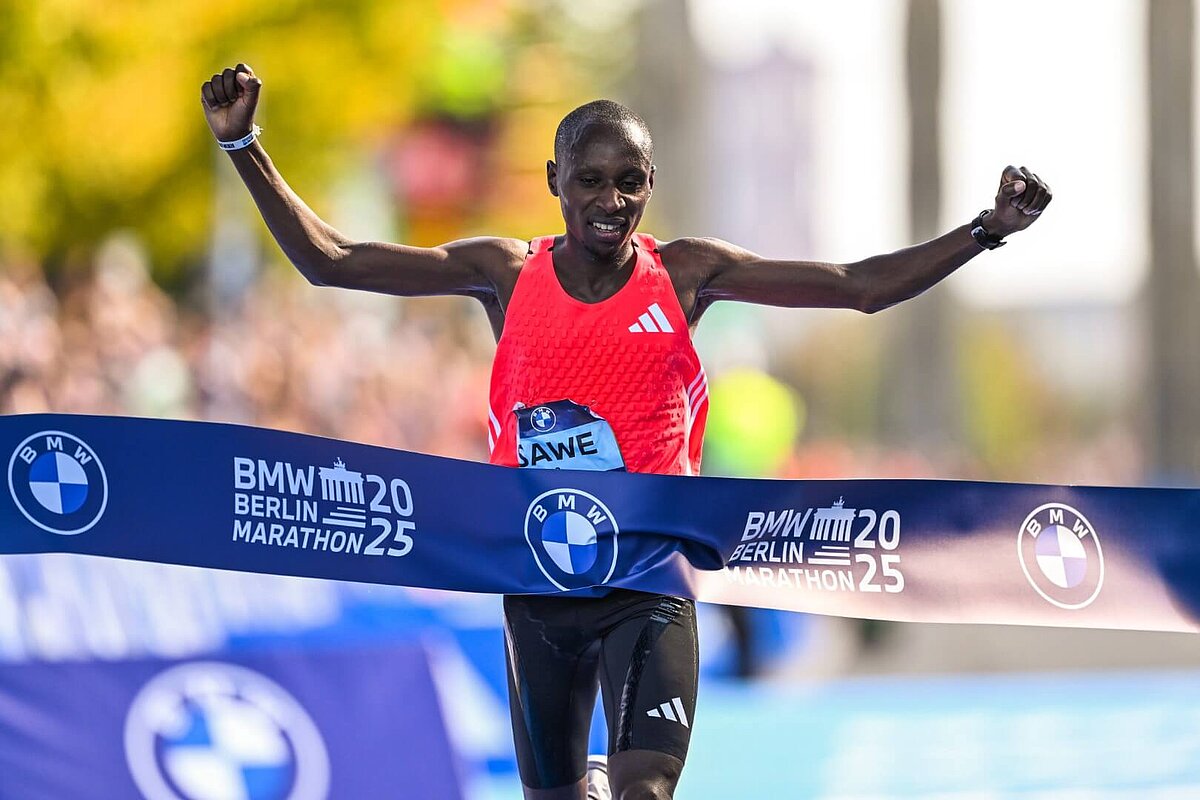
Foto vía BMW Berlin Marathon
There are news stories that make any runner—elite or Sunday morning jogger—look up from their watch. This is one of them: Sebastian Sawe, the Kenyan who holds the marathon world record and defended his title in Berlin last year, returns to the starting line on September 27. He does so with an entry that's already making waves: 1:59:30, the fastest entry time ever recorded for a race. And he does so, moreover, after overcoming a recent injury. For world running, this isn't just a calendar fact: it's the possibility of witnessing history live.
The Context
The Berlin Marathon is not just any race. It is one of six World Marathon Majors—alongside Boston, London, Chicago, New York, and Tokyo—and, above all, it is the fast course par excellence. Its flat course, smooth turns, and typically cool late-September weather have made it, for over a decade, the stage where world records fall. Kipchoge ran his best times there, and there Sawe crowned himself in 2024 with 2:02:16, a remarkable time considering that day the conditions were warmer than ideal.
That the organizers confirm Sawe as headliner, despite carrying a recent injury, says two things: first, that his recovery process is advancing as planned; second, that Berlin is betting big on him as the athlete capable of pushing human limits even further. An entry time of 1:59:30 is not a mark that runs on autopilot alone: it's a statement of intent, a message to other competitors that Sawe arrives ready to fight for the record, not just the title.
What the Science Says
The return of an elite athlete after an injury always raises the same question: when is it safe to demand maximum performance from the body again? Evidence on bone stress injuries and their management in distance runners (Warden et al., 2014; George et al., 2024) is clear on one point: successful return depends on progressive functional criteria—not calendar dates—and loads that respect the biological timelines of bone and tendon remodeling. If Berlin trusts Sawe as the event's star, it's reasonable to assume his support team manages objective recovery markers, not just optimism.
On the other hand, last year's warm conditions data is not insignificant. The science of heat acclimatization (Lorenzo et al., 2010) shows that controlled exposure to elevated temperatures before competition improves cardiovascular performance and heat dissipation capacity, something that likely explains why Sawe was able to win in 2:02:16 despite it not being a "perfect" day. And if this year conditions are cooler—as is typical in Berlin—the margin for attacking the world record expands considerably.
Finally, it's worth mentioning the role of strength and running economy. A recent study (Zanini et al., 2025) confirmed that strength training improves the "durability" of running economy—that is, the ability to maintain technical efficiency even when fatigue appears in the final kilometers, precisely where records are made or lost.
What It Means for You
You're not going to run 1:59:30, and probably neither will I. But there are lessons applicable at any level:
- Trust the process, not the calendar. If Sawe returns from an injury following functional criteria and not arbitrary dates, so should you. Progress by symptoms and capacity, not by anxiety.
- Climate matters more than you think. If your next important race could be hot, start exposing yourself in a controlled way weeks before. Don't leave it to chance.
- Strength is not optional. Incorporating strength work twice a week could be the difference between maintaining your goal pace through kilometer 30 or falling apart beforehand.
- Look at Berlin as a case study. Observe how elite pacing is executed: there are effort management lessons you can apply to your own race, regardless of your personal record.
Berlin 2025 promises to be memorable. And if you're a runner, there's always something to learn from those who run at the top.
References
- Lorenzo S, Halliwill JR, Sawka MN. "Heat acclimation improves exercise performance." J Appl Physiol, 2010. https://pubmed.ncbi.nlm.nih.gov/20724560/
- Warden SJ, Davis IS, Fredericson M. "Management and prevention of bone stress injuries in long-distance runners." J Orthop Sports Phys Ther, 2014. https://pubmed.ncbi.nlm.nih.gov/25103133/
- George ERM, Sheerin KR, Reid D. "Criteria and Guidelines for Returning to Running Following a Tibial Bone Stress Injury: A Scoping Review." Sports Med, 2024. https://pubmed.ncbi.nlm.nih.gov/39141251/
- Zanini M, Folland JP, Wu H. "Strength Training Improves Running Economy Durability and Fatigued High-Intensity Performance in Well-Trained Male Runners: A Randomized Control Trial." Med Sci Sports Exerc, 2025. https://pubmed.ncbi.nlm.nih.gov/40016936/
Original source
BMW Berlin Marathon ↗Never miss an edition.
Get the running news brief and analysis straight to your inbox. No spam, unsubscribe anytime.