25 Years Later, Stephen Siller's Family Runs His Final Route Again
September 11, 2026
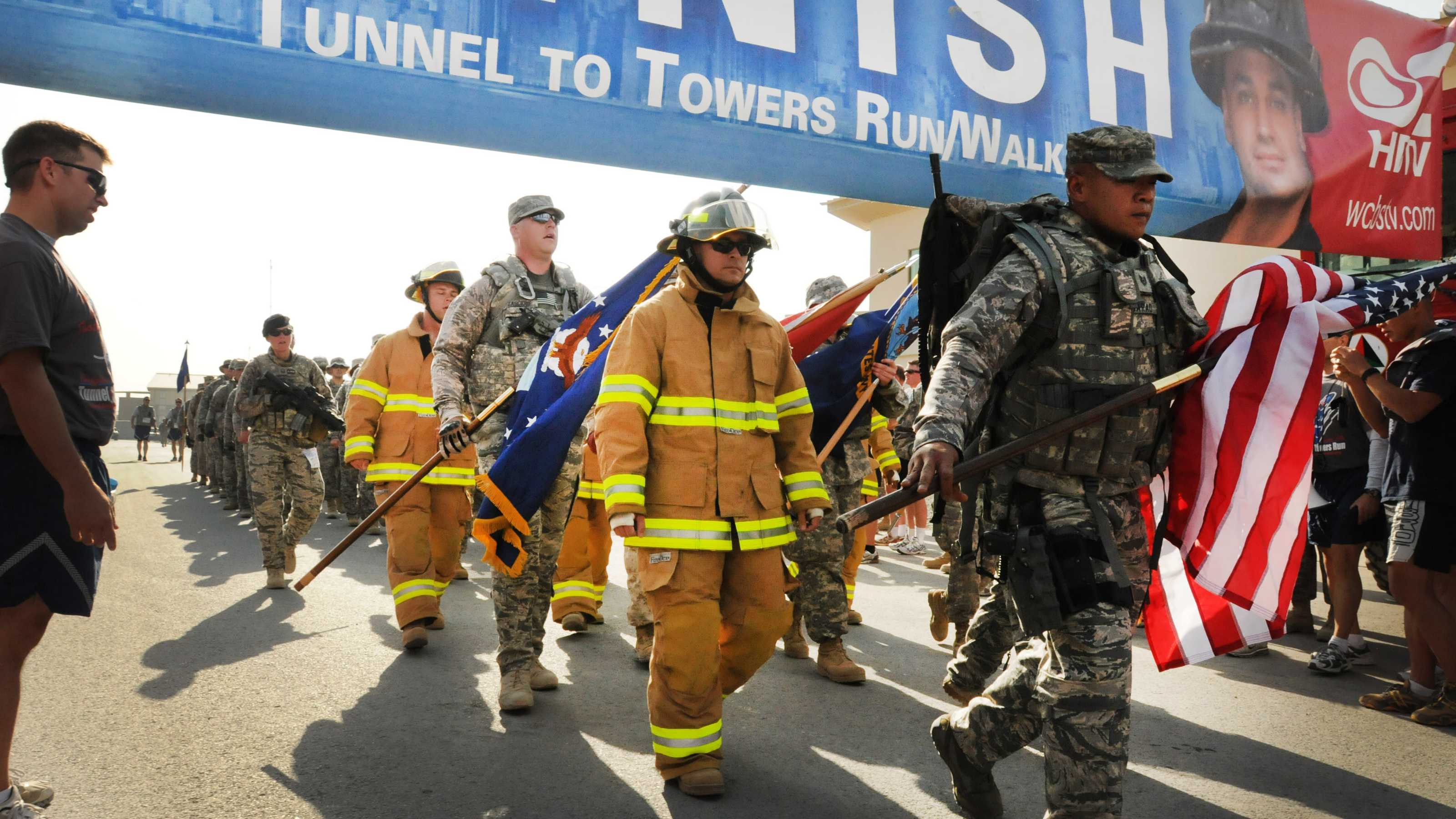
NATO and civilian partners participate in the "Tunnel to Towers run/walk race (Wikimedia Commons)
There are races run with legs and others run with memory. On September 11, 2001, firefighter Stephen Siller of Brooklyn's Rescue Squad 1 found the Hugh L. Carey Tunnel closed to traffic. He didn't hesitate: he strapped roughly 60 pounds of equipment to his back and ran through it on foot to reach the Twin Towers, where he died trying to save lives. A quarter century later, his family covered that same distance, this time accompanied by a steel beam recovered from the World Trade Center, a silent tribute to those final miles that became legend. On September 27, thousands of runners will close the commemorative month by repeating his route in the 25th edition of the Tunnel to Towers 5K Run & Walk.
The Context
Siller's story gave rise to one of the largest charitable foundations tied to running in the United States: the Tunnel to Towers Foundation, created by his brothers to honor his sacrifice and that of hundreds of firefighters, police officers, and first responders who died that day. Since then, the organization has built homes for wounded veterans, supported families of first responders who died in service, and funded programs addressing homelessness among veterans.
The Tunnel to Towers 5K is not just another race: it is a collective ritual. Thousands of people—many wearing 20-kilo firefighter vests, replicas of the equipment Siller carried—cross the same tunnel beneath the East River, emerge in Manhattan, and finish near where the towers stood. There are no times to chase and no podiums to celebrate; the goal is to feel, even if only for 5 kilometers, the literal and symbolic weight of what it meant to run toward danger instead of away from it.
That the family decided to retrace the complete route on the 25th anniversary, with an actual World Trade Center beam as witness, elevates the annual commemoration event to a historic milestone. It is running as active memory, not as statistics.
What the Science Says
Running with added load—as thousands of participants do while mimicking Siller's firefighter equipment—substantially changes the physiological demands of exercise. A light 5K is not the same as one with an extra 20 kilos distributed across the torso: running mechanics, energy expenditure, and perceived fatigue spike. Evidence on fatigue during self-paced exercise shows that perceived exertion (RPE) scales rapidly when variables like heat, load, or uneven terrain are added, and that the body adjusts pace anticipatorily to protect itself from complete collapse (Azevedo et al., 2021). This explains why, even though it's "only" a 5K, running it in full gear feels like a completely different challenge.
September in New York can also bring residual heat and humidity from summer, no small factors for thousands of recreational runners without specific heat acclimatization. Classical research on heat acclimatization confirms that the body improves its capacity to dissipate temperature and maintain performance after repeated heat exposure—something most participants in a commemorative event like this don't have time to develop (Lorenzo, Halliwill & Sawka, 2010). Add to that the fact that carrying extra weight increases metabolic heat production, making hydration and electrolyte replacement real priorities, not optional details (Shirreffs & Sawka, 2011).
What It Means for You
If this year you decide to run—or walk—a Tunnel to Towers, a local memorial run, or simply take part in a cause-driven event on September 11, there's something bigger at stake than your final time. But that doesn't mean running without a plan:
- If you're going to wear a weighted vest, practice at least a couple of times beforehand with similar load. Your body needs to learn that different movement pattern.
- Hydrate like the weather matters, because it does. Don't underestimate a 5K just because of the short distance; the load and heat change the entire equation.
- Adjust your pace expectations. This is not a day to chase a PR. It's a day to feel the effort, not to optimize it.
- Listen for early signs of fatigue. With extra load, the body compensates sooner than usual; slowing down is not weakness, it's smart strategy.
Running, sometimes, is the most honest way we have to remember. Stephen Siller didn't run to win anything. He ran to get there. Every September 27, thousands of people repeat that gesture—and in doing so, keep alive a story that deserves to keep running.
References
- Lorenzo S, Halliwill JR, Sawka MN. "Heat acclimatization improves exercise performance." J Appl Physiol, 2010. https://pubmed.ncbi.nlm.nih.gov/20724560/
- Shirreffs SM, Sawka MN. "Fluid and electrolyte needs for training, competition, and recovery." J Sports Sci, 2011. https://pubmed.ncbi.nlm.nih.gov/22150427/
- Azevedo RA, Silva-Cavalcante MD, Lima-Silva AE. "Fatigue development and perceived response during self-paced endurance exercise: state-of-the-art review." Eur J Appl Physiol, 2021. https://pubmed.ncbi.nlm.nih.gov/33389141/
Original source
Military.com ↗Never miss an edition.
Get the running news brief and analysis straight to your inbox. No spam, unsubscribe anytime.