Addisu Gobena Breaks Record at 2026 Sydney Marathon with More Than 40,000 Runners
August 31, 2026
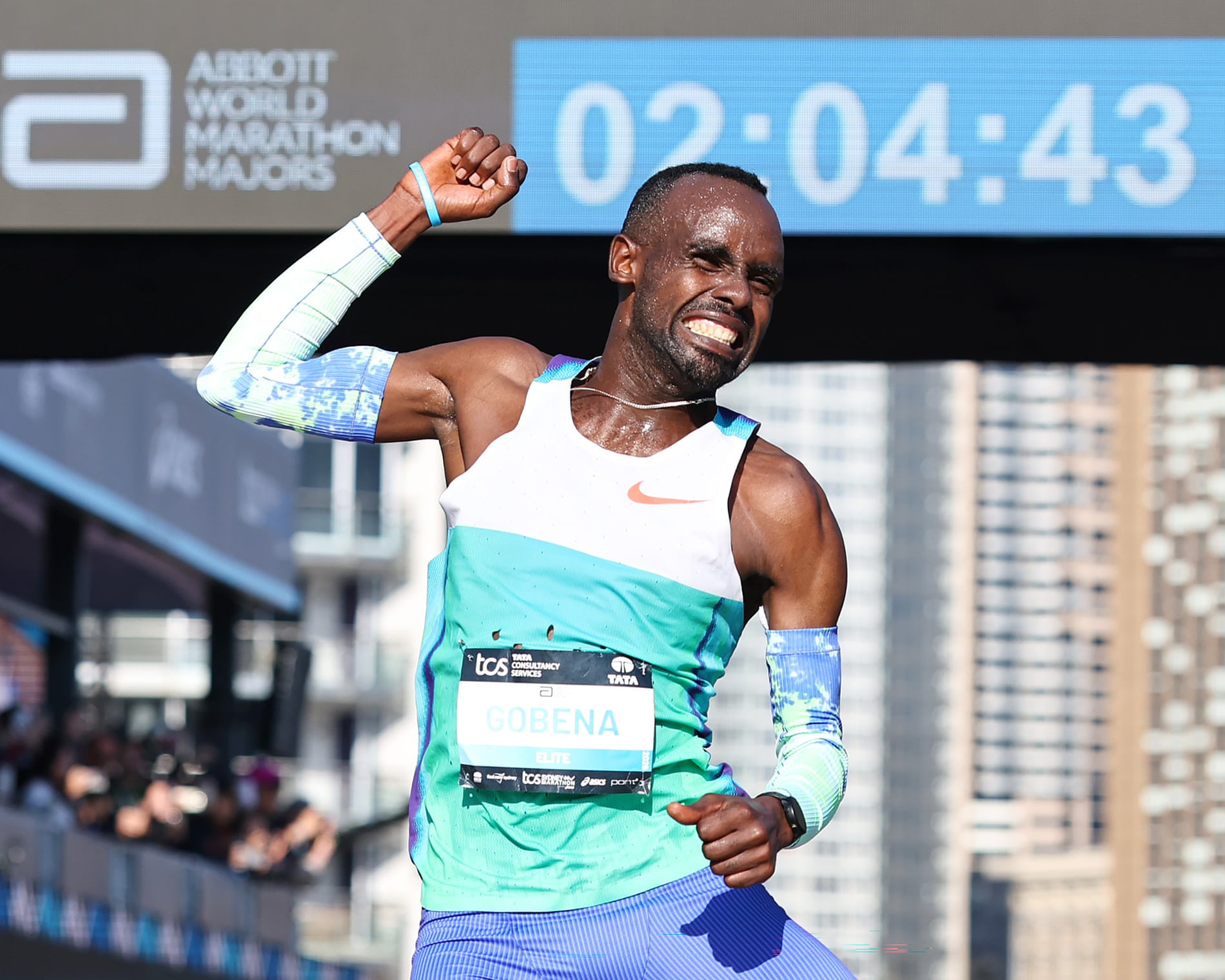
Photograph: Jeremy Ng/Getty Images
A year ago, Addisu Gobena crossed the finish line of the Sydney Marathon in second place, with the bittersweet feeling of having run a brilliant race that simply wasn't enough. This August 30, 2026, he returned to the same course between North Sydney and the iconic Opera House, and this time he left nothing to chance: 2:04:42, more than a minute below his own previous record, and the new course record. He did it, moreover, in the midst of a massive spectacle: more than 40,000 runners sharing the asphalt in the second edition of Sydney as part of the Abbott World Marathon Majors. This matters because it combines two things that rarely coexist with such clarity: an elite-level performance of the highest caliber and a mass participation phenomenon that confirms Sydney as the marathon that has come to stay among the greats.
The Context
The Abbott World Marathon Majors are the most prestigious circuit in world marathoning: Boston, London, Berlin, Chicago, New York, and Tokyo built that status over decades. Sydney officially joined as the seventh major in 2025, the first addition to the circuit in more than ten years. A city entering that club is not a procedural detail: it means guaranteed elite competition, world-class logistics, and a professional field that's beginning to treat that date as a mandatory stop on the calendar.
The 2026 edition confirmed that projection. Gobena, who had already shown his level by finishing second in 2025, returned with a more mature strategy and an explicit objective: the course record. Breaking 2:05 on a new course, with the added challenge of variable late-winter Australian weather and an urban route with surface changes and some elevation toward the bridge and the final descent to the Opera House, is a statement of physical fitness and also of race management. It's no surprise that it was the very runner who "knew" the course, with the muscle memory and tactical knowledge of having run it before, who ended up rewriting it.
What Science Says
Lowering your own record by more than 60 seconds in a year is not by chance or just being "in great shape": it's the result of nearly perfect pacing execution. Evidence on marathon pacing shows that elite runners who achieve their best times maintain minimal pace variability between the first and last kilometers, avoiding the classic "positive split" that penalizes most recreational runners (Cuk et al., 2024). Gobena, having known the course from the previous edition, likely adjusted his effort distribution on critical sections—the climbs toward the bridge, the harbor wind—with information a first-timer doesn't have.
Sustaining that pace under accumulated fatigue also depends on the ability to delay the perception of effort in the final 10K, the segment where an elite marathon is decided. Literature on fatigue in self-regulated exercise describes how the highest-level athletes manage to maintain neuromuscular power and running economy even when central fatigue signals spike (Azevedo et al., 2021). Add to this the silent work behind the scenes: carbohydrate nutrition during the race, now optimized with individualized protocols aimed at sustaining glucose availability in the final phases (Cao et al., 2025), and hydration strategies adjusted to environmental conditions, critical even in temperate climates like Sydney's in August (Shirreffs & Sawka, 2011).
What It Means for You
You're not going to run at 2:58 per kilometer like Gobena, but the logic of his record applies directly to your next marathon: the race is won (or lost) in pace management, not in the start. If you've run a course before, use that memory: note where you ran out of fuel, where the wind or the climb broke your rhythm, and adjust your carbohydrate plan and effort strategy for those specific sections next time. Practice your race nutrition in your long runs, don't save it for race day. And if you're going to run a major or any massive marathon with more than 40,000 people, add one extra variable to your plan: start in the correct corral to avoid losing precious minutes in the first crowded kilometer.
References
- "Running Variability in Marathon-Evaluation of the Pacing Variables." — Cuk I, Markovic S, Weiss K, Medicina (Kaunas), 2024. https://pubmed.ncbi.nlm.nih.gov/38399506/
- "Fatigue development and perceived response during self-paced endurance exercise: state-of-the-art review." — Azevedo RA, Silva-Cavalcante MD, Lima-Silva AE, Eur J Appl Physiol, 2021. https://pubmed.ncbi.nlm.nih.gov/33389141/
- "A Review of Carbohydrate Supplementation Approaches and Strategies for Optimizing Performance in Elite Long-Distance Endurance." — Cao W, He Y, Fu R, Nutrients, 2025. https://pubmed.ncbi.nlm.nih.gov/40077786/
- "Fluid and electrolyte needs for training, competition, and recovery." — Shirreffs SM, Sawka MN, J Sports Sci, 2011. https://pubmed.ncbi.nlm.nih.gov/22150427/
Original source
TCS Sydney Marathon (sitio oficial) ↗Never miss an edition.
Get the running news brief and analysis straight to your inbox. No spam, unsubscribe anytime.