Agnes Ngetich will seek to add another world title after her cross country crown
September 17, 2026
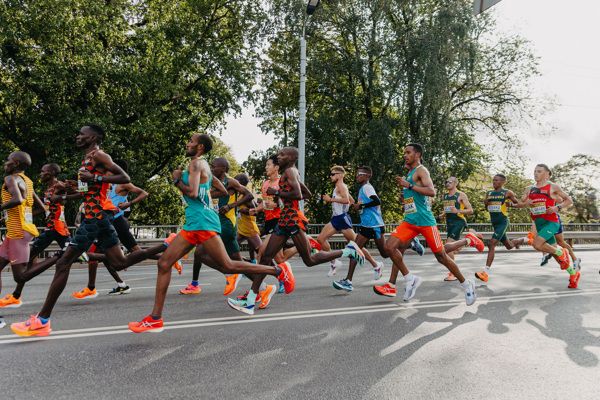
Foto vía World Athletics
When Agnes Ngetich crossed the finish line in Tallahassee in January to claim the world cross country title, many thought she had reached her seasonal peak. They were wrong. The Kenyan, holder of the world record for 10K on the road, now arrives in Copenhagen determined to prove that cross country was just the appetizer. She is accompanied by a Kenyan team loaded with talent, with Daniel Ebenyo—world half marathon runner-up—as the male standard-bearer. If you enjoy high-performance running, this is one of those events you can't afford to miss: rarely do you see a country present itself with such a density of talent in a single event.
The context
World Athletics' World Road Race Championships are, in essence, the most reliable thermometer of the global fitness status of distance and middle-distance running. Unlike a major marathon or a Diamond League event, this championship brings together various road distances (5K, 10K, and half marathon, depending on the edition) in a single weekend under the official umbrella of the international federation, with individual and team titles at stake. That means something crucial: the best runner "of a single race" doesn't compete—the best of the moment competes, representing his or her country, with all the pressure that entails.
For Kenya, these types of events are a strategic showcase. The country has dominated world distance running for decades, but sustaining that dominance requires constantly renewing generations. That Ngetich—already holder of the world record for 10K—and Ebenyo lead the delegation is no accident: they are the spearhead of a system that identifies, trains, and exposes its elite athletes to the international circuit from an early age.
Winning a world cross country title and then aiming for a road title in the same season is not trivial. They are distinct physiological stimuli: cross country demands strength, changes of pace, and tolerance for uneven terrain; the road rewards efficiency, consistency of pace, and fine management of effort over longer stretches on stable ground. For one athlete to excel in both worlds speaks to an exceptional aerobic base and neuromuscular versatility.
What the science says
Ngetich's ability to sustain elite performance in two such different disciplines within the same cycle is explained, in part, by variables that training science has been studying in greater detail. Running economy—how much oxygen an athlete expends at a given speed—is a central predictor of success in distance running, and a recent study showed that strength training specifically improves the "durability" of that economy: that is, the ability to keep it efficient even when the body is already fatigued, something crucial in demanding races like cross country or the final stretches of a world-class 10K (Zanini et al., 2025).
Additionally, fatigue management in self-paced races—where the athlete decides their own pace, as in a road race—depends on a complex interaction between physiological signals and perceived effort. The review by Azevedo and colleagues (2021) explains how elite athletes better "read" those internal signals, adjusting their pace almost intuitively to squeeze out maximum performance without collapsing before the finish line. That talent for pacing with precision is precisely what distinguishes runners like Ngetich in single-lap races, where there is no margin for pacing errors.
It's also worth looking at individualized nutrition. The review by Sutehall and Pitsiladis (2025) on personalized nutrition in elite athletes underscores that generic protocols no longer suffice at the top of the sport: the highest-performing teams, like Kenya's, tailor carbohydrate intake, hydration, and recovery to the individual physiology of each runner, optimizing every detail between one competition and the next.
What it means for you
You don't have to be a world record holder to apply these lessons. First: if you want to improve your long-term endurance, add strength work to your week. It won't slow you down; on the contrary, it will help you maintain efficient technique when you're tired—which is exactly when it matters most. Second: practice effort self-awareness in your tempo training sessions. Learning to identify your sensations at different intensities will allow you to pace race day better, without relying solely on your watch. And third: stop copying generic nutrition plans from the internet. What works for another runner doesn't necessarily work for you: experiment during training, not on race day.
References
- Zanini M, Folland JP, Wu H. "Strength Training Improves Running Economy Durability and Fatigued High-Intensity Performance in Well-Trained Male Runners: A Randomized Control Trial." Med Sci Sports Exerc, 2025. https://pubmed.ncbi.nlm.nih.gov/40016936/
- Azevedo RA, Silva-Cavalcante MD, Lima-Silva AE. "Fatigue development and perceived response during self-paced endurance exercise: state-of-the-art review." Eur J Appl Physiol, 2021. https://pubmed.ncbi.nlm.nih.gov/33389141/
- Sutehall S, Pitsiladis Y. "Personalized Nutrition for the Enhancement of Elite Athletic Performance." Scand J Med Sci Sports, 2025. https://pubmed.ncbi.nlm.nih.gov/40164953/
Original source
World Athletics ↗Never miss an edition.
Get the running news brief and analysis straight to your inbox. No spam, unsubscribe anytime.