Oblique Seville Crowned Champion of the 100m at the Brussels Diamond League Final
September 5, 2026
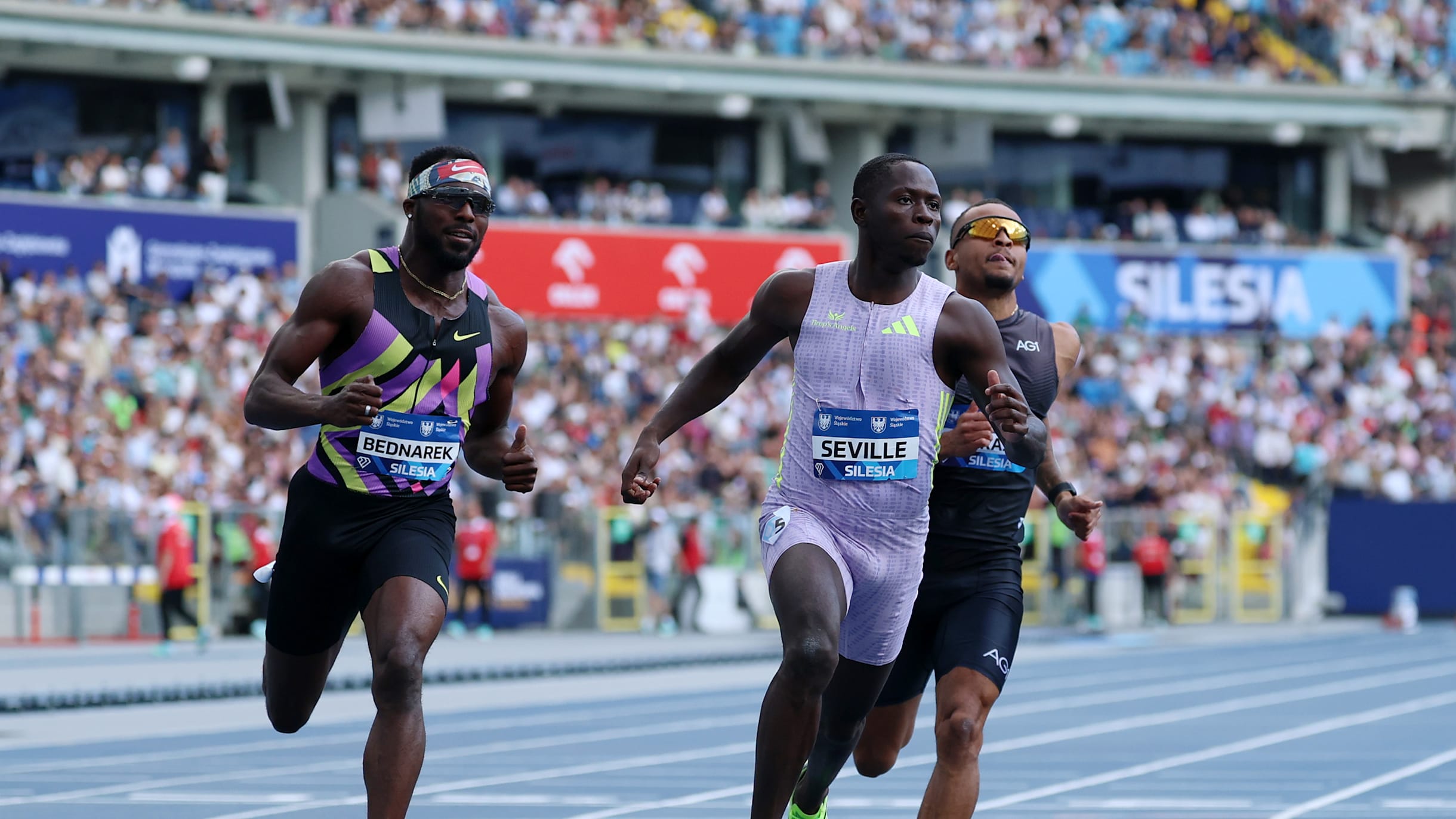
Foto por: 2026 Getty Images
When there were just meters left to the finish line in Brussels, there was no longer any doubt. Oblique Seville, the Jamaican who dominated 2025 from the opening race of the season, crossed the finish in 9.90 seconds to claim the 100-meter title at the Diamond League Final of the Memorial Van Damme. Behind him were Emmanuel Eseme (9.93) and Kayinsola Ajayi (9.97), in a race that confirmed what the circuit already knew: today there is no more complete or more consistent sprinter than him. And if you're passionate about track and field—whether you run 100 meters or 10 kilometers—understanding why this type of athlete wins teaches you something valuable about human performance in its purest form.
The Context
The Diamond League is the most prestigious track and field league in the world, a series of meets that travels to cities like Doha, Rome, London, Monaco, and Zurich throughout the season, and culminates each year with a Final where only the circuit's top point-scorers compete. Winning there is no small thing: it's the validation that an athlete was the most consistent and strongest when it mattered, race after race, not just on a single good day.
For Seville, this title arrives as the capstone to a year in which he had already claimed the world championship title, and now confirms him as the world number one in the 100 meters ranking. Winning a World Championship is a snapshot; winning the Diamond League Final is the complete film of a season. And the competition in Brussels had an exceptionally high level across the board: Diamond League records also fell in the hammer throw and men's 400 meters, a sign that the general level of elite track and field continues to rise.
What's interesting about the 100 meters is that there's no margin for error or room for reserve strategy: everything is decided in less than ten seconds, between the reaction at the start, the acceleration phase, and the ability to maintain technique when the body begins to lose maximum speed. Winning by hundredths, as happened in Brussels, is the difference between a perfect start and an imperfect one, between an efficient stride and one that breaks down in the final meters.
What the Science Says
Although pure sprinting seems like a world apart from the distance running that most of us practice, it shares physiological and technical principles that do directly affect you.
One of them is fatigue and how it's managed under pressure. The review by Azevedo and colleagues (2021) on the development of fatigue in self-regulated exercise explains that elite performance doesn't depend only on an athlete's maximum capacity, but on how much of that capacity they can sustain when the nervous and muscular systems begin to fail. In 100 meters this shows up in the final 20-30 meters of the race; in a marathon, in the final kilometers. The mechanism is the same: the ability to tolerate the drop in performance is what separates the champion from the rest.
Strength also plays a role. The study by Zanini and colleagues (Medicine & Science in Sports & Exercise, 2025) demonstrated that strength training improves the "durability" of running economy and performance at high intensity when the athlete is already fatigued. This is key even for sprinters: the power you see in the final meters of a final doesn't come only from genetics, but from years of specific neuromuscular work.
And behind every result at this level is also a component of precision: individualized nutrition. The work of Sutehall and Pitsiladis (2025) on personalized nutrition in elite athletes reminds us that it's no longer enough to "eat well" in a generic way; the highest-performing teams adjust every variable—from carbohydrate intake to recovery timing—on an individual basis, with data, not assumptions.
What It Means for You
You're not going to run 100 meters in 9.90, but the principles that got Seville there are completely transferable to your training:
- Train your strength, not just your endurance. If you run 5K, 10K, or marathon, strength work improves your ability to maintain technique when fatigue appears, just as the evidence shows in well-trained runners.
- Consistency wins seasons. Just as Seville didn't win because of one isolated race but by dominating the entire season, your progress depends on the regularity of your training, not on a single heroic effort.
- Personalize, don't copy. What works nutritionally for an elite sprinter isn't what works for you. Adjust hydration, carbohydrates, and recovery to your body and your actual training load.
The next time you see a 100-meter final decided by hundredths, remember: behind those nine seconds are years of science applied with surgical precision. The same science you can start applying, at your scale, starting tomorrow.
References
- "Fatigue development and perceived response during self-paced endurance exercise: state-of-the-art review." — Azevedo RA, Silva-Cavalcante MD, Lima-Silva AE, Eur J Appl Physiol 2021. https://pubmed.ncbi.nlm.nih.gov/33389141/
- "Strength Training Improves Running Economy Durability and Fatigued High-Intensity Performance in Well-Trained Male Runners: A Randomized Control Trial." — Zanini M, Folland JP, Wu H, Med Sci Sports Exerc 2025. https://pubmed.ncbi.nlm.nih.
Original source
Olympics.com ↗Never miss an edition.
Get the running news brief and analysis straight to your inbox. No spam, unsubscribe anytime.