Coros Adds Complete Maps and New Cycling Metrics to Its Watches
September 21, 2026
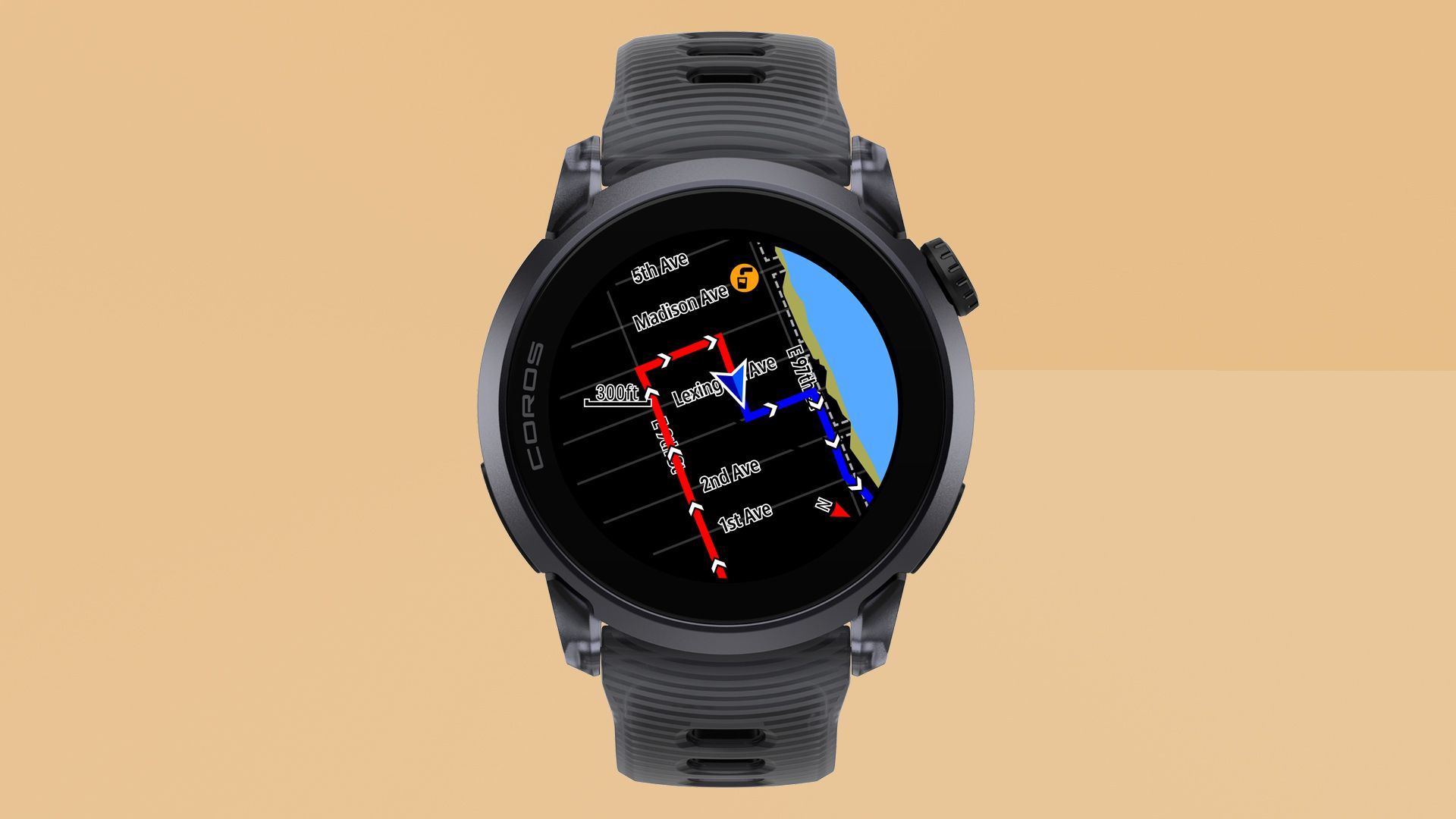
Foto vía T3
If you train with a Coros, your watch just got smarter. The brand launched a firmware update that brings complete maps in beta mode to the Pace 4, voice control, much more detailed battery statistics, and a new combo of cycling metrics focused on torque and total work. It's not a cosmetic update: it's a clear signal of where the sports watch wars are headed, and why you—runner or cyclist—should pay attention.
The Context
For years, Garmin dominated the advanced navigation landscape without rivals: detailed topographic maps, suggested routes, deviation alerts. Coros, on the other hand, built its reputation elsewhere: battery that lasts weeks, simple interface, reliable heart rate and GPS accuracy, and a more accessible price. The trade-off was clear: if you wanted pro-level maps, you went with Garmin; if you prioritized battery life and simplicity, you chose Coros.
This update seeks to erase that boundary. Complete maps (though still in beta, meaning in testing phase with possible adjustments) give the Pace 4 a tool that was once exclusive to the competition's high-end lineup. Voice control aims for more hands-free use, useful during long races or on the bike when you don't want to let go of the handlebars to touch the screen. And cycling metrics—torque and total work—are a direct nod to those using power meters and wanting to understand not just how much power they generate, but how they apply it pedal stroke by pedal stroke.
This matters because the wearables market no longer competes on sensor accuracy alone: it competes on ecosystem. Watches are becoming real-time decision centers, and that changes how we train, not just what we measure.
What the Science Says
Here it's worth separating technological hype from what actually improves your performance. The review by Guppy, Muniz-Pardos, and Angeloudis (2023, Sports Med) on technological innovation in elite sport is clear on one point: technology provides value when it generates actionable data, not when it simply accumulates numbers on a screen. A prettier map won't make you faster; what helps is making better pacing, hydration, or effort decisions thanks to the right information at the right moment.
That's where metrics like torque in cycling come in. Knowing how you distribute force with each pedal stroke can help you detect inefficiencies, something relevant when we consider effort variability during a long event. Evidence on pacing in endurance—like the work of Cuk, Markovic, and Weiss (2024, Medicina) on marathon variability—shows that those who better distribute their effort tend to perform more consistently. The same logic applies to cycling: a more efficient pedal stroke, sustained over time, translates to less accumulated fatigue, something also addressed in the review by Azevedo et al. (2021, Eur J Appl Physiol) on fatigue development in self-paced exercise.
Regarding wearables as a tool for health and performance overall, the study by Biswas, Ahmadi, and Bauman (2025, Nat Commun) reinforced something we already suspected: intensity and consistency of daily movement—well-measured—is associated with better cardiometabolic outcomes. Translation: the more reliable data you have on your actual effort, the better you can adjust your training to your needs.
⚖️ PMP Verdict
This update serves well anyone who already has a Coros and does trail, ultras, or long bike routes where navigation is critical. It's also a real jump for cyclists with power meters who want to deepen their pedaling technique, not just average watts.
Who won't see their life change? The street runner who trains on known routes and uses the watch for pace, HR, and basic GPS. There, the beta maps are a nice extra, not a necessity. And heads up: since it's beta, expect bugs. It's not the time to blindly trust navigation for an important race yet.
For Your Training
If you have a Pace 4 or compatible model, test the maps on low-risk workouts before taking them to a key race. If you do cycling with a power meter, start looking at torque not as an isolated number, but in relation to your cadence: aim for consistency, not spikes. And if voice control turns out to be useful for you, use it on long outings to check metrics without taking your attention off the road, something especially valuable on trail or road cycling with traffic.
References
- "Technology Innovation and Guardrails in Elite Sport: The Future is Now." — Guppy F, Muniz-Pardos B, Angeloudis K, Sports Med 2023. https://pubmed.ncbi.nlm.nih.gov/37787844/
- "Running Variability in Marathon-Evaluation of the Pacing Variables." — Cuk I, Markovic S, Weiss K, Medicina (Kaunas) 2024. https://pubmed.ncbi.nlm.nih.gov/38399506/
- "Fatigue development and perceived response during self-paced endurance exercise: state-of-the-art review." — Azevedo RA, Silva-Cavalcante MD, Lima-Silva AE, Eur J Appl Physiol 2021. https://pubmed.ncbi.nlm.nih.gov/33389141/
Original source
T3 ↗Never miss an edition.
Get the running news brief and analysis straight to your inbox. No spam, unsubscribe anytime.