Oblique Seville dominates the 100m at Diamond League Silesia with meet record
August 24, 2026
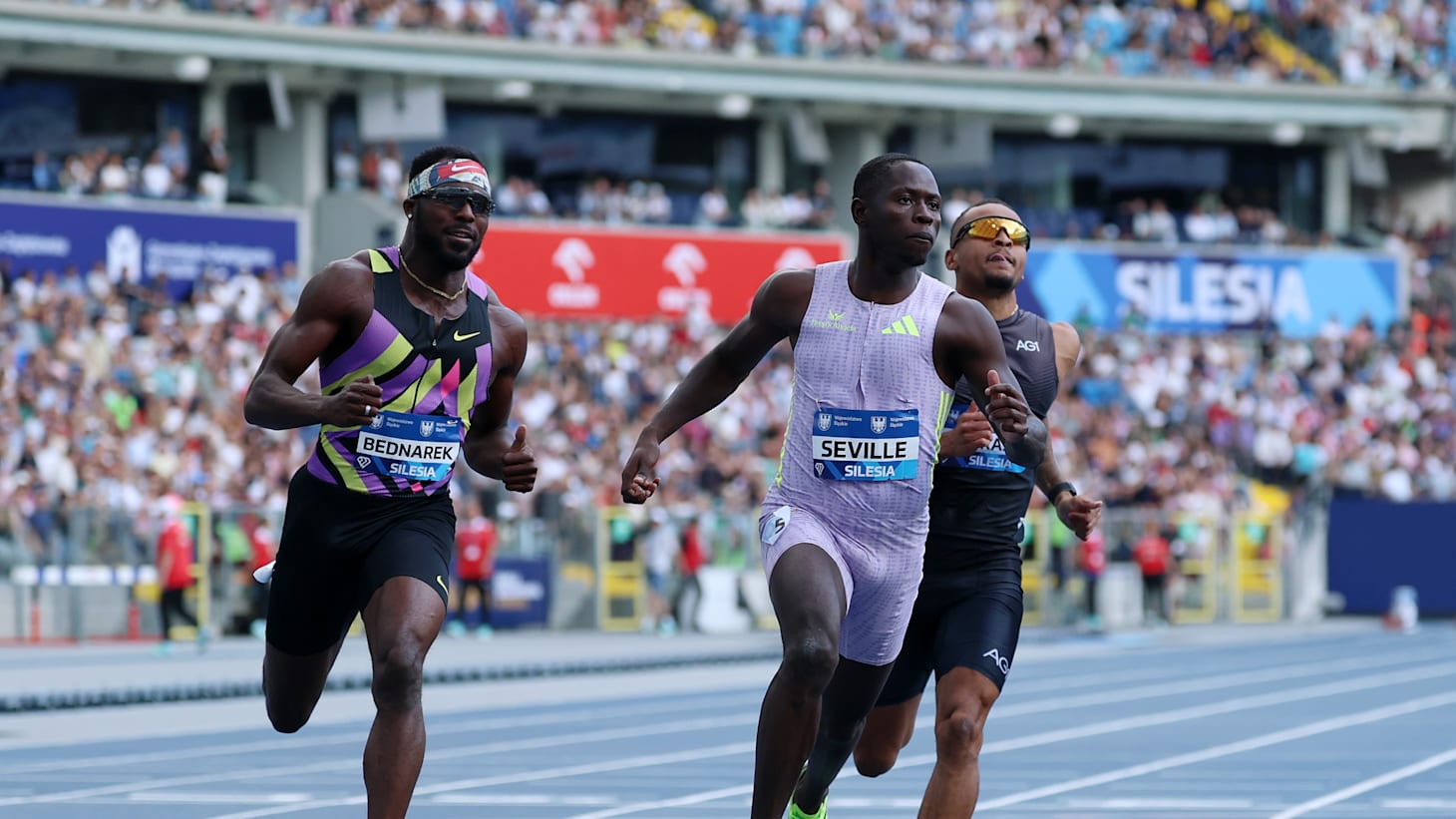
Picture by Maja Hitij/Getty Images
There are races you win and races you dominate. What Oblique Seville did at the Kamila Skolimowska Memorial in Chorzów was the latter. The Jamaican sprinter crossed the finish line in 9.83 seconds, leaving behind Kenny Bednarek and a Christian Coleman who arrived hungry for the spotlight. It was more than just a victory: it was a meet record, in a Diamond League day that had already been loaded with surprises in Poland. If you love track and field—or simply understand that speed is sport's most honest thermometer—this is a race worth keeping in your memory.
The context
The Diamond League is, in a nutshell, the league of the stars of world athletics. A circuit of meets (meetings) held in different cities around the world throughout the season, where the best specialists in each event—sprinting, middle distance, long distance, jumps, throws—compete while accumulating points toward a final that crowns the season's champions. It's not just prestige: it's also where we see the level that later shows up at World Championships and Olympic Games.
Silesia, in Chorzów, is one of the classic dates on the calendar, known for its fast track and for producing marks that tend to surprise even the athletes themselves. That Seville dipped below 9.85 at a mid-season meet—and not at a continental final—is a clear signal: the Jamaican is hitting his peak form just as the calendar starts to tighten. Beating Bednarek (one of the most consistent sprinters of recent years) and Coleman (world champion and one of the fastest men in history under pressure) is no minor detail. It's a snapshot of where world sprinting stands today.
What science says
Running 9.83 is not just explosiveness: it's the result of an entire system working in sync, something sports science has been trying to optimize for years. One key area, even for short events, is heat management and acclimatization: it's known that controlled exposure to warm environments improves physical performance by optimizing cardiovascular response and thermoregulation (Lorenzo et al., 2010), something elite sprinting teams work meticulously on before meets in variable climates like the European summer.
Precision nutrition also comes into play. Today, technical teams for elite athletes leave nothing to chance: hydration and electrolyte balance are adjusted individually based on each runner's losses (Shirreffs & Sawka, 2011), and personalized nutrition is increasingly discussed as a real competitive advantage, not a fad (Sutehall & Pitsiladis, 2025). In 100-meter races, where the difference between gold and fourth place is measured in hundredths, these details—which seem minor—end up defining who crosses the finish line with the nervous system firing at maximum and who arrives a gram short on freshness.
Beyond that, technology is now an indispensable part of the process: sensors, biomechanical analysis, and load monitoring allow technical teams to adjust training almost in real time (Guppy et al., 2023), which explains why elite times continue to drop year after year despite the human body having known physiological limits.
What it means for you
You don't need to run 100 meters in 9.83 to learn something from this race. The real lesson is about consistency and attention to detail:
- Prioritize the basics before the sophisticated. Hydration and electrolytes aren't just for elite: if you train hard in heat, your performance and recovery depend directly on this.
- Physical form has windows. Seville didn't run his best mark at the year's most important meet, but at the moment his body was ready. Learn to read your own form signals instead of forcing peaks on arbitrary dates.
- Technology is an ally, not a luxury. You don't need an Olympic sprinter's lab, but a good watch or heart rate monitor can give you real information about your load and recovery.
- Details win races. Whether in 100 meters or a 10K, the difference between a good day and a historic day is almost never a single factor: it's the sum of small decisions made well.
References
- Lorenzo S, Halliwill JR, Sawka MN. "Heat acclimation improves exercise performance." J Appl Physiol, 2010. https://pubmed.ncbi.nlm.nih.gov/20724560/
- Shirreffs SM, Sawka MN. "Fluid and electrolyte needs for training, competition, and recovery." J Sports Sci, 2011. https://pubmed.ncbi.nlm.nih.gov/22150427/
- Sutehall S, Pitsiladis Y. "Personalized Nutrition for the Enhancement of Elite Athletic Performance." Scand J Med Sci Sports, 2025. https://pubmed.ncbi.nlm.nih.gov/40164953/
- Guppy F, Muniz-Pardos B, Angeloudis K. "Technology Innovation and Guardrails in Elite Sport: The Future is Now." Sports Med, 2023. https://pubmed.ncbi.nlm.nih.gov/37787844/
Original source
Olympics.com ↗Never miss an edition.
Get the running news brief and analysis straight to your inbox. No spam, unsubscribe anytime.