From a Spinal Cord Injury to Finishing the Chicago Marathon in Under 4 Hours
October 15, 2026
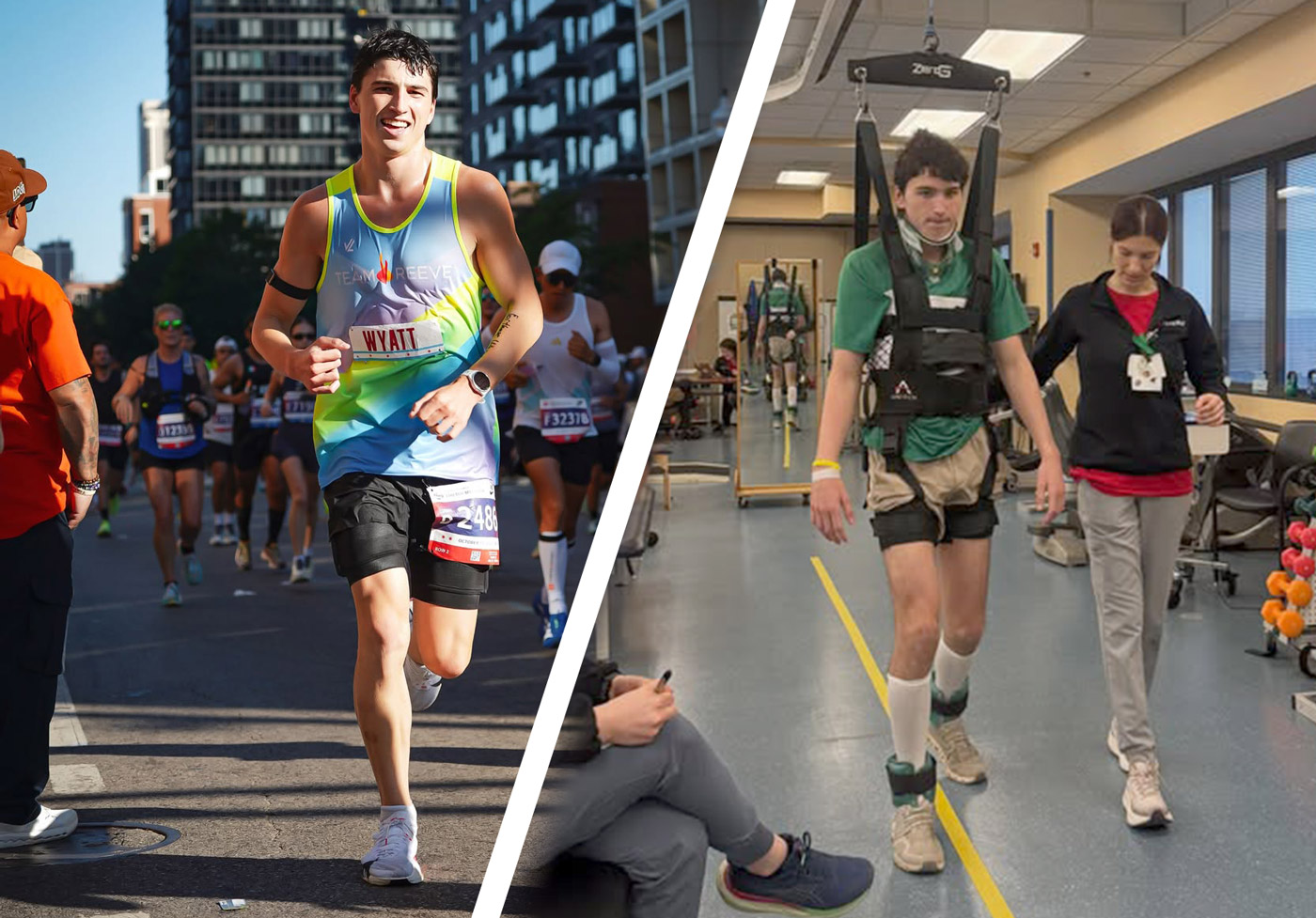
Foto www.labolsadelcorredor.com
November 2025. Wyatt Anderson, a 17-year-old from Kentucky, couldn't move his arms or legs. A severe spinal cord injury left him bedridden, with an uncertain prognosis and months of rehabilitation ahead. Eleven months later—in October 2026—he crossed the finish line of the Chicago Marathon in 3:56:28. This isn't a metaphor or an exaggerated headline: these are 42.195 km actually run by someone who was told he might never walk again. This story matters because it shatters the idea that running is only for "perfect" bodies and reminds us, with hard evidence, just how far human adaptability can reach.
The Context
A spinal cord injury (SCI) occurs when there is damage to the spinal cord, the superhighway of signals between the brain and the rest of the body. Depending on the level and severity of the damage, it can cause partial or total paralysis, loss of sensation, and months—or years—of intensive rehabilitation. Not all injuries are the same: there are complete and incomplete injuries, and the degree of recovery varies greatly from person to person. That Anderson went from being unable to move his limbs to running a certified marathon in under four hours is an exceptional case, likely involving an incomplete injury with a favorable recovery window, combined with aggressive rehabilitation and, let's be honest, a brutal amount of mental and physical work.
The Chicago Marathon is one of the six World Marathon Majors, races with the prestige, logistics, and competitive level of the highest tier of the global circuit. Finishing it in 3:56:28—a pace close to 5:36 min/km sustained for almost four hours—is no easy feat for anyone, much less for someone rebuilding their neuromuscular system from scratch. It is, literally, relearning to walk and then teaching your body to run 42 km.
What the Science Says
Fatigue in a marathon isn't just "muscle tiredness": it's a complex phenomenon where the brain regulates effort in real time according to physiological signals, metabolic factors, and perceived exertion (Azevedo et al., 2021). In a person with neurological sequelae, that regulation becomes even more delicate, because the nervous system—the same one that suffered the damage—is the one that has to coordinate every stride.
Pacing, that is, how you distribute effort throughout the race, is decisive in any marathon (Cuk et al., 2024; Nikolaidis et al., 2019). For a runner in recovery, running evenly isn't just competitive strategy: it's protection. An irregular rhythm, with strong surges and abrupt drops, places extra stress on structures that are already at the limit of their adaptive capacity.
Strength also comes into play. We know that strength training improves running economy and resistance to fatigue in trained runners (Zanini et al., 2025). In post-spinal cord injury rehabilitation, strength isn't an "extra" to run faster: it's the very foundation that allows legs to respond to the brain's commands consistently, kilometer after kilometer.
And we can't forget nutrition and hydration. Sustaining performance during nearly four hours of effort requires well-planned carbohydrate strategies (Cao et al., 2025) and careful management of fluids and electrolytes (Shirreffs & Sawka, 2011), something even more critical in a body that is still recalibrating its thermal regulation and stress response.
What It Means for You
Anderson's story isn't an excuse to minimize your own effort ("if he could, you have no excuses"). It's the opposite: it's a lesson in intelligent progression. Nobody goes from not being able to move to running a marathon in 11 months without a brutal structure of accumulated small steps.
Three things you can take from this story for your own training:
- Build a base before chasing speed. Strength and neuromuscular stability are the foundation; without that, there's no pace that will hold up for 42 km.
- Respect pacing. If someone rebuilding their nervous system can maintain a steady pace, you can train it too. Practice running even splits on your long runs.
- Recovery is training. Rest, sleep, and nutrition aren't the "after" part of hard work: they're an active part of adaptation, whether you're coming back from a serious injury or just had a tough week of intervals.
Sometimes the most powerful motivation doesn't come from a world record, but from someone who decided that their starting point wasn't going to be their final destination.
References
- Azevedo RA, Silva-Cavalcante MD, Lima-Silva AE. "Fatigue development and perceived response during self-paced endurance exercise: state-of-the-art review." Eur J Appl Physiol, 2021. https://pubmed.ncbi.nlm.nih.gov/33389141/
- Cuk I, Markovic S, Weiss K, et al. "Running Variability in Marathon-Evaluation of the Pacing Variables." Medicina (Kaunas), 2024. https://pubmed.ncbi.nlm.nih.gov/38399506/
- Nikolaidis PT, Ćuk I, Knechtle B. "Pacing of Women and Men in Half-Marathon and Marathon Races." Medicina (Kaunas), 2019. https://pubmed.ncbi.nlm.nih.gov/30646638/
- Zanini M, Folland JP, Wu H, et al. "Strength Training Improves Running Economy Durability
Original source
La Bolsa del Corredor ↗Never miss an edition.
Get the running news brief and analysis straight to your inbox. No spam, unsubscribe anytime.