Ironman Imposes New Restrictions on Rigid-Plated Running Shoes for 2026
August 28, 2026
Pic triatlonnoticias.com/
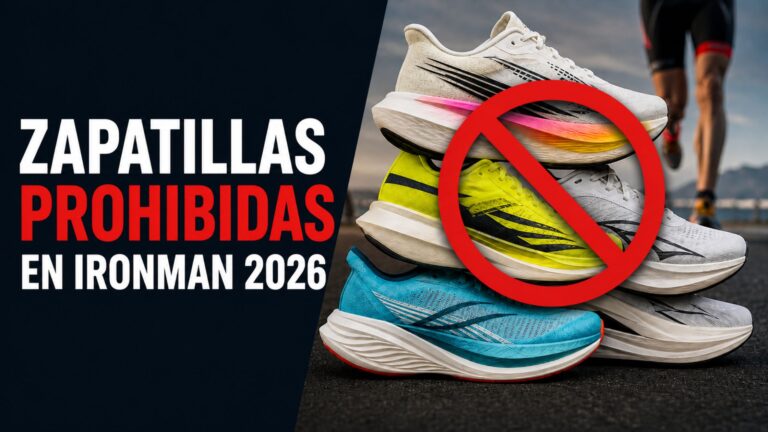
If you compete in triathlon—or dream of doing so—this news directly affects you. Ironman announced that starting in 2026, no shoe will be allowed to exceed 40 mm in sole height or carry more than one embedded rigid plate. The measure applies to everyone: from professionals fighting for the podium in Kona to the age grouper running their first 70.3. After years of a technological arms race between brands, the federation decided to draw a line. And that line is going to change how high-performance triathlon running is raced—and sold.
The Context
All of this stems from a trend that kicked off in 2016, when Nike launched the Vaporfly with high-resilience foam and a carbon plate. The result was a measurable improvement in running economy—the energy expenditure needed to sustain a given pace—that led to historic times and a growing suspicion: are we competing between athletes or between material engineering labs?
World Athletics had already regulated track and road running in pure athletics, limiting sole height to 40 mm for most events and to a single plate. But triathlon operated in looser territory, partly because Ironman is not a traditional Olympic federation, but a commercial organization that manages its own rulebook. Shoe sophistication kept advancing unchecked: shoes with double or triple plates, soles of 45-50 mm, curved geometries that act almost like mechanical springs.
Ironman's decision seeks to align its regulation with World Athletics' and, above all, to halt a dangerous dynamic: that winning depends increasingly on who has access to the latest prototype and less on who trains better. It's a discussion about sporting equity, but also about identity: what are we measuring when we time an Ironman?
What the Science Says
The review by Guppy, Muniz-Pardos and Angeloudis (2023, Sports Medicine) on technological innovation in elite sport is key here. The authors argue that sports technology needs "guardrails"—regulatory barriers—because without them, performance stops reflecting the athlete's physiological capacity and starts reflecting investment in materials. That's exactly the dilemma Ironman is facing now, years behind pure athletics.
This doesn't mean plated shoes don't work: the evidence for improved running economy with these technologies is solid and well-documented for nearly a decade. The regulatory problem isn't whether they work, but how much they should be allowed to work before footwear stops being a tool and becomes the decisive factor.
It's also worth connecting this to another angle: performance durability under fatigue. The study by Zanini et al. (2025, Medicine & Science in Sports & Exercise) showed that strength training improves "durable" running economy—that is, the economy that holds up even after a lot of fatigued running, like in an Ironman marathon. This matters in triathlon because in long-distance triathlon, shoes help at the start, but what really sustains your pace at kilometer 30 of the marathon is trained physiology, not foam.
⚖️ PMP Verdict
This rule serves the sport overall: it levels the playing field and refocuses attention on training. It especially serves age groupers who don't have the budget to renovate their shoe arsenal every six months chasing the latest release. It doesn't benefit brands that had bet heavily on extreme innovation as a commercial differentiator, and it will likely trigger quick adjustments in their product lines heading into 2026.
My honest advice: don't panic or rush to buy the "banned" shoe before it's banned. If your current pair meets the limits (the vast majority of carbon-plated models on the market are in the 35-39 mm range), you don't need to change anything.
What It Means for You
Check the tech specs of your race shoes: look at the stack height and whether they have one or multiple plates. If you're going to race an Ironman in 2026, verify that your footwear is within regulations before investing in a new pair. And above all, don't lose sight of what really builds performance over long distances: durable running economy is trained through strength and well-planned volume, not purchased in a shoe box.
References
- "Technology Innovation and Guardrails in Elite Sport: The Future is Now." — Guppy F, Muniz-Pardos B, Angeloudis K, Sports Medicine 2023. https://pubmed.ncbi.nlm.nih.gov/37787844/
- "Strength Training Improves Running Economy Durability and Fatigued High-Intensity Performance in Well-Trained Male Runners: A Randomized Control Trial." — Zanini M, Folland JP, Wu H, Medicine & Science in Sports & Exercise 2025. https://pubmed.ncbi.nlm.nih.gov/40016936/
Original source
Triatlón Noticias ↗Never miss an edition.
Get the running news brief and analysis straight to your inbox. No spam, unsubscribe anytime.