Gianmarco Tamberi Returns to Victory in High Jump and Reunites with Mutaz Barshim in Silesia
August 24, 2026
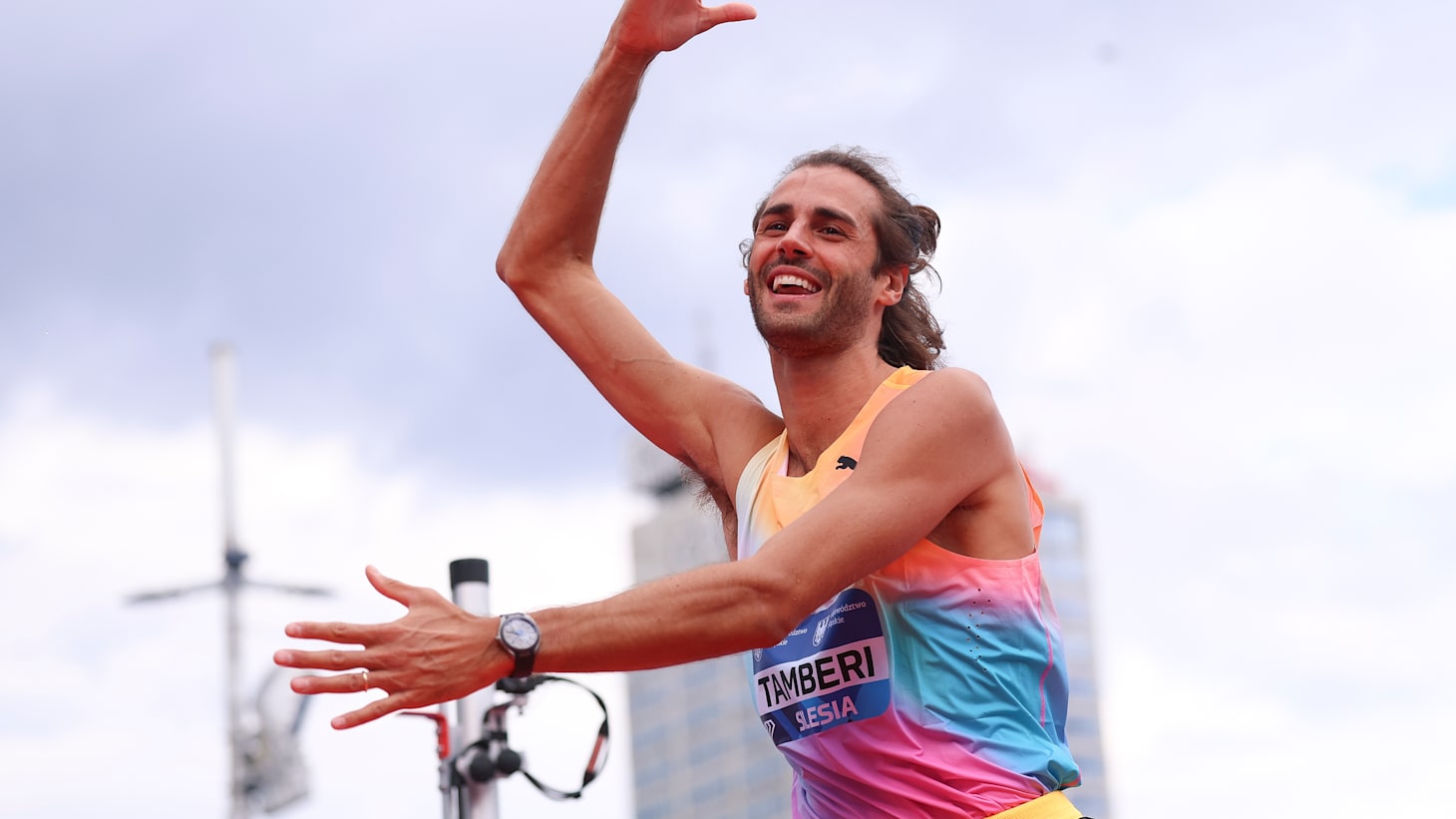
Picture by Maja Hitij/Getty Images
There are victories that matter for the centimeters, and there are victories that matter for the moment they arrive. Gianmarco Tamberi's win at the street event in Katowice is one of the latter. The Italian, Olympic champion in Tokyo 2020 (shared, in one of the most iconic images of recent athletics) and world champion, had not won a Diamond League since September 2024. He cleared 2.31 m on a day that had an extra ingredient: on the same track was Mutaz Barshim, the Qatari with whom he shared that unforgettable embrace when they split the Olympic gold. Two friends, two rivals, an urban track in Poland, and a clear signal: Tamberi is back.
The Context
The Diamond League is the most prestigious league in world athletics, a series of meetings that year after year brings together the biggest names in the sport in pursuit of points, prizes and, above all, prestige. Winning a stage is no minor achievement: it means competing against the best level available in each discipline, under pressure, with the clock and scoreboard watching every athlete's eyes.
For Tamberi, this victory carries particular weight. Since his triumph in Tokyo 2020 and his world title, he went through an irregular period marked by injuries and performance dips—something absolutely normal in high jump, a discipline that demands a brutal combination of power, technique, and sustained joint health over time. Not winning at this level for over a year is an alarm bell for any elite athlete; returning to it with 2.31 m is proof that the foundational work continues to bear fruit.
And then there's the Barshim factor. Their relationship is not merely sporting: it represents one of the few genuine examples of camaraderie in elite sports, two competitors who could hate each other over fighting for the same gold and who instead chose to share it. Seeing them come together again on a track, even at a street event (more informal, designed to bring athletics closer to the public), is a snapshot that transcends the technical result.
What the Science Says
High jump is, at its core, an exercise in repeated explosive power, and sustaining that level of performance year after year depends largely on the athlete's strength foundation. The evidence is clear that strength training not only improves movement economy, but also protects performance when the accumulated fatigue of a long season appears (Zanini et al., 2025). Although that study focused on distance runners, the principle applies equally well to a jumper: strength is what allows you to remain explosive when the body has already accumulated miles of competitions and training.
Recovery between seasons and load management also need consideration. Returning to peak form after an irregular year is not a matter of "training more," but of training better: dosing intensity, respecting adaptation timelines, and avoiding overuse injuries that so heavily impact jumping and sprinting athletes—a topic widely documented in the literature on stress fractures and their management in elite sports (Warden, Davis & Fredericson, 2014).
What It Means for You
You don't need to jump 2.31 m to learn something from this story. What Tamberi demonstrates, with almost 18 months without a win at the highest level, is that performance dips are not the end of the road: they're part of the process. If you're coming back from an injury, a poor season, or simply feel you've "lost the spark," the key is not to force your return, but to patiently rebuild the foundation that supports you: strength, technique, and recovery.
Three concrete applications for your training:
- Incorporate regular strength work, even if you run or train for endurance. It improves your movement economy and protects you when fatigue sets in.
- Don't measure your progress by immediate results alone. Great athletes have winning droughts that end in spectacular peaks.
- Manage your training load progressively, especially after an injury or a layoff, to avoid setbacks and build a solid, lasting foundation.
Consistency, more than perfection, is what brings you back to your best self.
References
- Zanini M, Folland JP, Wu H. "Strength Training Improves Running Economy Durability and Fatigued High-Intensity Performance in Well-Trained Male Runners: A Randomized Control Trial." Med Sci Sports Exerc, 2025. https://pubmed.ncbi.nlm.nih.gov/40016936/
- Warden SJ, Davis IS, Fredericson M. "Management and prevention of bone stress injuries in long-distance runners." J Orthop Sports Phys Ther, 2014. https://pubmed.ncbi.nlm.nih.gov/25103133/
Original source
Olympics.com ↗Never miss an edition.
Get the running news brief and analysis straight to your inbox. No spam, unsubscribe anytime.