Ethan Strand Surprises Ingebrigtsen on His Diamond League Return in Silesia
August 24, 2026
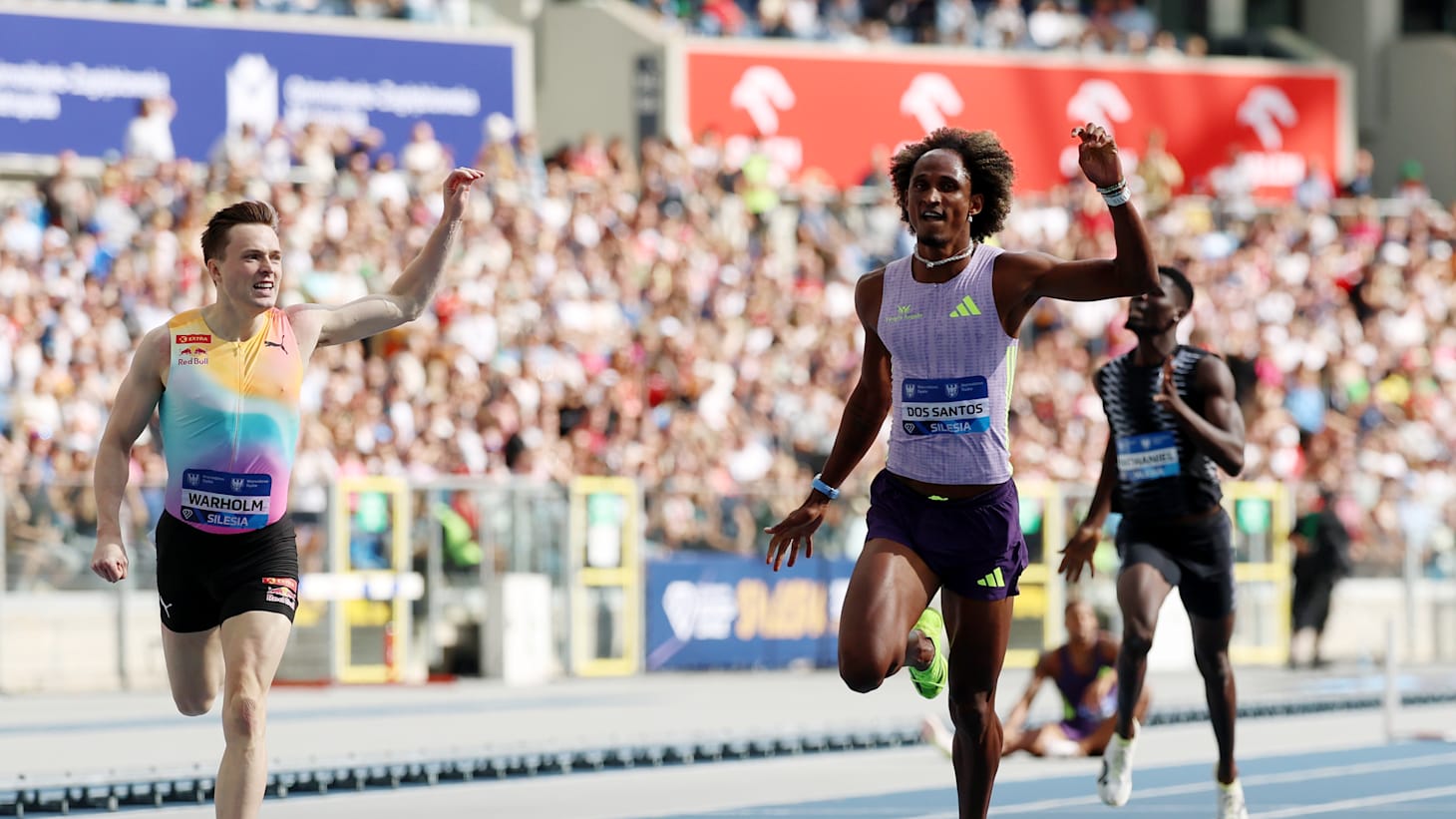
Picture by Maja Hitij/Getty Images
Jakob Ingebrigtsen was back on the Diamond League after months of absence, and the entire track and field world had its eyes on Silesia to see what shape the Norwegian was in. The answer was not what everyone expected: Ethan Strand, an American who until recently was barely a standout on the college circuit, took the victory in the 1500m and sent Ingebrigtsen all the way to fourth place. At the same meet, Alison Dos Santos reminded the world once again who's in charge of the 400m hurdles, winning in 46.43—the year's best time—and leaving Karsten Warholm in her dust once more. Two different stories, one same message: in elite track and field, no one's throne is guaranteed.
The Context
The Diamond League is the most prestigious track and field circuit in the world outside the Olympics and World Championships. There are 14 meets spread across cities like Doha, Eugene, Monaco, and Silesia, where the planet's best athletes accumulate points throughout the season to fight for the year-end "final" and the prized diamond. For distance and middle-distance runners, it's the stage where reputations are built: winning here brings not only prestige and visibility to sponsors, but above all, confidence heading into major championships.
That Ingebrigtsen—a three-time world champion and one of the absolute dominators of the 1500m and 5000m over the past decade—was making his return in Silesia was, in itself, news. Comebacks after a break (whether due to injury, strategic rest, or seasonal adjustments) are always a thermometer: no one returns at 100% in their first race, and rivals know it. Ethan Strand understood this perfectly and gave nothing away. His victory wasn't an isolated stroke of luck: it confirms a generation of young American middle-distance runners who are pushing hard in the world's middle-distance scene.
On the other hand, the Dos Santos–Warholm showdown is already one of track and field's great classics, comparable to a Grand Slam tennis final. Every time they race together, they lower the time. A 46.43 at a "regular" Diamond League meet (not a World Championships or Olympics) is a statement of intent: Dos Santos is in exceptional physical form, and early in the season.
What the Science Says
That an athlete "returns" and isn't at their best level isn't chance or lack of talent—it's physiology. Sports science literature has extensively documented how fatigue and self-regulated performance depend on peripheral and central signals that the body constantly adjusts based on training status, accumulated stress, and athlete freshness (Azevedo et al., 2021). Coming back from a break—even a short one—alters that fine calibration between perceived effort and actual capacity, which explains why even a champion of Ingebrigtsen's caliber can finish off the podium in a race he would normally dominate.
On the other end is Dos Santos, whose sustained elite performance over time isn't explained by raw talent alone. Today, high-performance teams work with increasingly sophisticated approaches to personalized nutrition (Sutehall & Pitsiladis, 2025) and technological monitoring—from load sensors to wearables—that allow training and recovery to be adjusted with individual precision (Guppy et al., 2023). That personalization is, likely, one of the reasons athletes like him manage to stay at the top year after year, competing at their limit against a rival of similar caliber without breaking down.
What It Means for You
You don't need to be a professional to draw lessons from this:
- Your comebacks matter as much as your peak performances. If you're returning from an injury, time off, or a break, don't expect your best version in the first race. Plan a gradual return, not a trial by fire.
- Consistency beats isolated heroism. Dos Santos isn't at the top because of one great race, but because of a sustained process of training, recovery, and fine-tuning, season after season.
- Use data in your favor. You don't need a Diamond League lab, but you can rely on simple tools—heart rate, perceived exertion, or sleep—to understand when you're truly ready to push hard and when your body is still "re-adapting."
- Fatigue isn't weakness, it's information. Listen to it before an injury forces you to.
References
- Azevedo RA, Silva-Cavalcante MD, Lima-Silva AE. "Fatigue development and perceived response during self-paced endurance exercise: state-of-the-art review." Eur J Appl Physiol, 2021. https://pubmed.ncbi.nlm.nih.gov/33389141/
- Sutehall S, Pitsiladis Y. "Personalized Nutrition for the Enhancement of Elite Athletic Performance." Scand J Med Sci Sports, 2025. https://pubmed.ncbi.nlm.nih.gov/40164953/
- Guppy F, Muniz-Pardos B, Angeloudis K. "Technology Innovation and Guardrails in Elite Sport: The Future is Now." Sports Med, 2023. https://pubmed.ncbi.nlm.nih.gov/37787844/
Original source
Olympics.com ↗Never miss an edition.
Get the running news brief and analysis straight to your inbox. No spam, unsubscribe anytime.