Gressier and Ingebrigtsen Will Face Off for the First Time on Road at the Copenhagen World Championships
September 18, 2026
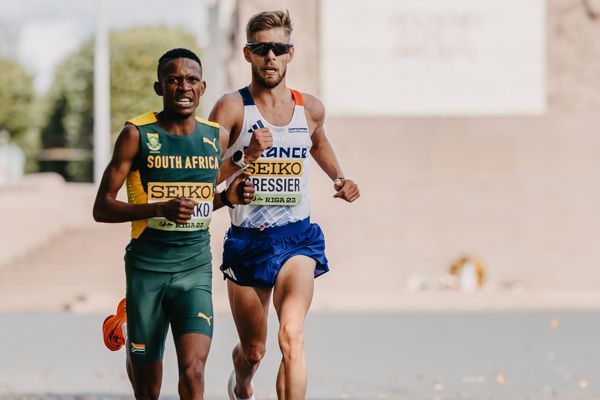
Foto vía World Athletics
There are rivalries that simmer on the track and explode on the asphalt. On Saturday, September 19, in Copenhagen, we will see for the first time face-to-face on the road the Frenchman Jimmy Gressier, world champion in the 10,000 m, and the Norwegian Jakob Ingebrigtsen, Olympic champion in the 5,000 m. It is no ordinary clash: it is the collision between the year's best time in the 5 km (Gressier's 12:51 in Lille) and one of the most dominant talents of the last decade, returning to competition after undergoing surgery for an Achilles injury. If you enjoy elite running, this is a masterclass in preparation.
The Context
The World Athletics Road Running Championships is the biennial event where it's decided who dominates short distances on asphalt: 5 km and mixed 5 km team events, with a mass-start format and a fast, technical urban circuit without the benefit of controlled pacing assistance as on the track. Unlike a 5,000 m in a stadium, here variables come into play such as pavement, tight turns, street-level wind, and real-time tactical decision-making without such clear lap markers.
Gressier arrives as the man in form of the year: his 12:51 in Lille is not only the world's best mark of 2024 at the distance, but a statement that his world title in the 10,000 m was not a stroke of luck, but the consequence of solid aerobic base work. Ingebrigtsen, on the other hand, arrives from another place: reconstruction. Coming back from Achilles surgery—one of the most demanding tendons in high-intensity running—is not simply "regaining strength," but reconstructing the mechanical confidence of the foot to absorb and return energy at elite race speeds. That he chooses to run this 5 km in Copenhagen is, in itself, a trial by fire.
What the Science Says
Ingebrigtsen's return connects directly to what sports science literature calls "return-to-activity criteria" following structural injuries. Although most published protocols focus on bone stress injuries, the underlying principle is the same as it applies to tendons like the Achilles: load progression must be gradual, monitored, and based on objective functional criteria, not merely on time elapsed since surgery (George et al., 2024; Warden et al., 2014). An elite athlete does not return to competition "when it no longer hurts," but when their tendon demonstrates tolerance to the repetitive high-speed loads, something that is only proven by competing.
On Gressier's side, his dominance in 5 km and 10,000 m is explained in part by the "durability" of running economy: the ability to maintain efficient technique even when fatigue appears. A recent study (Zanini et al., 2025, Med Sci Sports Exerc) showed that strength training improves precisely that: running economy degrades less in well-trained runners, even in demanding final stretches of high intensity. It is likely that part of Gressier's current superiority carries that signature: he is not just fast, he is fast when it hurts the most.
It's also worth mentioning the physiological component of fatigue in self-paced races like this one. The review by Azevedo et al. (2021, Eur J Appl Physiol) explains that in self-paced tests—such as a 5 km road race without pace control—perception of effort and real-time tactical decision-making are just as determining as pure aerobic capacity. In other words: this duel will not be decided solely by each one's VO2max, but by who reads the race better and manages their effort under pressure.
What It Means for You
You don't need to be a professional to learn from this matchup. First: if you're coming back from an injury, respect the progression criteria and not the date on the calendar. Ingebrigtsen's patience (or calculated audacity) is a clear message about taking rehabilitation seriously. Second: if your goal is to run stronger in the final kilometer without falling apart, add strength work to your week. The evidence is consistent: it's not just about running more, but running more resilient to technical breakdown. And third, for your own 5 or 10 km races: train tactical reading as well, not just the engine. Practice varying paces, work on breaking out of the pack, and make decisions under real fatigue. That is the true battlefield on Saturday in Copenhagen, and also yours on the day of your next race.
References
- George ERM, Sheerin KR, Reid D. "Criteria and Guidelines for Returning to Running Following a Tibial Bone Stress Injury: A Scoping Review." Sports Med 2024. https://pubmed.ncbi.nlm.nih.gov/39141251/
- Warden SJ, Davis IS, Fredericson M. "Management and prevention of bone stress injuries in long-distance runners." J Orthop Sports Phys Ther 2014. https://pubmed.ncbi.nlm.nih.gov/25103133/
- Zanini M, Folland JP, Wu H. "Strength Training Improves Running Economy Durability and Fatigued High-Intensity Performance in Well-Trained Male Runners: A Randomized Control Trial." Med Sci Sports Exerc 2025. https://pubmed.ncbi.nlm.nih.gov/40016936/
- Azevedo RA, Silva-Caval
Original source
World Athletics ↗Never miss an edition.
Get the running news brief and analysis straight to your inbox. No spam, unsubscribe anytime.