Last-Minute Withdrawals Shake Up UTMB 2026 Before Chamonix Start
August 25, 2026
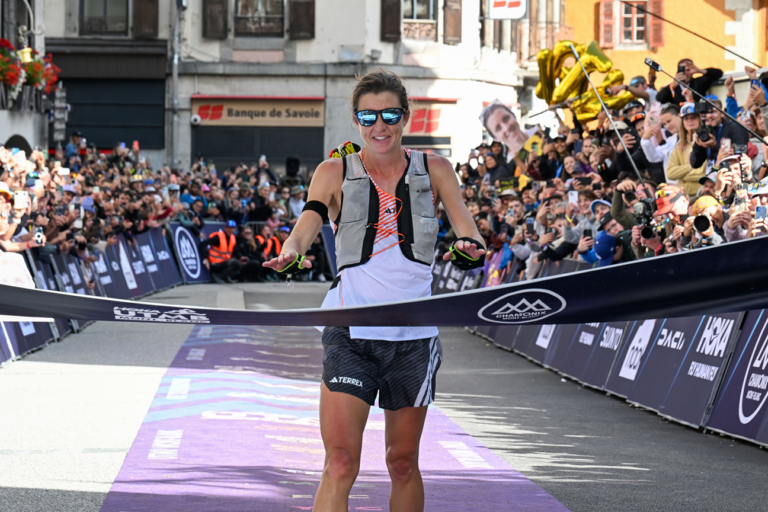
New Zealand’s Ruth Croft earned the win in the UTMB last year, after placing second in 2024 and winning CCC in 2015.
Just days before Chamonix trembles again under the sound of thousands of trekking poles and running shoes, UTMB 2026 has already changed its face before the starting gun fires. Kilian Jornet and Tom Evans, two names that single-handedly dominated any conversation about the men's podium, won't be at the starting line. And as if that weren't enough, Jim Walmsley, Molly Seidel, and Katie Schide—three runners who were also in the favorites conversation—have also withdrawn. If you're someone who follows elite trail running—or simply love understanding how a race of this caliber is built (and sometimes falls apart)—this edition is going to interest you more than usual.
The Context
The UTMB (Ultra-Trail du Mont-Blanc) is, without exaggeration, the most important race on the global trail running calendar. It's roughly 170 kilometers with more than 10,000 meters of positive elevation gain circling Mont Blanc, crossing France, Italy, and Switzerland. It's not just a race: it's the final event of a global qualifying series (the UTMB World Series circuit) that brings together thousands of runners at all levels seeking a spot, and a select elite competing for the sport's most prestigious title.
Having five names of this caliber—Jornet, Evans, Walmsley, Seidel, and Schide—drop out before the start is no minor detail. Each represented a different path to victory: Jornet as the historic mountain dominator, Evans as the defending champion with the best pacing management in recent years, Walmsley as the American powerhouse who revolutionized ultras with marathon-like speeds on technical terrain, and Seidel and Schide as clear leaders in the women's field. With all of them out, the favorites map is completely rewritten, opening the door for runners we've been watching from the sidelines who now have a real opportunity to write their names into the event's history.
Adding to this is a detail worth attention: the organization announced increased anti-doping controls and there is greater local scrutiny over the event's growth—something that reflects a tension growing year after year in elite trail running: how to sustain sporting integrity and balance with mountain communities as a race becomes a global phenomenon.
What the Science Says
Last-minute withdrawals in ultradistance running are rarely coincidence: they're the logical consequence of subjecting the body to extreme training and racing loads over months. Evidence on stress bone injuries in long-distance runners (Warden et al., 2014) shows that the accumulated impact of repetitive stress without adequate recovery is one of the main triggers for forced withdrawals, especially in athletes who string together demanding seasons without real breaks.
There's also a less visible but decisive factor: fatigue management. The review by Azevedo et al. (2021) on fatigue development in self-paced exercise explains how the body starts to "negotiate" effort well before obvious pain appears, and in races lasting more than 20 hours, that process becomes decisive. Elite athletes live with this limit all the time, and sometimes the smartest decision—though it hurts—is not to start racing.
Finally, it's worth mentioning that ultradistance performance also depends on carefully individualized nutrition and supplementation. The work of Sutehall and Pitsiladis (2025) on personalized nutrition in elite sport reinforces something any UTMB runner knows firsthand: there's no margin for error when the body is pushed for so many consecutive hours.
What It Means for You
You don't need to run a UTMB to learn from this. The lesson is transferable to any recreational runner:
- Listen to early warning signs. If something hurts differently or persists, don't ignore it: most last-minute withdrawals start as minor discomfort weeks before.
- Plan your load, not just your volume. Alternating hard weeks with real recovery weeks is what lets you arrive intact, not just trained.
- Nutrition is trainable. Practice your carbohydrate and electrolyte strategy on long runs, don't leave it for race day.
- Sometimes, not racing is the right move. The world's best athletes make this decision constantly. You can too.
References
- "Management and prevention of bone stress injuries in long-distance runners." — Warden SJ, Davis IS, Fredericson M, J Orthop Sports Phys Ther 2014. https://pubmed.ncbi.nlm.nih.gov/25103133/
- "Fatigue development and perceived response during self-paced endurance exercise: state-of-the-art review." — Azevedo RA, Silva-Cavalcante MD, Lima-Silva AE, Eur J Appl Physiol 2021. https://pubmed.ncbi.nlm.nih.gov/33389141/
- "Personalized Nutrition for the Enhancement of Elite Athletic Performance." — Sutehall S, Pitsiladis Y, Scand J Med Sci Sports 2025. https://pubmed.ncbi.nlm.nih.gov/40164953/
Original source
UltraSignup Trailhead ↗Never miss an edition.
Get the running news brief and analysis straight to your inbox. No spam, unsubscribe anytime.