Preview of the 2026 Amsterdam Marathon: Kipchumba and Desta Seek to Defend Their Titles
October 18, 2026
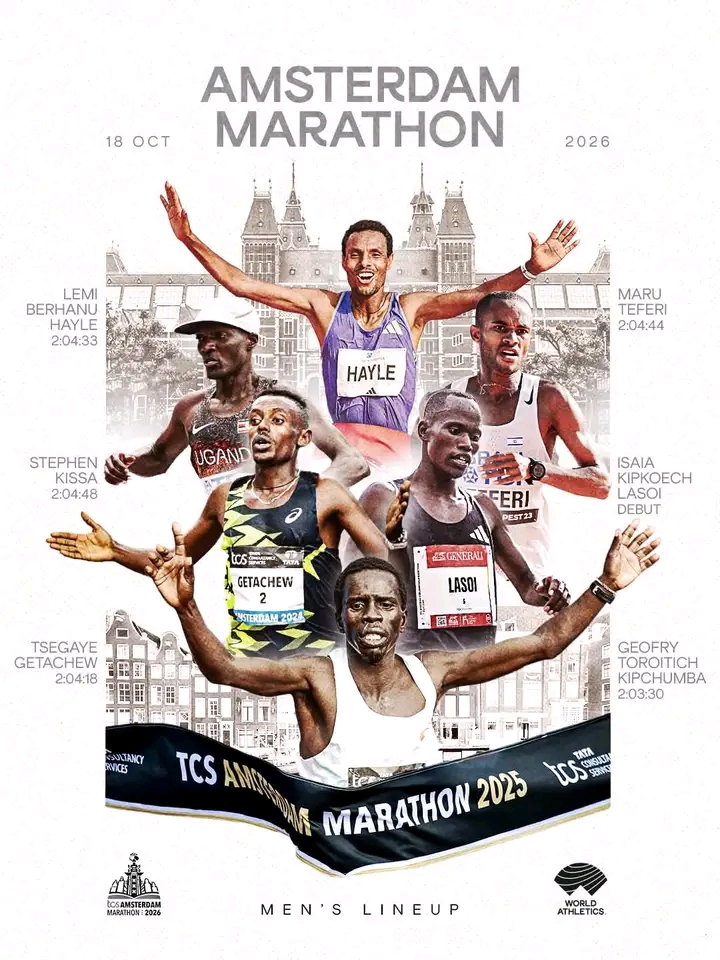
Foto sportsflashworld.com
This Sunday, Amsterdam's Olympic Stadium becomes the epicenter of world distance running once again. The 51st edition of the TCS Amsterdam Marathon arrives with a favorite who makes no bones about his intentions: Kenyan Geofry Kipchumba, holder of the course record with 2:03:30, will seek to defend his crown on a circuit he knows by heart. On the women's side, Ethiopian Aynalem Desta will do the same, defending a title that positions her among the most consistent runners on the European circuit. If you're passionate about running, this is not just another race: it's a window into how the world's elite is built—and how it's defended.
The Context
The Amsterdam Marathon belongs to the Platinum Label category of World Athletics, the highest level of certification for marathons outside the six majors (Boston, London, Berlin, Chicago, New York, and Tokyo). This label is not merely decorative: it demands rigorous standards for organization, anti-doping control, course measurement, medical services, and above all, competitive level. These are the races where records are born and athletic careers are consolidated.
That Kipchumba arrives as the course record holder (2:03:30) makes him the man to beat, but also the one with the most pressure: in the marathon, defending a title is rarely as simple as repeating the formula. Weather conditions, the pace set by the pacemakers, and the athlete's form on the day weigh as much as their track record. On the women's side, Desta represents Ethiopia's historical strength in the distance, a country that has dominated the world podium over the past two decades alongside Kenya.
The Amsterdam course, moreover, has a reputation for being fast and flat, ideal for pursuing personal bests and course records, which explains why it attracts athletes of this caliber with the start and finish at the iconic Olympic Stadium, the venue of the 1928 Games.
What the Science Says
Defending a marathon title doesn't depend on talent alone: it depends on fine management of physiological variables. The evidence on pacing in marathons is clear on this point: elite runners who achieve the best results tend to maintain a more uniform pace distribution, avoiding sharp declines in the second half of the race (Cuk et al., 2024). This is precisely what distinguishes a course record from a failed attempt: not starting faster, but sustaining.
We also know that fatigue in self-paced endurance events, such as the marathon, has both a peripheral component (muscular) and a central one (perceived effort), and that elite athletes are extraordinarily skilled at calibrating their effort in real time according to that perception (Azevedo et al., 2021). That ability to "read" the body kilometer by kilometer is, fundamentally, what separates someone defending a crown from someone falling apart at kilometer 35.
Another relevant factor is race nutrition. Modern carbohydrate supplementation strategies in elite endurance runners show that well-calculated intake—not only in quantity, but in timing and type of carbohydrate—can make the difference between maintaining the target pace or entering an energy crisis (Cao et al., 2025). Furthermore, recent research in personalized nutrition suggests that individualized protocols, tailored to each athlete, increasingly outperform generic approaches (Sutehall & Pitsiladis, 2025).
Finally, it's worth noting that there are physiological and pacing differences between male and female marathon runners: women tend to show more stable pace distribution throughout the race, which is relevant when analyzing the strategy Desta might use against her rivals (Besson et al., 2022; Nikolaidis et al., 2019).
What It Means for You
You don't need to run 2:03 to apply these lessons:
- Train your pacing, don't improvise it. Use your prep races to calibrate feel at different paces. On race day, the discipline to not go out too fast is worth more than initial ambition.
- Plan your nutrition in advance. Practice during long training runs what and when to eat; don't leave it for race day.
- Listen to your body, but train that listening. Perceived effort is a trainable skill, not a fixed gift.
- Look at professionals as reference, not as a template. What's valuable about Kipchumba and Desta isn't the time, but the consistency and management that got them there.
References
- Cuk I, Markovic S, Weiss K. "Running Variability in Marathon-Evaluation of the Pacing Variables." Medicina (Kaunas), 2024. https://pubmed.ncbi.nlm.nih.gov/38399506/
- Azevedo RA, Silva-Cavalcante MD, Lima-Silva AE. "Fatigue development and perceived response during self-paced endurance exercise: state-of-the-art review." Eur J Appl Physiol, 2021. https://pubmed.ncbi.nlm.nih.gov/33389141/
- Cao W, He Y, Fu R. "A Review of Carbohydrate Supplementation Approaches and Strategies for Optimizing Performance in Elite Long-Distance Endurance." Nutrients, 2025. https://pubmed.ncbi.nlm.nih.gov/40077786/
- Sutehall S, Pitsiladis Y. "Personalized Nutrition for the Enhancement of Elite Athletic Perform
Original source
Marathon Handbook ↗Never miss an edition.
Get the running news brief and analysis straight to your inbox. No spam, unsubscribe anytime.