Kenyan Bethwel Kibet Chumba Crowned Champion at the 2026 Buenos Aires Marathon
September 21, 2026
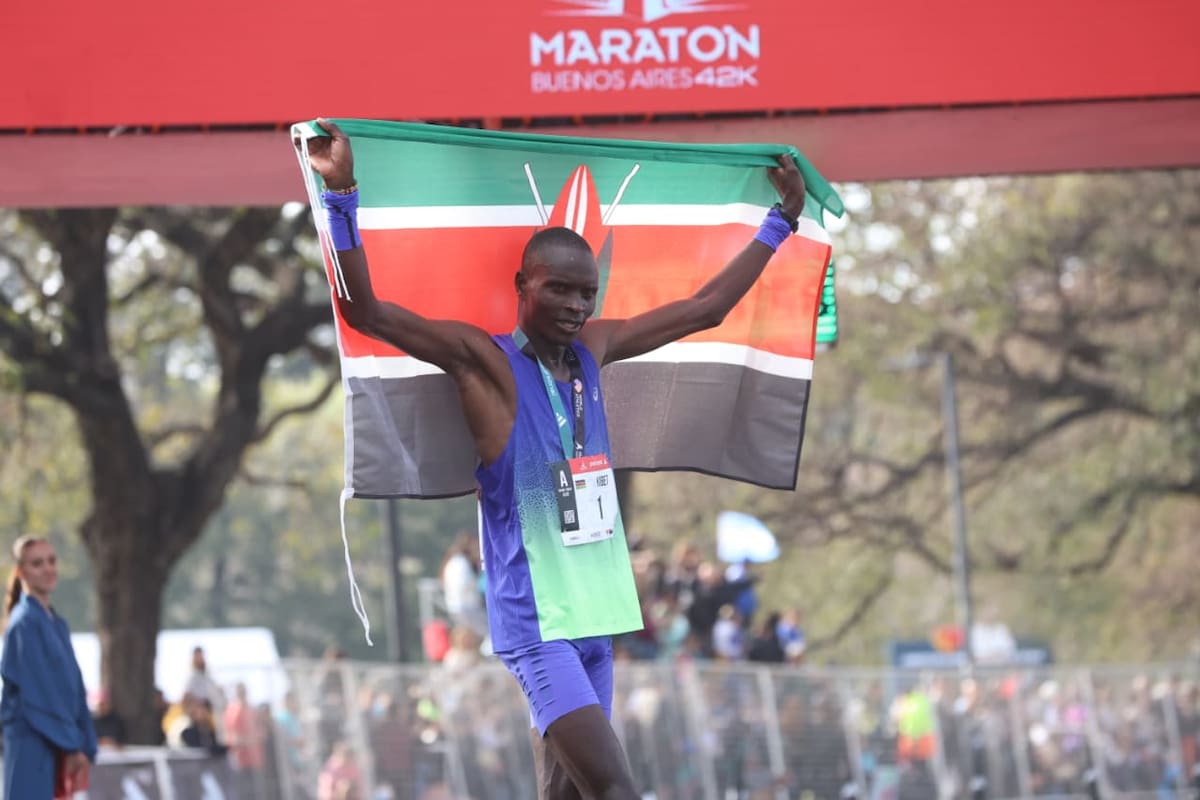
Fabián Marelli - LA NACION
A winter Sunday in Buenos Aires, with the city opening its avenues to more than 16,000 runners, became the perfect setting for a display of pure efficiency. Bethwel Kibet Chumba crossed the finish line at Figueroa Alcorta and Dorrego in 2h08m28s, making clear why Kenyan distance running continues to set the world standard. Behind him, Rwandan John Hakizimana and fellow Kenyan Felix Kiptoo Kirwa rounded out an international podium that confirms Buenos Aires as an increasingly relevant plaza on the Spanish-language marathon calendar. Among Argentines, Ignacio Erario took home the national title—no small detail for local running as it seeks its own role models in such demanding distances.
If you're someone who runs 5K on Sundays or you're about to tackle your first 42K, this race matters to you for one simple reason: it shows you, in real time, what's possible when preparation, race strategy, and human physiology align.
The Context
The Buenos Aires Marathon is, alongside events in Chicago, Berlin or New York, one of the most important appointments in the Southern Hemisphere for street running. The 2026 edition brought together 16,384 runners from 64 countries, a volume that positions it as one of the most popular marathons in Latin America. The course—which traverses Palermo, Recoleta, Puerto Madero and La Boca—combines tourist appeal with a relatively flat layout, ideal for pursuing fast times.
It's not a World Marathon Majors race, but it functions as a key platform for Kenyan and Ethiopian runners looking to add results to their annual calendar, and for Argentine running, which finds in this event its seasonal classic. Chumba's time, while not a world record, is a solid mark considering the conditions of an urban race of this nature: temperature, street traffic, turns and elevation changes always subtract compared to a circuit designed specifically for records, like Berlin.
What the Science Says
Running 42.195 km in just over two hours is not just talent: it's the result of physiological decisions made second by second. The science of pacing—how you distribute your effort throughout the race—is determinant in the final outcome. Studies on variability in marathon pace show that elite runners maintain minimal pace fluctuations compared to recreational runners, who typically suffer sharp drops in the final stretch (Cuk et al., 2024). That ability to sustain pace depends directly on neuromuscular and metabolic fatigue that accumulates kilometer by kilometer, a phenomenon well documented in the literature on self-regulated exercise (Azevedo et al., 2021).
Another invisible but crucial factor is race nutrition. Elite marathoners optimize carbohydrate intake before and during the race to delay glycogen depletion, the primary cause of the dreaded "wall" at kilometer 32 (Cao et al., 2025). Add to this fine-tuned fluid and electrolyte management, especially relevant in races with thermal variations like those of Buenos Aires autumn, where progressive dehydration can erode performance even in highly trained athletes (Shirreffs & Sawka, 2011).
Finally, don't underestimate base work: running economy—how much energy you expend per kilometer—improves significantly with strength training, something that today forms part of any serious marathoner's program, professional or amateur (Zanini et al., 2025).
What It Means for You
You don't need to run at 3:02 min/km like Chumba to apply the same principles. First, work on your pacing during long training runs: practice starting controlled and finishing strong, not the other way around. Second, plan your carbohydrate strategy before your next long race—don't leave it for race day. Third, add two weekly strength sessions (squats, lunges, core) to your routine: the evidence is clear that it improves your fatigue resistance in the final kilometers. And finally, hydrate with a plan, not by thirst: in long races, thirst arrives too late.
The 2026 Buenos Aires Marathon left behind a Kenyan champion, a highlighted Argentine, and a universal lesson: the marathon is won with strategy, not just speed.
References
- "Running Variability in Marathon-Evaluation of the Pacing Variables." Cuk I, Markovic S, Weiss K, Medicina (Kaunas) 2024. https://pubmed.ncbi.nlm.nih.gov/38399506/
- "Fatigue development and perceived response during self-paced endurance exercise: state-of-the-art review." Azevedo RA, Silva-Cavalcante MD, Lima-Silva AE, Eur J Appl Physiol 2021. https://pubmed.ncbi.nlm.nih.gov/33389141/
- "A Review of Carbohydrate Supplementation Approaches and Strategies for Optimizing Performance in Elite Long-Distance Endurance." Cao W, He Y, Fu R, Nutrients 2025. https://pubmed.ncbi.nlm.nih.gov/40077786/
- "Fluid and electrolyte needs for training, competition, and recovery." Shirreffs SM, Sawka MN, J Sports Sci 2011. https://pubmed.ncbi.nlm.nih.gov/22150427/
- "Strength Training Improves Running Economy Durability and Fatigued High-Intensity Performance in Well-Trained Male
Original source
Maratón de Buenos Aires (sitio oficial) ↗Never miss an edition.
Get the running news brief and analysis straight to your inbox. No spam, unsubscribe anytime.