United States breaks championship record in mixed 4x400 relay at U20 Worlds
August 8, 2026
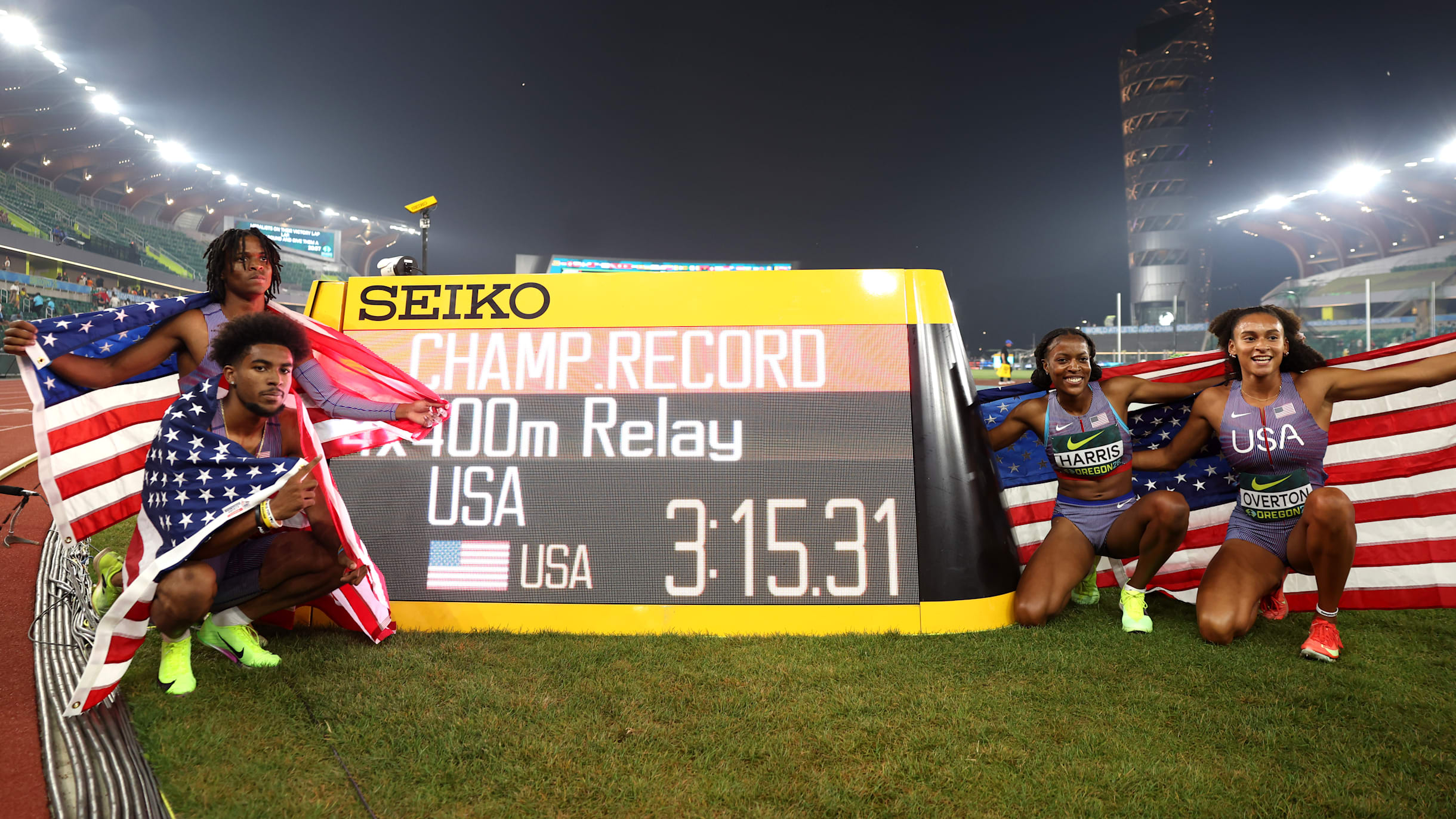
Picture by Steph Chambers/WA/Getty Images for World Athletics 2026
There was a moment, on the final curve at Hayward Field, when 12,000 people stood up at the same time. It wasn't for an Olympic final or an adult world record: it was for four U20 athletes running as if their lives depended on every stride. Joshua Shelton, Taylor-Nicole Overton, Jaelen Hunter and Olivia Harris gave the United States gold and the championship record in the mixed 4x400 meters relay, with a time of 3:15.31, on opening day of the 2026 U20 World Athletics Championships. And if you're wondering why this should matter to you beyond the result, the answer lies in what it reveals about the state of young global talent and the science behind running fast under pressure.
The context
The mixed 4x400 relay is one of the youngest events in international track and field—it debuted in global competitions just a few years ago—and also one of the most unpredictable. The rule is simple: two men and two women per team, and each federation decides the leg order. That opens a fascinating tactical game: do you start with your strongest runner to take an early lead, or save her for the final stretch under pressure? Every country assembles its puzzle differently, and that's a big part of the appeal.
The World Athletics U20 Championships, for its part, is the showcase where the next generation makes its debut: the same venues where names we now know from Diamond League and the Olympics made their debuts years ago. The fact that the United States breaks the championship record in the opening event, at home, in Eugene—the historic mecca of American track and field—is not a minor detail. Hayward Field has witnessed foundational moments in the sport, and seeing a quartet of adolescents and young adults rewrite history there, with the local crowd pushing on every relay, is the type of scene that gets engraved in track and field's collective memory.
A 3:15.31 in the U20 category is a mark that competes closely with senior standards from not many years ago. It speaks to a generation that trains better, competes younger at the international level, and arrives with a tactical maturity that previously took more years to develop.
What the science says
Running a 400 meters—and worse yet, closing it as the fourth leg with the stadium roaring—is an exercise in managing fatigue under extreme pressure. Sports science literature describes this as a process where perception of effort and physiological fatigue signals constantly interact with the race strategy the athlete chooses, consciously or unconsciously (Azevedo et al., 2021). In a relay leg, that management becomes even more complex because you're not running your own race from the silence of the starting line: you inherit the rhythm and energy—or tension—of your teammates.
There's another factor that's rarely mentioned but that in Eugene, with a local crowd and warm conditions in late July in Oregon, could have played a role: the ability to perform in heat. The classic evidence on heat acclimatization shows that progressive heat exposure improves performance in intense efforts, optimizing the body's cardiovascular and thermal regulation (Lorenzo, Halliwill & Sawka, 2010). For a home team, training and competing regularly under those conditions can translate into a real physiological advantage against rivals arriving from cooler climates.
And let's not forget the team dimension: in a mixed relay, sports science is also beginning to look at physiological differences between male and female runners—in running economy, training response and pacing strategies—as key pieces for assembling the optimal relay strategy (Besson, Macchi & Rossi, 2022). Choosing who runs first, who closes, and in what order, is no longer intuition: it's an optimization problem based on individual data.
What it means for you
You may not run a U20 world relay, but the lesson applies equally to your training:
- Train your ability to manage fatigue under pressure, not just your top speed. Simulate in your 400-800m repeats the scenario of "closing tired," because that's how real races are won.
- If you compete in warm climates, give yourself time for heat acclimatization. One to two weeks of progressive heat exposure can improve your performance measurably.
- Run with others when you can. The collective push—even if it's not an official relay—changes your perception of effort and lets you demand more of yourself than you would alone.
The next big race of your life doesn't need a packed stadium. It needs you to train with the same intention that this quartet ran for their country.
References
- "Heat acclimatization improves exercise performance." Lorenzo S, Halliwill JR, Sawka MN, J Appl Physiol, 2010. https://pubmed.ncbi.nlm.nih.gov/20724560/
- "Sex Differences in Endurance Running." Besson T, Macchi R, Rossi J, Sports Med, 2022. https://pubmed.ncbi.nlm.nih.gov/35122632/
- "Fatigue development and perceived response during self-paced endurance exercise: state-of-the-art review." Azevedo RA, Silva-Cavalcante MD, Lima-Silva AE, Eur J Appl Physiol, 2021. https://pubmed.ncbi.nlm.nih.gov/33389141/
Original source
Olympics.com ↗Never miss an edition.
Get the running news brief and analysis straight to your inbox. No spam, unsubscribe anytime.