Asics Repeats as the Fastest Shoe in the UTMB 2026 Victory
October 8, 2026
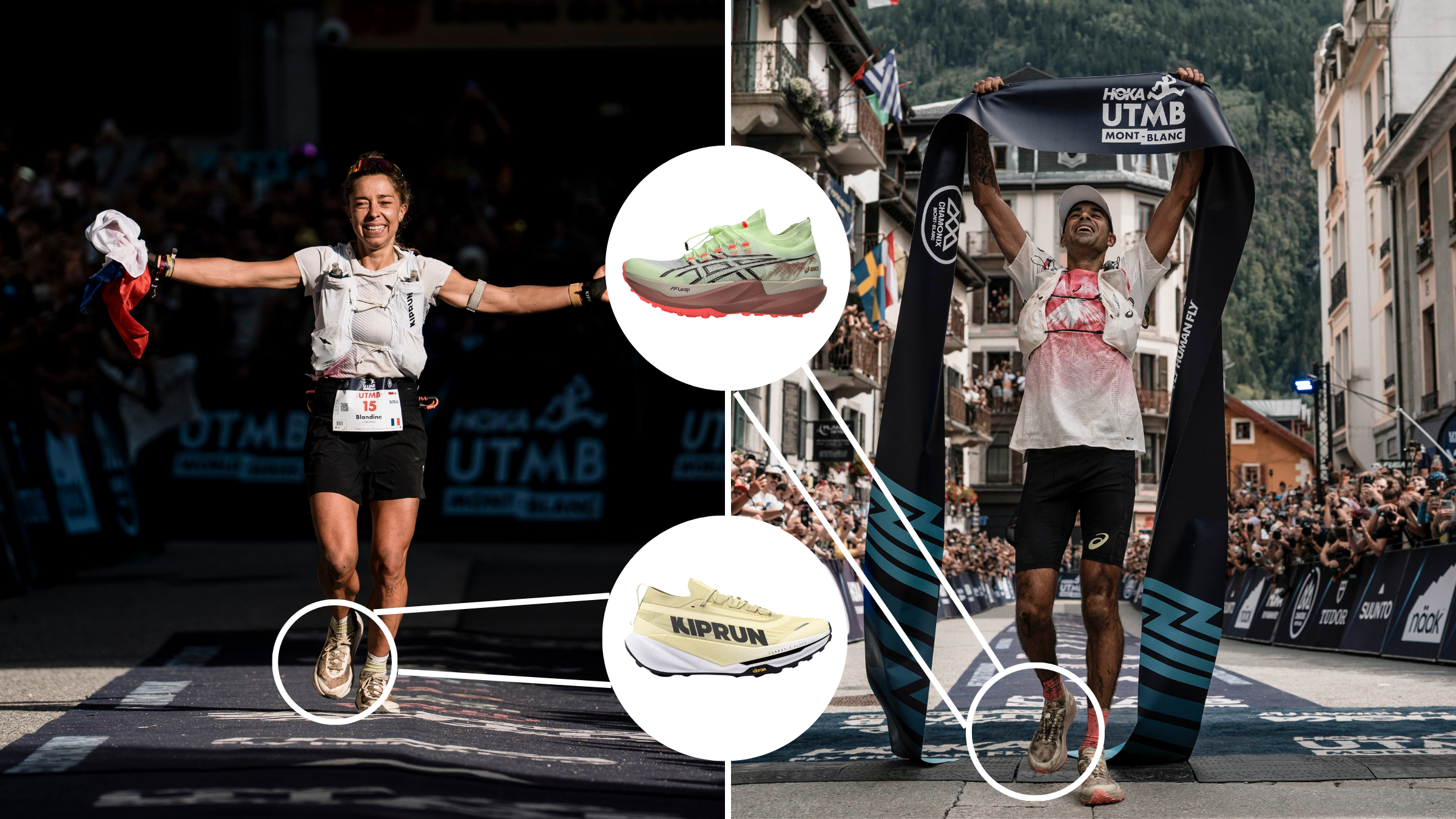
Foto vía Trail Runner Magazine
There are numbers that redefine what we thought was possible. American Ben Dhiman crossed the finish line in Chamonix in under 19 hours, a time no one had ever achieved in the UTMB Mont-Blanc's more than 20-year history. He did it wearing Asics Metafuji Trail 2 shoes. On the women's side, Blandine L'Hirondel did the same by breaking the 22-hour barrier. Two records, one same brand of shoes on the feet of both champions. If you run trail, this isn't just an interesting race tidbit: it's a signal of where the technical equipment you use to tackle the mountains is headed.
The Context
The UTMB Mont-Blanc is, without exaggeration, the Everest of trail running. It's 171 kilometers with roughly 10,000 meters of elevation gain circling Mont Blanc through France, Italy, and Switzerland. It's not a race: it's a test of physical and mental survival that combines brutal climbs, technical descents, unpredictable weather changes, and accumulated fatigue from running for nearly a full day without stopping. Winning it—or simply finishing it—is the ultimate aspiration for thousands of mountain runners around the world.
That the same shoe model wins two years in a row (and now with records to boot) is no coincidence. The trail shoe market has become a laboratory of innovation nearly as intense as the road shoe market: carbon plates or rigid fibers, high-energy-return foams, and geometries designed specifically for irregular terrain. When a brand repeats on the sport's most demanding podium, it sends a clear signal to the rest of the industry—and to runners looking for their next pair of shoes for their own "mountain."
What the Science Says
It's tempting to think that footwear alone explains these results, but reality is more nuanced. Technology in elite sport advances quickly, and a recent review on technological innovation in high-performance sport warns that equipment should be evaluated critically: there are real benefits to biomechanics and running economy, but also physiological limits that no foam can replace (Guppy et al., Sports Med, 2023).
Running nearly 19 hours straight is, above all, an exercise in fatigue management. Evidence on fatigue development in self-paced endurance efforts shows that performance at these distances depends on how the body perceives and regulates effort over hours, not just on the power or cushioning of the shoe (Azevedo et al., Eur J Appl Physiol, 2021). Add to this the pacing strategy: studies on pacing in marathons and ultradistances confirm that those who better distribute their energy—without burning out early—achieve the best final times (Cuk et al., Medicina, 2024).
There's also a key nutritional component. In races this long, carbohydrate intake during effort is crucial to sustaining intensity in the final hours, when glycogen stores collapse (Cao et al., Nutrients, 2025). And it's no coincidence that more and more elite athletes are personalizing their nutrition with individual data, a trend that recent sports science supports as a real competitive advantage (Sutehall & Pitsiladis, Scand J Med Sci Sports, 2025).
As for the difference between categories, it's worth noting that performance gaps between men and women in ultradistance have been narrowing, and sports physiology helps explain why women tend to handle prolonged fatigue better compared to short efforts (Besson et al., Sports Med, 2022). L'Hirondel's record is not an isolated fact, but part of a documented trend.
⚖️ PMP Verdict
The Metafuji Trail 2 are a great shoe, but they're not magic. They work for someone who already has serious volume training in the mountains, is looking for a premium shoe for long technical races, and wants to maximize every variable possible on race day. They don't work for someone just starting out in trail or running short distances: there the cost doesn't translate to real benefit, and a more accessible and durable shoe performs equally or better.
For Your Training
If your goal is an ultra, don't start with the shoe. Start with the foundation: hours on technical terrain, strength to protect your knees on descents (evidence shows that strength training improves running economy even in a fatigued state, Zanini et al., Med Sci Sports Exerc, 2025), and a proven nutrition and hydration strategy tested in your long training runs, never improvised on race day (Shirreffs & Sawka, J Sports Sci, 2011). The shoe is the last 5% of the equation. The other 95% you build yourself, kilometer by kilometer.
References
- Guppy F, Muniz-Pardos B, Angeloudis K. "Technology Innovation and Guardrails in Elite Sport: The Future is Now." Sports Med, 2023. https://pubmed.ncbi.nlm.nih.gov/37787844/
- Azevedo RA, Silva-Cavalcante MD, Lima-Silva AE. "Fatigue development and perceived response during self-paced endurance exercise." Eur J Appl Physiol, 2021. https://pubmed.ncbi.nlm.nih.gov/33389141/
- C
Original source
Trail Runner Magazine ↗Never miss an edition.
Get the running news brief and analysis straight to your inbox. No spam, unsubscribe anytime.