The Adidas Adizero Adios Pro Evo 3 Redefines the Technological Limit of the Marathon
September 1, 2026
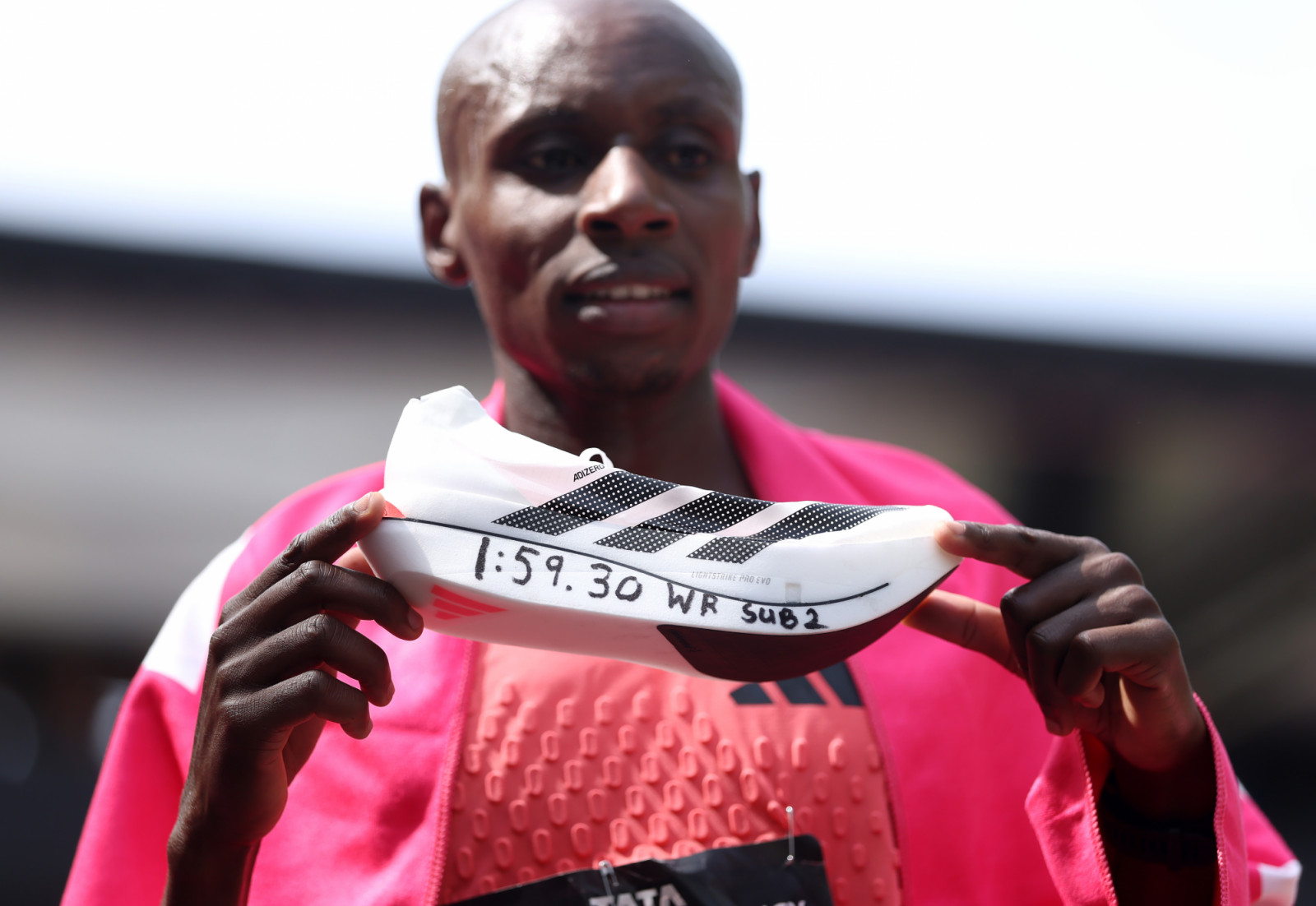
Imagen: Getty Images
There are races won with legs and there are races won with legs, head, and a piece of foam weighing less than 100 grams under your foot. What happened in London with Sabastian Sawe and Yomif Kejelcha, both breaking the psychological barrier of two hours (in actual race conditions, not in an isolated attempt like Breaking2), reopened a conversation that every runner—from elite to someone running their first 10K—should understand: how much of the record is the athlete and how much is the shoe? The answer isn't comfortable, but it's important, because the technology that today runs the London marathon will be on your local store's shelf in a couple of years.
The Context
The Adizero Adios Pro Evo 3 is the latest evolution of Adidas's "Evo" line, a series of shoes designed not to last or for daily use, but for a single objective: to run fast one time (or a few times). They are, in essence, competition prototypes that push every variable to the extreme: lighter foam, thinner carbon plate, more aggressive geometry. What makes this particular model newsworthy is that it managed to bring the carbon plate—the element that provides rigidity and returns energy with each stride—down to less than 100 grams of total shoe weight, something no elite racer had achieved before without sacrificing stability.
To put it in perspective: elite marathon shoes weighed around 200-230 grams a decade ago. Today we're talking about models that hover around 130-140 grams with all the cushioning included. Less weight means lower energy cost per stride, repeated thousands of times over 42.195 kilometers. In a two-hour race, even marginal advantages accumulate brutally.
Berlin, with its flat circuit, cool climate, and history of world records, is already appearing on the radar as the next stage where this technology will seek its ultimate confirmation.
What the Science Says
The carbon plate revolution isn't empty marketing: there's serious research behind the concept of "running economy," which measures how much oxygen an athlete burns to maintain a given speed. The lower the energy expenditure at the same speed, the greater the performance margin.
Recent work published in Medicine & Science in Sports & Exercise (Zanini et al., 2025) showed that strength training improves the "durability" of running economy—that is, how well that efficiency holds up when fatigue appears in the final kilometers. This is key because the benefit of a super-light shoe with a carbon plate isn't just the initial energy savings, but how that savings holds up (or degrades) after kilometer 30, when the body starts to fail.
It's also worth mentioning the work by Guppy, Muniz-Pardos and Angeloudis (2023) in Sports Medicine, which analyzes how technological innovation in elite sport advances faster than regulatory frameworks ("guardrails"). This is exactly the debate that resurfaces every time a brand presents a limit-pushing racer: where does legitimate ergogenic aid end and mechanical doping begin? World Athletics has already set limits on sole thickness and number of plates, and it's very likely that models like this Evo 3 will continue pushing those regulatory boundaries in coming years.
⚖️ PMP Verdict
If you're elite, a high-level amateur looking to break 3 hours, or someone with the budget to invest in a single-use shoe for your target marathon: it makes sense to try it, but keep your feet on the ground (literally). These shoes are designed for a specific race on flat, fast surfaces, not for training or long easy runs. Their durability is low and their lateral stability is limited—they're not for technical terrain or runners with very unstable gait patterns.
If you're just starting out or your goal is to finish your first marathon while enjoying the process: save your money. The marginal benefit of these racers is only noticeable in already well-trained athletes running at demanding paces; for everyone else, a stable and comfortable training shoe delivers more in safety than what it adds in seconds.
What It Means for You
You don't need the Evo 3 to improve. You need a foundation: running economy is built with strength training (squats, plyometrics, lower body work), consistent mileage, and an intelligent pacing strategy. The shoe is the cherry on top, not the cake. If your goal is a marathon in the coming months, invest first in strength and pacing strategy, and save the decision on competition shoes for the final weeks, when you already know what pace you're going to sustain.
References
- Zanini M, Folland JP, Wu H. "Strength Training Improves Running Economy Durability and Fatigued High-Intensity Performance in Well-Trained Male Runners: A Randomized Control Trial." Med Sci Sports Exerc, 2025. https://pubmed.ncbi.nlm.nih.gov/40016936/
- Guppy F, Muniz-Pardos B, Angeloudis K. "Technology Innovation and Guardrails in Elite Sport: The Future is Now." Sports Med, 2023. https://pubmed.ncbi.nlm.nih.gov/37787844/
Original source
Marathon Handbook ↗Never miss an edition.
Get the running news brief and analysis straight to your inbox. No spam, unsubscribe anytime.