Cristhian Pacheco Wins Mexico City Marathon and Peru Returns to the Top After 12 Years
September 14, 2026
Por Katy López
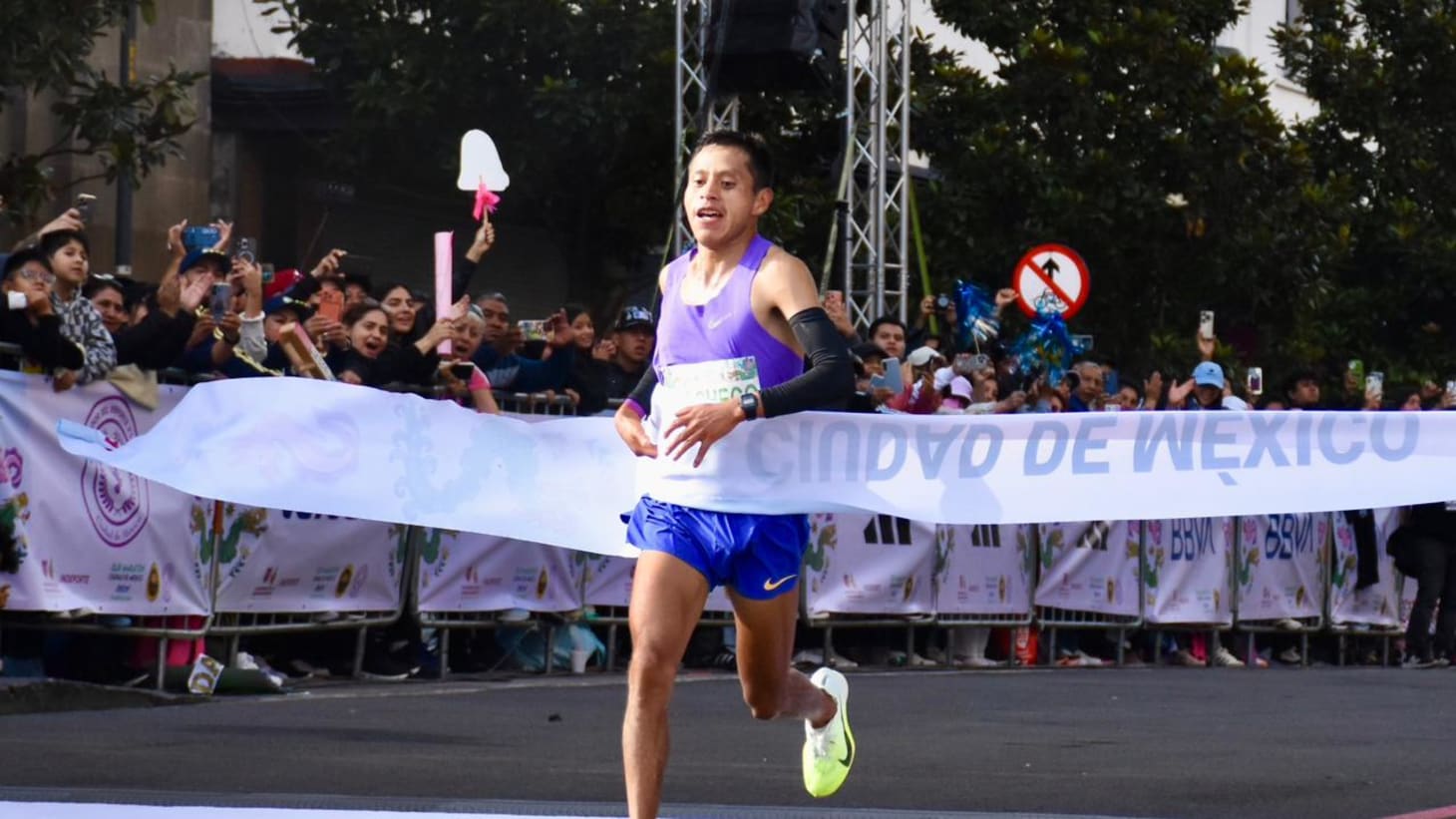
In the streets of Mexico City, under that altitude that spares no one, Cristhian Pacheco crossed the finish line in 2:10:03 and with that rewrote a chapter in the history of Peruvian athletics. He didn't win just any race: he triumphed at one of the most demanding Majors on the Latin American calendar, and he did it twelve years after the last Peruvian flag waved at the top of this podium. The detail that adds a special flavor to the achievement: that last victory was by his brother and coach, Raúl Pacheco. A story of family, of patience and of silent work that today culminates in 42.195 kilometers.
The Context
The Mexico City Marathon is one of the most important running events in Latin America and is part of the select group of marathons labeled as "Elite Platinum" by World Athletics, a recognition that places the race among the best organized and competitive in the world. But it has a plus that makes it unique: it's run at over 2,200 meters above sea level. That's not a minor detail — running a marathon at that altitude is a completely different physiological challenge than doing it at sea level, because the air has less available oxygen and the body must adapt in real time to that extra demand.
That Pacheco won there, with that time, is no accident. Peru, as an Andean country, has a tradition of athletes who train and compete at altitude naturally, something that in the world of sports training is considered a real competitive advantage. The victory also resonates for its symbolism: twelve years is a long time in elite sports, and the fact that the generational relay came from the Pacheco family itself —from brother to brother, from coach to athlete— makes this story something that transcends the results sheet.
What the Science Says
Running at this altitude requires specific physiological preparation that can't be improvised. Sports science has extensively studied how the body responds to adverse environmental conditions, and one of the most solid findings in exercise physiology is that acclimation —whether to heat or altitude— directly improves performance because it optimizes how the organism regulates its temperature, blood volume, and cardiovascular efficiency (Lorenzo et al., 2010). Athletes who train regularly at altitude, as is often the case with Peruvian, Ecuadorian, or Kenyan runners from high-altitude regions, develop adaptations that allow them to sustain a race pace that would be devastating for others.
Another key factor in a marathon at this level is pace management. Evidence on pacing in elite marathons shows that the most successful runners are not necessarily those who start fastest, but those who manage to distribute their effort more evenly throughout the race, minimizing pace decline in the final kilometers (Cuk et al., 2024). Sustaining 2:10:03 at altitude requires precisely that: mathematical patience, not just brute force. Add to this the progressive fatigue that any runner faces in the second half of a marathon, a well-documented physiological phenomenon that combines muscular, metabolic, and even perceptual factors —the mind gets tired too, and knowing how to manage that perceived fatigue makes the difference between finishing strong or collapsing (Azevedo et al., 2021).
What It Means for You
You don't need to run at 2,200 meters of altitude to learn from this victory. There are three lessons applicable to any recreational or competitive runner:
- Respect the environmental context. If you're going to run a race at an altitude or in a climate different from where you train, give your body time to adapt. A few days of prior acclimation can completely change your race experience.
- Even pacing wins races. Don't get swept up in the excitement of the start. The evidence is clear: those who distribute their effort better finish stronger than those who "burn powder" in the first kilometers.
- Fatigue is both mental and physical. Training your ability to tolerate discomfort in the final stretches —with long intervals, progressives, or race simulations— prepares you for those final kilometers where everything is really decided.
The Pacheco brothers' story also reminds us of something simple but powerful: great results are rarely individual. Behind every marathon won are years of shared work, trust built, and patience with the process.
References
- "Heat acclimation improves exercise performance." — Lorenzo S, Halliwill JR, Sawka MN, J Appl Physiol (1985), 2010. https://pubmed.ncbi.nlm.nih.gov/20724560/
- "Running Variability in Marathon-Evaluation of the Pacing Variables." — Cuk I, Markovic S, Weiss K, Medicina (Kaunas), 2024. https://pubmed.ncbi.nlm.nih.gov/38399506/
- "Fatigue development and perceived response during self-paced endurance exercise: state-of-the-art review." — Azevedo RA, Silva-Cavalcante MD, Lima-Silva AE, Eur J Appl Physiol, 2021. https://pubmed.ncbi.nlm.nih.gov/33389141/
Original source
Olympics.com ↗Never miss an edition.
Get the running news brief and analysis straight to your inbox. No spam, unsubscribe anytime.