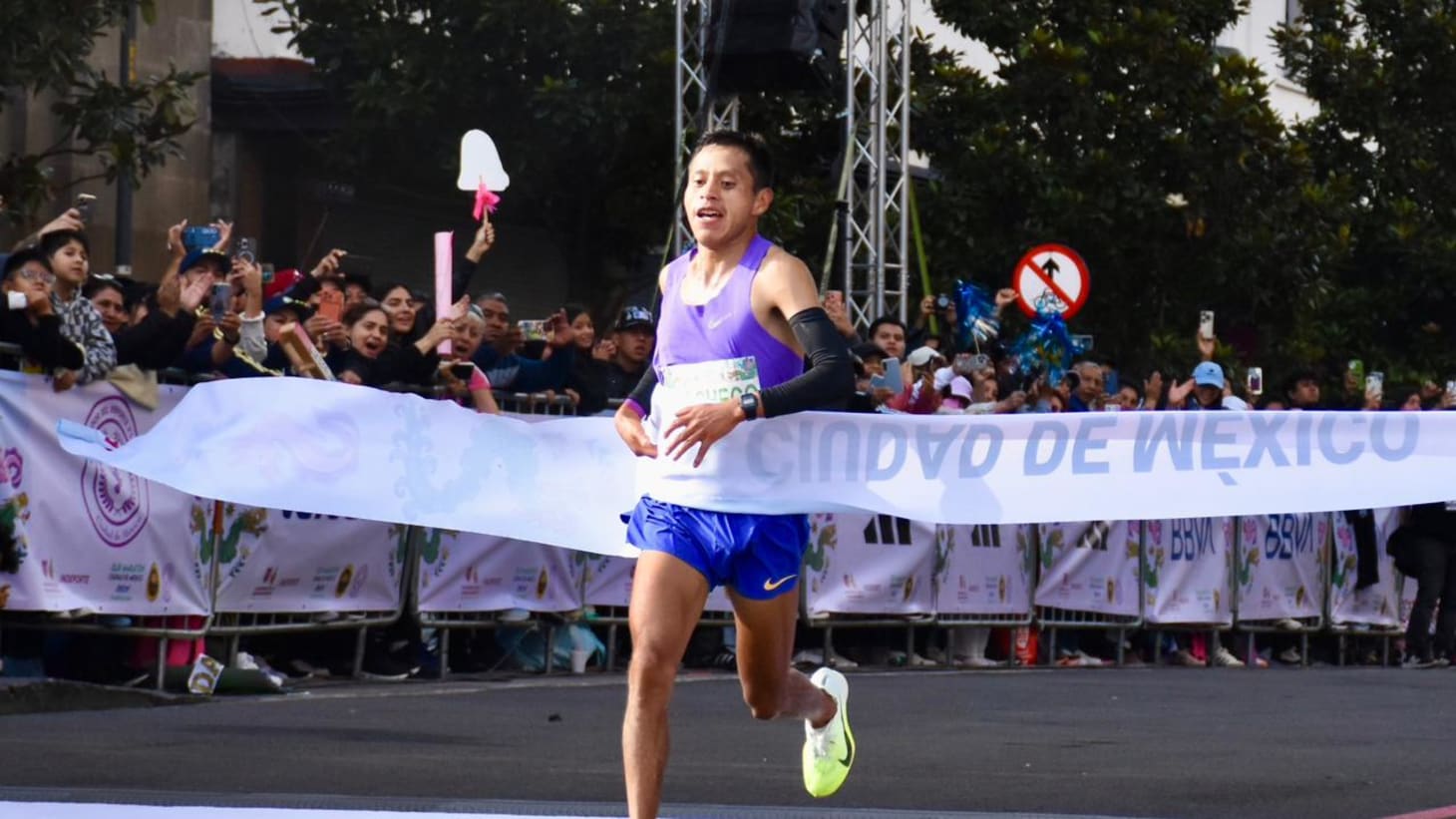
Cristhian Pacheco revives his brother's feat and returns Peru to the top of the Mexico City Marathon
August 31, 2026
Por Katy López
There are victories that are only yours, and there are victories that carry the weight—and the glory—of an entire family history. Cristhian Pacheco's is one of the latter. Twelve years after Raúl Pacheco, his older brother and also his coach, stood atop the podium at the Mexico City Marathon in 2013 and 2014, Cristhian repeated the script in the 2026 edition. Same pavement, same last name, same competitive lineage. For Peruvian athletics, a dreamed déjà vu. For any runner who trains with a close mentor, proof that knowledge transmitted generation to generation—or brother to brother—remains one of sport's most underestimated technologies.
The Context
The Mexico City Marathon is one of the most important events on the Latin American calendar: challenging altitude (over 2,200 meters above sea level), a historic route through emblematic avenues, and a field level that grows year after year thanks to investment in the region's marathon circuit. Winning it is not just crossing the finish line first; it's doing so while dealing with an altitude that reduces oxygen availability and demands almost surgical effort management.
That two brothers won the same race more than a decade apart is not statistical coincidence: it's the result of an inherited training system, adjusted and perfected over time. Raúl went from champion to coach, and that transfer of experience—volume, paces, race strategy—ended up embodied in Cristhian's legs, who confessed to training up to 220 kilometers weekly, a figure that places him in the absolute elite of global distance training volume.
Pacheco also touched on a topic that's been gaining traction in the running world: the sustained rise of South American distance runners, narrowing a gap that for decades seemed the exclusive territory of East African runners. Argentina, Peru, Colombia, and Ecuador have been showing competitive names in international marathons, and this victory is further proof that the conversation about who dominates global distance running is diversifying.
What the Science Says
Running 220 kilometers per week isn't simply "running a lot": it's the tip of an iceberg of well-calibrated physiological decisions. At that volume, running economy—how much oxygen you spend per meter covered—becomes the factor that separates winners from the rest, and recent evidence confirms that strength work combined with distance training specifically improves the durability of that economy, meaning it stays efficient even when the body is already fatigued in the final kilometers (Zanini et al., Med Sci Sports Exerc, 2025).
Mexico City's altitude adds another layer: competing above 2,200 meters demands specific physiological adaptations, and although the human body responds similarly to heat and altitude in terms of cardiovascular stress, acclimatization—whether thermal or hypoxic—is a trainable process that directly improves performance (Lorenzo, Halliwill & Sawka, J Appl Physiol, 2010). It's not magic: it's progressive, planned exposure.
And then there's managing fatigue during the race itself. The science of pacing in marathons shows that elite runners distribute their effort with remarkable precision, avoiding the classic "euphoric start" that takes its toll at kilometer 30 (Cuk et al., Medicina, 2024). Sustaining pace when your body starts to fail is, in large part, a trained skill, not just a gift (Azevedo et al., Eur J Appl Physiol, 2021).
What It Means for You
You don't need to run 220 km weekly to learn something from this story. Three immediately applicable ideas:
- Find a mentor or coach who truly knows you. The jump from Raúl to Cristhian wasn't just genetics: it was transfer of practical experience, fine-tuning of mistakes already lived.
- Add strength to your distance plan. It's not optional for anyone seeking to sustain pace in the final kilometers; it's one of the variables with the best recent evidence.
- Practice your race pace, don't improvise it. Pacing is trained in long workouts, not discovered on race day.
References
- Zanini M, Folland JP, Wu H. "Strength Training Improves Running Economy Durability and Fatigued High-Intensity Performance in Well-Trained Male Runners." Med Sci Sports Exerc, 2025. https://pubmed.ncbi.nlm.nih.gov/40016936/
- Lorenzo S, Halliwill JR, Sawka MN. "Heat acclimation improves exercise performance." J Appl Physiol, 2010. https://pubmed.ncbi.nlm.nih.gov/20724560/
- Cuk I, Markovic S, Weiss K. "Running Variability in Marathon-Evaluation of the Pacing Variables." Medicina (Kaunas), 2024. https://pubmed.ncbi.nlm.nih.gov/38399506/
- Azevedo RA, Silva-Cavalcante MD, Lima-Silva AE. "Fatigue development and perceived response during self-paced endurance exercise." Eur J Appl Physiol, 2021. https://pubmed.ncbi.nlm.nih.gov/33389141/
Original source
Olympics.com ↗Never miss an edition.
Get the running news brief and analysis straight to your inbox. No spam, unsubscribe anytime.