Audrey Werro and Femke Broeders-Bol Prepare for 800m Rematch Before Brussels
August 28, 2026
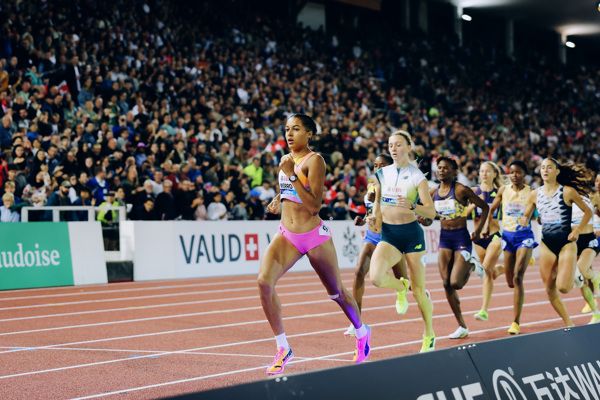
Foto vía World Athletics
Just a few weeks remain until the Diamond League final, and the two best 800-meter runners on the planet are already facing off head-to-head. In Zurich, Swiss Audrey Werro—the third-fastest runner in the distance's history—shared the track once again with Dutch Femke Broeders-Bol, fresh off her national record in Lausanne. It wasn't a final, it was a dress rehearsal. And for anyone who loves middle-distance running, this preview is worth as much as the final itself: two athletes in peak form, knowing that both have practically secured their tickets to Brussels, racing as if the title were already on the line.
The Context
The Diamond League is elite-level world athletics: a series of meets distributed between May and September where the best specialists in each event compete, accumulating points that determine who reaches the grand final. Zurich is one of the last stops before that final—scheduled this year for September 4 and 5 in Brussels—and it functions as a thermometer: it's where you see the final adjustments in tactics, pace, and fitness before the race that truly decides the title.
In the women's 800 meters, Werro and Broeders-Bol have become the rivalry of the year. Werro, at just 20 years old, has already climbed to third place historically in the distance, a generational leap that reminds you why this event—half speed, half endurance—is one of the most tactically demanding in athletics. Broeders-Bol, for her part, broke the Dutch national record in Lausanne, confirming that she's not coming to Brussels just to fill a spot: she's coming to fight.
The fact that both already have qualification practically settled changes the nature of these preliminary duels. They're not racing to survive; they're racing for information: reading reaction times, lap paces, the rival's capacity to respond in the final stretch. Zurich was, in that sense, more of a chess match than a race.
What the Science Says
The 800 meters are fascinating physiologically because they live at the frontier between two energy systems: they demand enormous anaerobic power in the first 200-300 meters and, at the same time, an aerobic base capacity to sustain the pace without collapsing in the final stretch. That duality explains why pace management—pacing—is decisive in the result, something that evidence in endurance tests consistently supports: variability in race pace is directly associated with final performance, and more stable or strategically distributed pacing patterns typically anticipate better times (Cuk et al., 2024).
It's also worth examining this rivalry through the lens of physiological sex differences in endurance performance, an area where science has made significant advances in recent years. Factors such as muscle fiber composition, relative VO2 max, and running economy explain part of the historical gap between men's and women's times, but they also help us understand why athletes like Werro are rewriting the women's record books at a pace that seemed unthinkable a decade ago (Besson et al., 2022).
Finally, fatigue in an event of this intensity is not just muscular: it's also perceptual and neuromuscular. The way the body interprets self-imposed effort—and how each athlete quantitatively responds to that accumulated fatigue during the 800 meters—is an active area of research that helps explain why some runners "explode" in the final 150 meters and others manage to sustain their speed to the line (Azevedo et al., 2021).
What It Means for You
You don't need to run 800 meters at an elite level to learn from this rivalry. Three ideas applicable to your training:
- Pace matters more than initial bravery. Just as Werro and Broeders-Bol adjust their race strategy from race to race, you should also train your ability to feel pace before you compete. Practicing segments at goal pace in interval workouts gives you that "internal clock" that prevents you from burning out in the first few minutes.
- Strength sustains speed when fatigue arrives. Strength work isn't exclusive to marathon runners: it improves running economy and your capacity to maintain power even in a fatigued state, something crucial in any race where the final is decided in the last meters (Zanini et al., 2025).
- Use "prep" races to your advantage. Just as these athletes use Zurich as a laboratory before Brussels, take advantage of your smaller-scale races to test pace strategies without the pressure of your main objective.
References
- "Sex Differences in Endurance Running." Besson T, Macchi R, Rossi J. Sports Med, 2022. https://pubmed.ncbi.nlm.nih.gov/35122632/
- "Running Variability in Marathon-Evaluation of the Pacing Variables." Cuk I, Markovic S, Weiss K. Medicina (Kaunas), 2024. https://pubmed.ncbi.nlm.nih.gov/38399506/
- "Fatigue development and perceived response during self-paced endurance exercise: state-of-the-art review." Azevedo RA, Silva-Cavalcante MD, Lima-Silva AE. Eur J Appl Physiol, 2021. https://pubmed.ncbi.nlm.nih.gov/33389141/
- "Strength Training Improves Running Economy Dur
Original source
World Athletics ↗Never miss an edition.
Get the running news brief and analysis straight to your inbox. No spam, unsubscribe anytime.