Agnes Ngetich Arrives in Copenhagen in the Best Form of Her Career
September 18, 2026
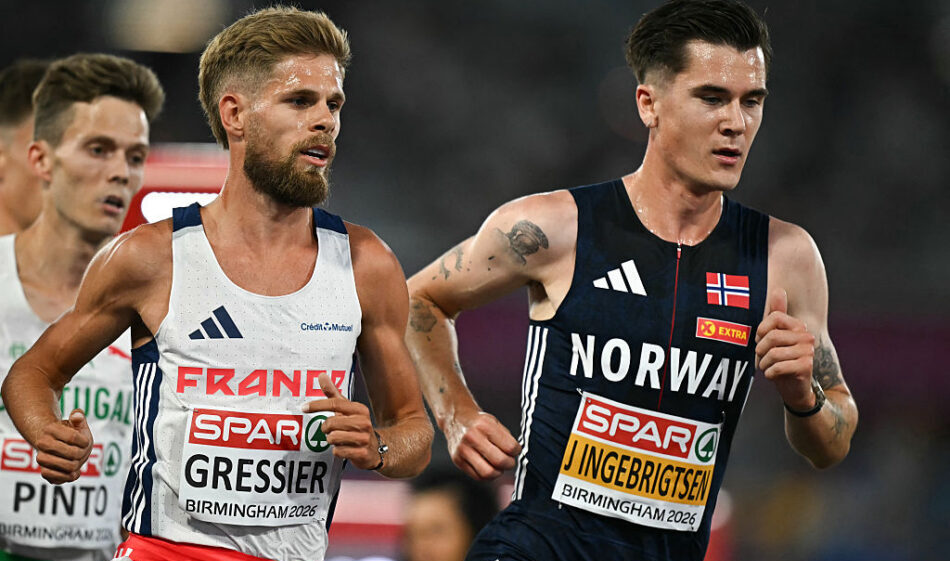
Foto vía Athletics Weekly
There are athletes who arrive at a world championship with hope. And then there are others who arrive with evidence. Agnes Ngetich belongs to the second group: in 2024 she was world cross country champion, broke the 10K world record in Lille, and posted the year's best mark in the 3,000m in Monaco. Now she lands in Copenhagen for the World Road Running Championships with the second-best half marathon time in history (1:03:04) in her pocket. This is not a promise: it is, probably, the runner in the best form on the planet right now. And that, for anyone who loves running, is an appointment you can't miss.
The Context
The World Road Running Championships is the competition organized by World Athletics to crown the planet's best road runners in distances that are not part of the "classic" Olympic track program: 5K and half marathon, with formats that include individual and team events. It is relatively young—it debuted in 2023 in Riga—but it quickly established itself as the showcase where road running distance is measured without the variable of each commercial race's course profile: same circuit, same conditions, everyone against everyone.
Copenhagen brings together a spectacular lineup this year, with the Ingebrigtsen-Gressier duel dominating the headlines on the men's side. But Ngetich's story is, in terms of dominance, even more compelling. Winning a cross country world title, holding the 10K world record, and leading the annual 3,000m rankings in the same cycle is a combination of versatility that is rarely seen: it demands pure speed, fatigue resistance, and aerobic capacity that holds up from grass to asphalt. The Copenhagen half marathon is, in that sense, the missing exam: can all that accumulated speed translate into 21,097 meters without a stumble?
What the Science Says
The half marathon is a particular distance because it lives on the frontier between predominantly aerobic metabolism and the need to tolerate intensity close to threshold for more than an hour. Literature on pacing in half marathons and marathons shows that elite female runners tend to employ more even pacing strategies than their male counterparts, a detail that has been linked to physiological differences and tactical decision-making differences during racing (Nikolaidis et al., 2019). Sustaining a mark like 1:03:04 is not just a matter of VO2max: it is the ability to keep pace variability to a minimum over 21K, something that has also been studied in the marathon context (Cuk et al., 2024).
On the other hand, the fact that Ngetich combines dominance in 3,000m, 10K, and half marathon in the same season makes sense when we think about fatigue as a centrally regulated process and not just a peripheral one: current models of fatigue in self-paced exercise (Azevedo et al., 2021) suggest that athletes with a very well-developed aerobic and neuromuscular base can "transfer" that capacity between distances with greater efficiency, because the physiological ceiling—running economy, threshold, fast-twitch fiber fatigue resistance—is shared between races of 3 to 21 km. Furthermore, recent evidence on strength training in well-trained runners shows that working on strength specifically improves the "durability" of running economy, that is, the ability to keep running efficiently even when accumulated fatigue sets in (Zanini et al., 2025)—exactly what is needed to sustain a world championship pace in the second half of a half marathon.
What It Means for You
You won't be running at 3:00/km like Ngetich, but the principles that sustain her performance do apply to your training:
- Train durability, not just speed: adding 2 weekly strength sessions (squats, lunges, basic plyometrics) helps keep your running economy from collapsing in the final stretch of your long runs.
- Practice even pacing: in your next 10K or half marathon, try to keep the second half no more than 2–3% slower than the first. Excessive pace variability is one of the silent causes of "blowing up" before the finish line.
- Think about versatility: if you only train one distance all year, you're missing out on cross-training adaptations. Adding speed blocks on the track (like Ngetich does) improves your aerobic ceiling even if your ultimate goal is the marathon.
Copenhagen is going to be a real thermometer of how far Kenyan women's distance running can go. And perhaps, too, a lesson that the best form of a running career is not built overnight, but by stacking layers of work at each distance.
References
- "Pacing of Women and Men in Half-Marathon and Marathon Races." — Nikolaidis PT, Ćuk I, Knechtle B, Medicina (Kaunas) 2019. https://pubmed.ncbi.nlm.nih.gov/30646638/
- "Running Variability in Marathon-Evaluation of the Pacing Variables." — Cuk I, Markovic S, Weiss K, Medicina (Kaunas) 2024. https://pubmed.ncbi.nlm.nih.gov/38399506/
- "Fatigue development and perceived response during self-paced endurance exercise: state-of-the-art review." — Azevedo RA, Silva-Cavalcante MD, Lima-Silva AE, Eur J App
Original source
Athletics Weekly ↗Never miss an edition.
Get the running news brief and analysis straight to your inbox. No spam, unsubscribe anytime.