Buze Diriba shatters Amsterdam Marathon record and Lemi Berhanu wins in the rain
October 19, 2026
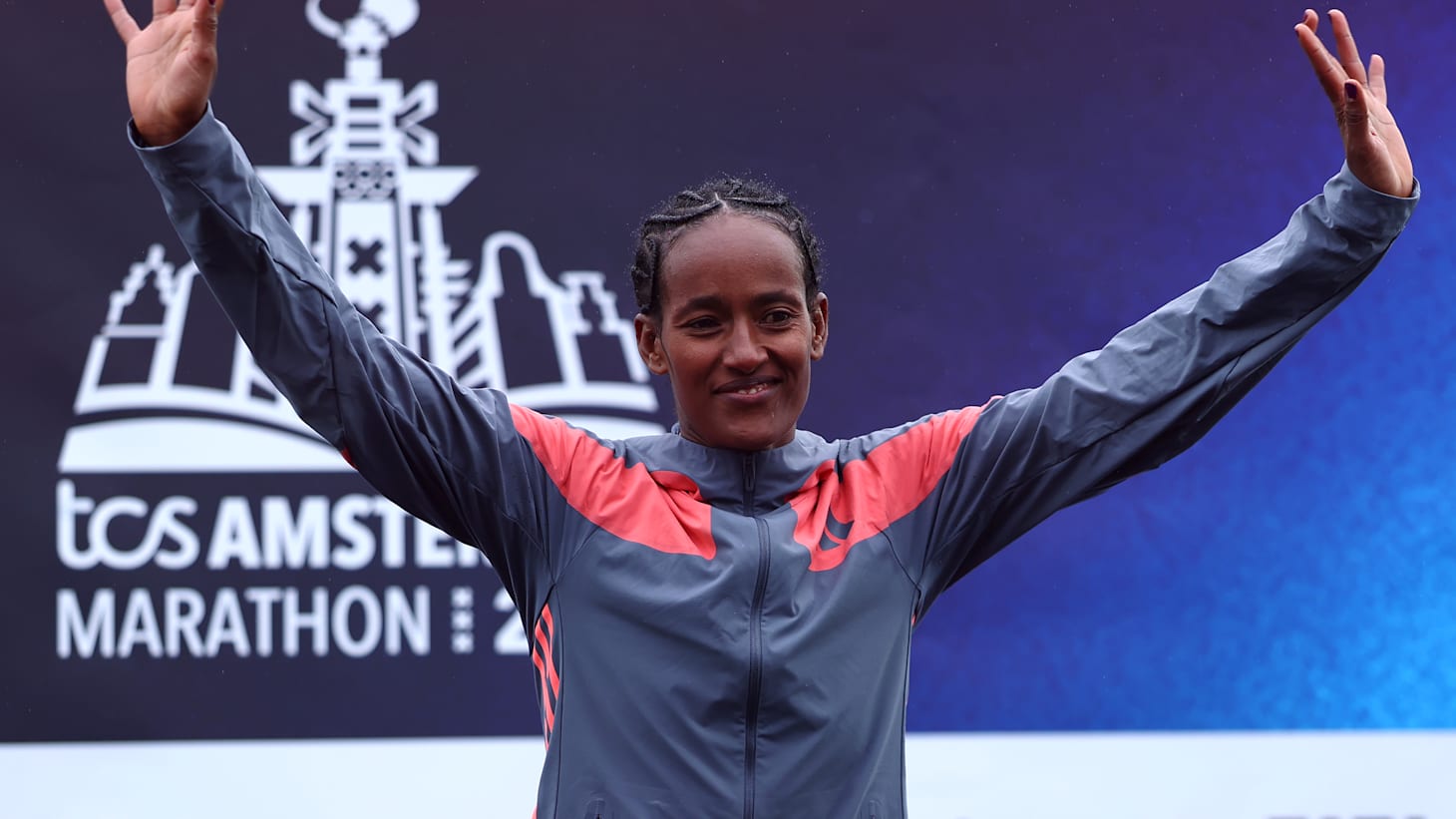
Picture by Dean Mouhtaropoulos/Getty Images
Some records are broken by design, and some are broken despite everything. Buze Diriba's belongs to the second category. The Ethiopian ran 2:16:12 at the 2026 Amsterdam Marathon in persistent rain, improving the course record by 40 seconds. It wasn't a perfect day for weather, nor dry surfaces, nor ideal conditions. It was a day of mud, crosswinds, and tactical decisions under constant pressure — and yet, she flew. Meanwhile, her compatriot Lemi Berhanu came within just three seconds of Geofry Kipchumba's men's record, winning in 2:03:33, and Aynalem Desta, the defending women's champion, ran the best marathon of her life (2:17:06) to finish... second. That's how brutal the level was in the Netherlands this weekend.
The context
Amsterdam isn't the most high-profile marathon on the World Marathon Majors circuit, but it is one of the most technically respected: fast course, meticulous organization, and a track record of serving as a launching pad for Ethiopian and Kenyan runners who later dominate in London, Berlin, or Chicago. The women's record falling in adverse conditions is the most striking part of the story. Rain typically hurts marathon performance: it cools the body unevenly, adds weight to clothing and footwear, and can alter stride biomechanics on slippery surfaces. That Diriba ran faster than any woman in that course's history, in those conditions, speaks to a level of physiological and mental control that goes beyond simple aerobic talent.
Berhanu's result also deserves context: finishing three seconds short of a record isn't "coming up short"—it's executing an nearly perfect race where every second over 42.195 km mattered. And Desta's case illustrates something every competitive runner understands all too well: sometimes you run the best marathon of your life and it's not enough, because someone else had a historic day.
What the science says
The key to understanding a performance like this in the rain lies in how the body manages heat and fluids when external conditions change the game. Research on acclimatization and thermoregulation (Lorenzo et al., 2010) shows that elite athletes develop superior capacity for physiological adaptation to variable environmental conditions, which applies not only to extreme heat but also to scenarios where thermoregulation becomes unpredictable, like cold rain combined with intense effort. The balance of electrolytes and fluids (Shirreffs & Sawka, 2011) is also critical: even in rain, the body continues to sweat and lose sodium, and elite marathoners specifically train hydration strategies that don't depend on "feeling thirsty," because by the time you feel it, you've already lost performance.
Another key factor is pacing. Studies on pace variability in marathons (Cuk et al., 2024; Nikolaidis et al., 2019) confirm that elite runners, especially women, tend to maintain more even and conservative pacing in the first half, which allows them to have reserves when conditions become complicated mid-race. That probably explains how Diriba was able to accelerate toward the finish instead of simply "surviving" the rain. And don't underestimate the nutritional component: recent research on carbohydrate supplementation in elite endurance (Cao et al., 2025) shows that personalized race-fueling strategies—not just pre-race—are decisive for sustaining intensity in the final 10 kilometers, exactly where records are decided.
What it means for you
You're not going to run a 2:16, but Amsterdam's lessons do apply to your next rainy or uncertain race:
- Don't change your pacing because of the weather, adjust your expectation. If it rains or it's cold, your body burns extra energy on thermoregulation. Start with a slightly conservative pace plan for the first few kilometers.
- Hydrate even if you're not thirsty. Rain deceives: you sweat the same, but you don't feel it. Maintain your electrolyte protocol as if it were hot.
- Practice running in wet gear during key workouts. Adaptation isn't just physiological; it's also about confidence and stride technique on slippery surfaces.
- Race nutrition isn't optional. If you're pushing for more than 90 minutes of effort, a carbohydrate plan rehearsed in training can be the difference between sustaining your pace or falling apart at kilometer 35.
The biggest lesson from Diriba, however, isn't technical: it's mental. Perfect conditions don't exist. The ones who break records are the ones who learn to run fast despite them.
References
- Lorenzo S, Halliwill JR, Sawka MN. "Heat acclimation improves exercise performance." J Appl Physiol, 2010. https://pubmed.ncbi.nlm.nih.gov/20724560/
- Shirreffs SM, Sawka MN. "Fluid and electrolyte needs for training, competition, and recovery." J Sports Sci, 2011. https://pubmed.ncbi.nlm.nih.gov/22150427/
- Cuk I, Markovic S, Weiss K. "Running Variability in Marathon-Evaluation of the Pacing Variables." Medicina (Kaunas), 2024. https://pubmed.ncbi.nlm.n
Original source
Olympics.com ↗Never miss an edition.
Get the running news brief and analysis straight to your inbox. No spam, unsubscribe anytime.