Guye Adola wins the Berlin Marathon and Tigst Assefa records the third-best time in history
September 28, 2026
Pic run247.com
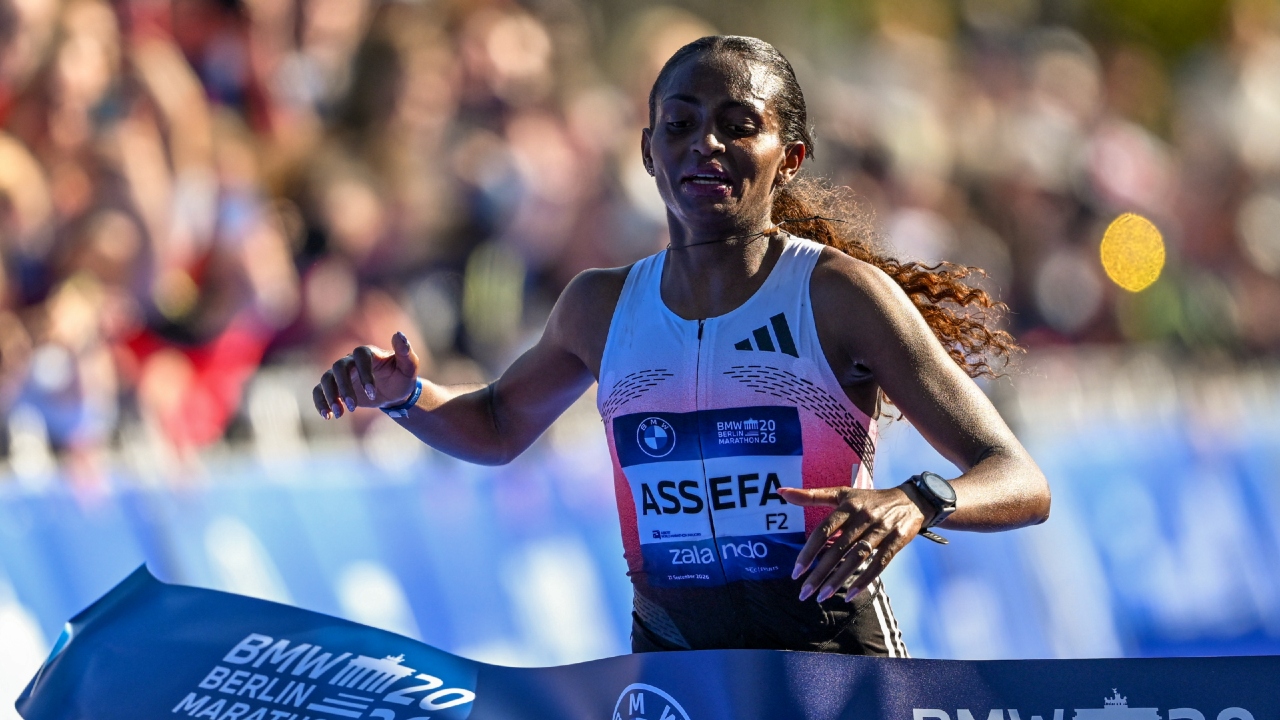
Berlin once again proved why it's the mecca for fast marathon times. Guye Adola crossed the finish line in 2:02:50 to claim his second title in the German capital, patiently waiting behind the Ethiopian pack until the race broke open after the 25-kilometer mark. Meanwhile, Tigst Assefa ran a 2:11:04 that leaves her as the third-fastest woman in history, just 68 seconds above Ruth Chepngetich's world record. There was no world record this time, but there was a display that the ceiling of the marathon keeps rising almost every season.
The context
The Berlin Marathon is one of the six World Marathon Majors (along with Boston, London, Chicago, New York, and Tokyo) and, within that select group, it has its own reputation: it's the fastest course on the planet. Its flat layout, smooth turns, and typically cool late-September weather make it the perfect laboratory for attacking records. That's where Eliud Kipchoge's world records fell in 2018 and 2022, and Kelvin Kiptum's in 2023. It's no accident: the organization arranges pacemakers specifically calibrated to maintain world-record pace during the first half of the race.
That Adola won by "waiting" and not attacking from kilometer one speaks to a classic tactical race: let the pack wear itself out with the pace set by the pacemakers and strike when the bodies of the others start to fail. In elite marathoning, patience is rarely a flaw.
On the women's side, Assefa already has the second-best time in history (2:09:56, Berlin 2023) and now adds this 2:11:04, confirming that it wasn't a one-off: she's an athlete who competes consistently at the highest level ever seen in the women's marathon.
What the science says
Running under 2:03 or 2:12 for 42.195 km isn't just talent: it's the near-perfect execution of variables that sports science has been studying for years. One of the key factors is pacing, or how effort is distributed throughout the race. Evidence on pace variability in elite marathons shows that the most successful runners are those who achieve the smallest possible fluctuation in step, avoiding the classic "positive split" that punishes nearly all recreational runners (Cuk et al., 2024). That Adola was able to respond right when everyone else was starting to fatigue suggests an almost surgical effort management.
Also at play is perceived fatigue and how the brain regulates effort under prolonged stress. Research on fatigue development in self-regulated exercise explains that much of what determines who can hold the pace in the final stretch is not just muscular, but the ability to tolerate and manage the signal of discomfort that the body constantly sends (Azevedo et al., 2021). That's where races are broken, and that's exactly where Adola gained his advantage after the 25-kilometer mark.
Finally, there's no time at this level without a nutrition strategy fine-tuned to the millimeter. Modern protocols for carbohydrate supplementation during exercise allow elite athletes to sustain extremely high intensities without running out of fuel, optimizing the oxidation of multiple carbohydrate sources simultaneously (Cao et al., 2025). That detail, invisible to the spectator, is part of why marathons are being run today that seemed like science fiction a decade ago.
What it means for you
You're not going to run at 2:55 min/km like Adola, but the lessons from Berlin do apply to your training:
- Learn to wait. If you start conservatively and save energy for the second third of your race, you have better chances of a strong finish than if you go "all out" from the starting line. The science of pacing is clear: pace consistency wins races, not initial euphoria.
- Train your tolerance for discomfort. Race fatigue is as much mental as physical. Include specific tempo or threshold sessions in your plan where you practice holding effort when your body is asking you to slow down.
- Don't leave nutrition to chance. Practice your carbohydrate strategy in long training runs, not on race day. Trying new gels, drinks, or doses in competition is a recipe for gastrointestinal disaster.
- Look at the course, not just the time. If you're chasing a personal record, choose flat races with good weather. Terrain and environmental conditions matter more than many recreational runners believe.
References
- "Running Variability in Marathon-Evaluation of the Pacing Variables." Cuk I, Markovic S, Weiss K, Medicina (Kaunas), 2024. https://pubmed.ncbi.nlm.nih.gov/38399506/
- "Fatigue development and perceived response during self-paced endurance exercise: state-of-the-art review." Azevedo RA, Silva-Cavalcante MD, Lima-Silva AE, Eur J Appl Physiol, 2021. https://pubmed.ncbi.nlm.nih.gov/33389141/
- "A Review of Carbohydrate Supplementation Approaches and Strategies for Optimizing Performance in Elite Long-Distance Endurance." Cao W, He Y, Fu R, Nutrients, 2025. https://pubmed.ncbi.nlm.nih.gov/40077786/
Original source
Marathon Handbook ↗Never miss an edition.
Get the running news brief and analysis straight to your inbox. No spam, unsubscribe anytime.