Yomif Kejelcha Reclaims Half Marathon World Record with 56:51 in Buenos Aires
August 24, 2026
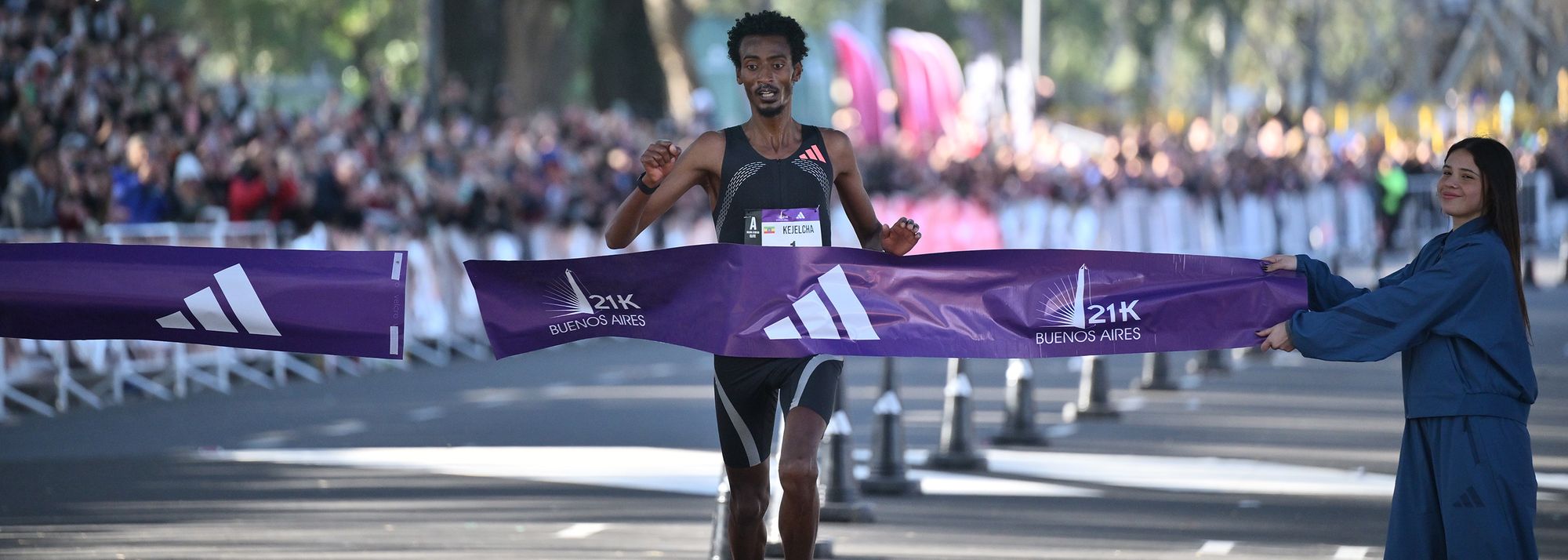
Yomif Kejelcha runs a world half marathon record in Buenos Aires (© Organisers)
The half marathon ceiling moved once more, and this time the architect was the usual one. Yomif Kejelcha crossed the finish line of the Buenos Aires Half Marathon in 56 minutes and 51 seconds, snatching the pending ratification world record from Uganda's Jacob Kiplimo, who had set it just in March with 57:20 in Lisbon. What's striking is not just the mark: it's that Kejelcha reclaims a throne he had already occupied in October 2024, when he ran 57:30 in Valencia. In just over a year, the record changed hands three times between two athletes who seem to push each other toward the impossible. If you're passionate about running, this is a live lesson in how far the human body can go when genetics, training, and conditions align.
The Context
The half marathon world record is one of the most contested marks in current athletics, because it combines something few events achieve: track speed and endurance resistance in almost perfect doses. Running 21.097 km at an average pace of 2:41 per kilometer (how Kejelcha ran in Buenos Aires) is sustaining an effort near the anaerobic threshold for nearly a full hour, with no margin for error.
This type of mark rarely happens by accident. You need perfectly calibrated pacers, a flat and fast circuit, and ideal weather conditions. In Buenos Aires, the 6°C temperature and light wind were a gift: the body doesn't spend extra energy dissipating heat or fighting gusts, two silent enemies of endurance performance. It's the same reason most road world records are broken in fall or winter, in races designed specifically to chase times, not just to compete.
The rivalry between Kejelcha and Kiplimo also adds an important chapter to this story. Both represent the new generation of African distance runners who have decided to attack the half marathon with the same seriousness that was previously reserved only for the marathon, pushing the human limit almost kilometer by kilometer over the past 18 months.
What the Science Says
That Kejelcha ran his best mark in cool conditions is no coincidence. The evidence on acclimation and heat is compelling: endurance performance degrades significantly when body temperature rises, because the body diverts blood flow toward the skin to cool down, reducing oxygen delivery to active muscles (Lorenzo, Halliwill & Sawka, 2010). At 6°C, that "cooling cost" practically disappears, allowing all cardiovascular capacity to go toward sustaining the pace.
There's also pacing to discuss, or how effort is distributed throughout the race. Reviews on pace variability in distance running show that the best world marks are achieved with even or slightly positive pace strategies, minimizing fluctuations that speed up perceived fatigue (Cuk et al., 2024; Azevedo et al., 2021). An athlete in Kejelcha's category, supported by professional pacers, can execute that nearly millimetric pace, avoiding the extra wear of accelerating and decelerating.
Finally, marks of this magnitude aren't explained by talent alone: behind them are increasingly personalized nutritional strategies. Recent research on precision nutrition in elite athletes (Sutehall & Pitsiladis, 2025) confirms that individualized management of carbohydrates, hydration, and electrolytes—adjusted to each runner and each weather condition—is now as important a piece as the physical training itself for maximizing performance in high-demand races.
What It Means for You
You're not going to run 2:41 per kilometer, but the principles that took Kejelcha to this record apply to any serious runner:
- Choose your target race well. If you're chasing a personal best, prioritize events in cool climates and flat circuits. The difference between 6°C and 20°C in your performance is real and measurable.
- Train your pace, not just your endurance. Practicing stretches at constant target pace teaches you to avoid the fluctuations that burn you out early.
- Don't underestimate hydration and carbohydrates. Even in cool climates, your fluid and electrolyte strategy during long races directly influences how much you can sustain your target pace (Shirreffs & Sawka, 2011).
- Strength runs too. Strength work continues to show clear benefits for running economy under fatigue, something every half marathon or marathon runner should incorporate (Zanini et al., 2025).
Kejelcha reminded us that the human limit is still an open question. You can also keep running your own version of that question.
References
- Lorenzo S, Halliwill JR, Sawka MN. "Heat acclimation improves exercise performance." J Appl Physiol, 2010. https://pubmed.ncbi.nlm.nih.gov/20724560/
- Shirreffs SM, Sawka MN. "Fluid and electrolyte needs for training, competition, and recovery." J Sports Sci, 2011. https://pubmed.ncbi.nlm.nih.gov/22150427/
- Sutehall S, P
Original source
World Athletics ↗Never miss an edition.
Get the running news brief and analysis straight to your inbox. No spam, unsubscribe anytime.