Amos Kipruto and Hawi Feysa Win the 2026 Chicago Marathon
October 12, 2026
RUN247
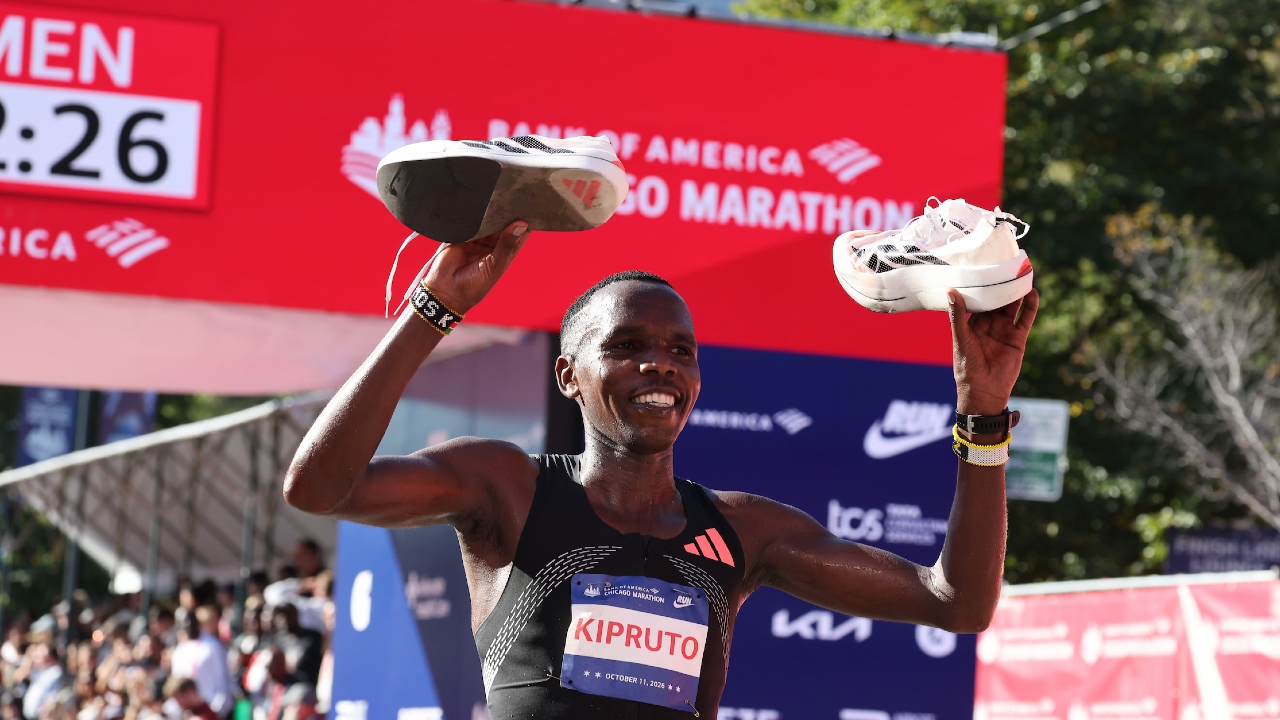
On Sunday, on the streets of Chicago, Amos Kipruto did something that separates the greats from the rest: he didn't run faster than everyone from kilometer one, he ran smarter. Between km 30 and 35—that zone where the marathon stops being a race of legs and becomes one of nerves—the Kenyan launched an attack that dropped Jacob Kiplimo and carried him across the finish line in 2:01:09, the second-best time in this marathon's history. In the women's race, Ethiopian Hawi Feysa defended her crown after a fierce head-to-head with Sharon Lokedi, settling it with a brutal closing kick in 2:13:33. Two results, one same lesson: the marathon is won where it hurts the most.
The context
Chicago is one of the six World Marathon Majors, the circuit that brings together Boston, London, Berlin, Chicago, New York, and Tokyo as the most prestigious races on the world calendar. It's also, historically, a "fast" circuit: flat, with favorable fall weather and an organization that deploys elite-level pacemakers to chase records. That a second-best time in the event's history is run there is no accident, it's the result of a decade and a half of optimization: surface, hydration, carbon-plated shoes, and increasingly, race strategy based on data.
What made this edition special was the timing of the attack. Kipruto didn't wait until the final kilometer or attempt a classic sprint finish: he attacked in the marathon's "no man's land," those five kilometers between the 30 and 35 mark where glycogen starts to run low and the head starts negotiating with the body. That's where Kiplimo, one of the most gifted runners on the planet, couldn't respond.
What the science says
This type of attack in the mid-to-late race is not pure intuition; it has physiological backing. Research on pacing in marathons shows that elite runners who manage to sustain or even accelerate their pace in the final third tend to have better results than those who simply try not to collapse; pace variability and the exact timing of intensity changes are key predictors of final performance (Cuk et al., 2024). Attacking at that specific point—when the rival is probably already managing fatigue—is a tactical decision as important as VO2max.
But that attack is also possible because something "holds up" when everything else starts to fail: endurance fatigue isn't just muscular, it's an integrated phenomenon where the central nervous system, perceived effort, and fuel availability interact constantly (Azevedo et al., 2021). Athletes who manage to sustain high effort right when that internal negotiation gets uphill are the ones who win these races, not necessarily the fastest ones at 10K.
Fuel also matters, literally. The carbohydrate strategy during the marathon—how much, when, and in what form to consume before and during the 42K—is today an active research area because it marks the difference between sustaining pace or collapsing at km 35 (Cao et al., 2025). Kipruto and Feysa didn't just train their bodies, they trained their fuel.
What it means for you
You're not going to run a 2:01, but the tactical lesson is exactly equally valid in your next 10K, half marathon, or marathon:
- Save a card for the second half. Mentally define a point in your race (not the last km, but before, when it still hurts but you can still do it) where you'll try to sustain or even raise your pace. Practice it on your long runs.
- Practice your nutrition in training, not race day. Tolerance to carbohydrates during effort is trained like any other variable (Cao et al., 2025).
- Train your head as much as your legs. The fatigue you feel at km 30 is as much central as muscular; working through blocks of controlled discomfort in your quality sessions prepares you for that internal negotiation.
- Don't ignore strength. Sustaining running economy when the body is already fatigued—exactly the scenario of Kipruto's attack—directly benefits from strength training (Zanini et al., 2025).
The marathon continues to be won, as always, in the head of whoever dares to attack when everyone else is just trying to survive.
References
- "Running Variability in Marathon-Evaluation of the Pacing Variables." Cuk I, Markovic S, Weiss K, Medicina (Kaunas) 2024. https://pubmed.ncbi.nlm.nih.gov/38399506/
- "Fatigue development and perceived response during self-paced endurance exercise: state-of-the-art review." Azevedo RA, Silva-Cavalcante MD, Lima-Silva AE, Eur J Appl Physiol 2021. https://pubmed.ncbi.nlm.nih.gov/33389141/
- "A Review of Carbohydrate Supplementation Approaches and Strategies for Optimizing Performance in Elite Long-Distance Endurance." Cao W, He Y, Fu R, Nutrients 2025. https://pubmed.ncbi.nlm.nih.gov/40077786/
- "Strength Training Improves Running Economy Durability and Fatigued High-Intensity Performance in Well-Trained Male Runners: A Randomized Control Trial." Zanini M, Folland JP, Wu H, Med Sci Sports Exerc 2025. https://pubmed.ncbi.nlm.nih.gov/40016936/
Original source
Run247 ↗Never miss an edition.
Get the running news brief and analysis straight to your inbox. No spam, unsubscribe anytime.